Funny trivia questions
60 silly-sounding questions with completely true answers: cube-shaped droppings, pufflings and words that sound made up. Family-friendly, every one.
130 original questions with answers: ten categories from general knowledge to art, plus a taste of our funny, hard, kids and grown-up lists. Tap to reveal each answer, or play them as a quiz.
Round 1 free to play · No sign-up · Print a free sheet
Trivia questions are short questions with one right answer, like “How many cards are in a standard deck, not counting the jokers?” This page has 130 original questions with answers: ten categories in full, and a taste of our funny, hard, kids, tweens and adults lists: 400 questions across the six lists. Each answer stays hidden until you tap it, with a one-line fact, so the page works as a quiz by itself. Every list also plays as a quiz on one screen or a TV, with round 1 free.
A little of everything, to warm up.
How many cards are in a standard deck, not counting the jokers?
A. 56B. 48C. 52D. 54
C. 52. There are four suits, with 13 cards in each.
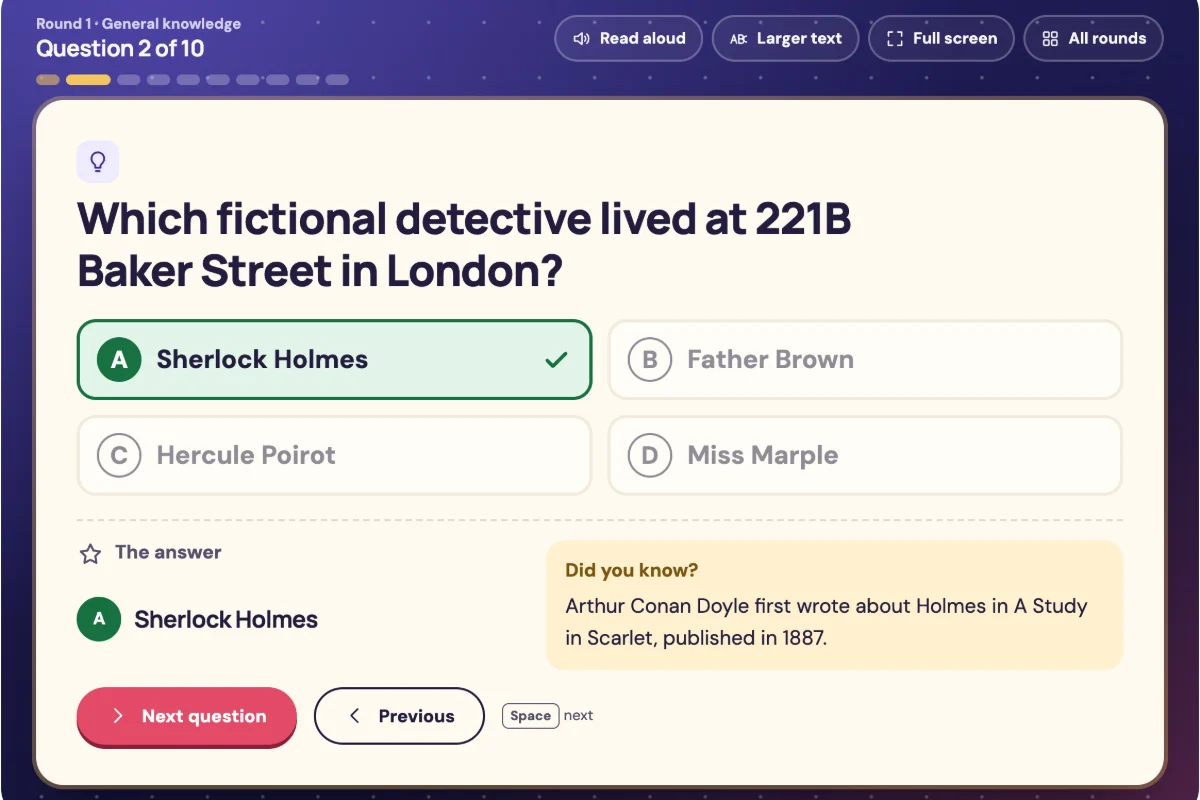
Which fictional detective lived at 221B Baker Street in London?
A. Sherlock HolmesB. Father BrownC. Hercule PoirotD. Miss Marple
A. Sherlock Holmes. Arthur Conan Doyle first wrote about Holmes in A Study in Scarlet, published in 1887.
If you buy a gross of pencils, how many pencils do you get?
A. 1,000B. 100C. 12D. 144
D. 144. A gross is a dozen dozens: 12 × 12.
What is the main language spoken in Brazil?
A. PortugueseB. ItalianC. SpanishD. French
A. Portuguese. Brazil was a Portuguese colony for about three centuries, until independence in 1822.
How many sides does a stop sign have in the United States?
A. 5B. 6C. 10D. 8
D. 8. The unusual eight-sided shape lets drivers recognise a stop sign even from behind or under snow.
In the fairy tale, what does Cinderella leave behind at the ball?
A. A glass slipperB. A velvet gloveC. A pearl necklaceD. A silver comb
A. A glass slipper. Charles Perrault’s 1697 version of the story is the one that gave her the glass slipper.
Which month has the fewest days?
A. AprilB. NovemberC. JuneD. February
D. February. February has 28 days, or 29 in a leap year.
In a rainbow, which colour is on the outside of the arc?
A. BlueB. GreenC. RedD. Violet
C. Red. Violet is on the inside. In a fainter second rainbow, the order is reversed.
How many pieces does each player start with in a game of chess?
A. 16B. 32C. 20D. 12
A. 16. Each side has eight pawns and eight other pieces.
Which bird, often shown carrying an olive branch, is a symbol of peace?
A. The owlB. The doveC. The eagleD. The swan
B. The dove. In the story of Noah’s ark, a dove returns carrying an olive leaf.
Atoms, plants, weather and the human body.
What is H₂O better known as?
A. WaterB. SaltC. OxygenD. Hydrogen peroxide
A. Water. Each water molecule has two hydrogen atoms and one oxygen atom.
Which gas do plants take in from the air to make their food?
A. Carbon dioxideB. OxygenC. NitrogenD. Helium
A. Carbon dioxide. Plants use sunlight to turn carbon dioxide and water into sugar. This is called photosynthesis.
What is the centre of an atom called?
A. The electronB. The shellC. The orbitD. The nucleus
D. The nucleus. The nucleus holds the atom’s protons and neutrons; its electrons move around it.
Which is the largest organ of the human body?
A. The liverB. The lungsC. The skinD. The brain
C. The skin. Skin helps keep your body at the right temperature, partly by sweating.
At sea level, at what temperature does water boil?
A. 90 °C (194 °F)B. 80 °C (176 °F)C. 100 °C (212 °F)D. 120 °C (248 °F)
C. 100 °C (212 °F). Higher up a mountain, the air pressure is lower and water boils at a lower temperature.
What does a seismometer detect?
A. SunlightB. EarthquakesC. Wind speedD. Rainfall
B. Earthquakes. The strength of an earthquake is described with a magnitude scale.
What do we call animals that eat only plants?
A. CarnivoresB. HerbivoresC. OmnivoresD. Insectivores
B. Herbivores. Cows, rabbits and elephants are all herbivores.
Which part of a plant takes up water from the soil?
A. The petalsB. The rootsC. The leavesD. The flowers
B. The roots. Tiny root hairs give roots a huge surface for soaking up water.
Which tall, towering clouds often bring thunderstorms?
A. CirrusB. StratusC. CumulonimbusD. Altostratus
C. Cumulonimbus. Cumulonimbus clouds can tower more than 10 km (6 miles) high.
Which vitamin does your skin make when it’s in sunlight?
A. Vitamin CB. Vitamin AC. Vitamin DD. Vitamin K
C. Vitamin D. Vitamin D helps the body take in calcium for strong bones.
Capitals, rivers, mountains and maps.
What is the capital of Japan?
A. HiroshimaB. OsakaC. KyotoD. Tokyo
D. Tokyo. Tokyo was called Edo until 1868.
Which imaginary line runs around the middle of the Earth, halfway between the poles?
A. The Tropic of CancerB. The prime meridianC. The Arctic CircleD. The equator
D. The equator. Ecuador, Kenya and Indonesia all lie on the equator.
Which river flows through London?
A. The SeineB. The TiberC. The ThamesD. The Danube
C. The Thames. The Seine flows through Paris, and the Tiber through Rome.
What is the capital of Australia?
A. PerthB. MelbourneC. CanberraD. Sydney
C. Canberra. Canberra was purpose-built as the capital, partly as a compromise between Sydney and Melbourne.
Which US state is made up entirely of islands?
A. HawaiiB. FloridaC. AlaskaD. Rhode Island
A. Hawaii. Hawaii’s islands were formed by volcanoes.
Which country has a red maple leaf on its flag?
A. SwitzerlandB. AustriaC. JapanD. Canada
D. Canada. The maple leaf flag was adopted in 1965.
The Andes mountains run down which continent?
A. AfricaB. AsiaC. South AmericaD. Europe
C. South America. The Andes stretch about 7,000 km (4,300 miles) along the continent’s western side.
What is the capital of Egypt?
A. AlexandriaB. CairoC. LuxorD. Aswan
B. Cairo. The Great Pyramid stands at Giza, on the edge of greater Cairo.
In which country is the city of Marrakesh?
A. EgyptB. MoroccoC. AlgeriaD. Tunisia
B. Morocco. Marrakesh’s main square, Jemaa el-Fnaa, fills with food stalls and performers in the evening.
Which sea lies between southern Europe and North Africa?
A. The MediterraneanB. The CaribbeanC. The BalticD. The North Sea
A. The Mediterranean. At the Strait of Gibraltar, Europe and Africa are only about 14 km (9 miles) apart.
Dates and people that historians agree on.
In which year did people first walk on the Moon?
A. 1959B. 1981C. 1975D. 1969
D. 1969. Neil Armstrong and Buzz Aldrin landed in Apollo 11’s lunar module, the Eagle.
Which ship sank in April 1912 after hitting an iceberg on its first voyage?
A. The TitanicB. The LusitaniaC. The EnduranceD. The Mayflower
A. The Titanic. It was sailing from Southampton to New York.
Which ancient people built the pyramids at Giza?
A. The ancient EgyptiansB. The GreeksC. The RomansD. The Aztecs
A. The ancient Egyptians. The Great Pyramid was built for the pharaoh Khufu, about 4,500 years ago.
In which year did the Berlin Wall fall?
A. 1961B. 1991C. 1979D. 1989
D. 1989. The wall had divided East and West Berlin since 1961.
Which queen came to the British throne in 1837 and reigned for almost 64 years?
A. Elizabeth IB. Mary IIC. VictoriaD. Anne
C. Victoria. Her reign gave its name to the Victorian era.
In 1215, which English king agreed to the Magna Carta?
A. Henry VIIIB. William the ConquerorC. Richard the LionheartD. King John
D. King John. The charter was agreed at Runnymede, beside the River Thames.
In which year did the Great Fire of London break out?
A. 1666B. 1766C. 1066D. 1566
A. 1666. It started in a bakery on Pudding Lane.
Which empire built Hadrian’s Wall across northern England?
A. The Ottoman EmpireB. The Mongol EmpireC. The Viking EmpireD. The Roman Empire
D. The Roman Empire. Building began around AD 122, under the emperor Hadrian.
Who was the first person to travel into space, in 1961?
A. Neil ArmstrongB. Yuri GagarinC. Alan ShepardD. John Glenn
B. Yuri Gagarin. His flight in Vostok 1 made one orbit of Earth.
In which year did the Second World War end?
A. 1950B. 1918C. 1945D. 1939
C. 1945. The war in Europe ended in May 1945, and the war in the Pacific that September.
Kitchens and dishes from around the world.
Pierogi, filled dumplings, are a famous dish of which country?
A. PortugalB. GreeceC. PolandD. Ireland
C. Poland. Pierogi can be filled with potato and cheese, cabbage, meat or fruit.
What kind of food is a shiitake?
A. A mushroomB. A pepperC. A fishD. A noodle
A. A mushroom. Shiitake mushrooms have been grown on logs in East Asia for centuries.
Which grain is used to make a traditional Italian risotto?
A. BarleyB. RiceC. WheatD. Oats
B. Rice. Arborio is one of the most popular rice varieties for risotto.
What is the main ingredient of a classic Spanish gazpacho?
A. LentilsB. MushroomsC. TomatoesD. Potatoes
C. Tomatoes. Gazpacho is a soup that is served cold.
Which fruit is the star of a French tarte Tatin?
A. PeachesB. ApplesC. LemonsD. Cherries
B. Apples. The tart is baked upside down, then turned out so the caramelised fruit sits on top.
Tofu is made from which bean?
A. Kidney beansB. SoybeansC. LentilsD. Chickpeas
B. Soybeans. Soy milk is curdled and pressed into blocks, a little like making cheese.
What is the Japanese dish of thin slices of raw fish, served without rice, called?
A. RamenB. TeriyakiC. SashimiD. Tempura
C. Sashimi. Tempura is something else entirely: seafood or vegetables fried in a light batter.
Feta cheese comes from which country?
A. GreeceB. SwitzerlandC. FranceD. The Netherlands
A. Greece. Feta is made from sheep’s milk, sometimes mixed with a little goat’s milk.
Which spice comes from the bark of a tree?
A. VanillaB. NutmegC. Black pepperD. Cinnamon
D. Cinnamon. Cinnamon sticks are strips of inner bark that curl up as they dry.
What is the main ingredient of the dip baba ghanoush?
A. ChickpeasB. YogurtC. LentilsD. Aubergine (eggplant)
D. Aubergine (eggplant). The aubergine is often charred over a flame first, which gives the dip a smoky taste.
Rules, numbers and kit, not results.
In basketball, how many players does each team have on the court?
A. 4B. 6C. 5D. 7
C. 5. James Naismith invented basketball in 1891, using peach baskets as the goals.
In golf, what is one stroke under par on a hole called?
A. An albatrossB. A birdieC. An eagleD. A bogey
B. A birdie. Two under par is an eagle, and one over par is a bogey.
How many points is a touchdown worth in American football?
A. 2B. 6C. 3D. 7
B. 6. The scoring team then tries for one or two extra points.
In which sport would you see a scrum?
A. RugbyB. BaseballC. HockeyD. Cricket
A. Rugby. A scrum restarts play after small mistakes, such as a forward pass.
How long is a marathon?
A. About 42.2 km (26.2 miles)B. About 26.2 km (16.3 miles)C. About 50 km (31 miles)D. About 21.1 km (13.1 miles)
A. About 42.2 km (26.2 miles). The distance was fixed at 42.195 km in 1921.
In baseball, how many strikes make an out?
A. 2B. 4C. 5D. 3
D. 3. Four balls earn the batter a walk to first base.
In tennis, what is a serve called if the opponent can’t even touch it?
A. A volleyB. A smashC. An aceD. A let
C. An ace. A let is called when a serve clips the net and lands in. It’s replayed.
How many holes are there in a standard round of golf?
A. 9B. 18C. 12D. 24
B. 18. Many courses are laid out as two loops: the front nine and the back nine.
In which sport do teams slide stones and sweep the ice with brooms?
A. Speed skatingB. CurlingC. BobsleighD. Ice hockey
B. Curling. Sweeping in front of the stone helps it travel farther and straighter.
In indoor volleyball, how many players does each team have on the court?
A. 7B. 6C. 8D. 5
B. 6. Players rotate positions each time their team wins back the serve.
Wild, wet, winged and woolly.
What is a group of lions called?
A. A prideB. A herdC. A flockD. A pack
A. A pride. The lionesses in a pride often hunt together.
How many humps does a dromedary camel have?
A. OneB. ThreeC. NoneD. Two
A. One. Bactrian camels, from Central Asia, have two humps.
What is a baby goat called?
A. A foalB. A calfC. A lambD. A kid
D. A kid. Goats are expert climbers, and some even climb trees to reach the leaves.
Which mammal lays eggs and has a bill like a duck?
A. The beaverB. The platypusC. The otterD. The anteater
B. The platypus. Echidnas are the only other mammals that lay eggs.
What do giant pandas mostly eat?
A. BerriesB. BambooC. FishD. Insects
B. Bamboo. A giant panda can spend more than half the day eating.
Why does a snake flick its tongue in and out?
A. To clean its teethB. To pick up smellsC. To scare off birdsD. To cool down
B. To pick up smells. The tongue carries scent particles to a special organ in the roof of the mouth.
Which bird can fly backwards?
A. The owlB. The sparrowC. The pelicanD. The hummingbird
D. The hummingbird. Hummingbirds can also hover in one spot, like a tiny helicopter.
What is a female deer called?
A. A mareB. A sowC. A eweD. A doe
D. A doe. A male deer is a buck or a stag, depending on the species.
How many arms does a starfish usually have?
A. 4B. 6C. 8D. 5
D. 5. Many starfish, or sea stars, can regrow a lost arm.
What colour is a polar bear’s skin, under its fur?
A. GreyB. PinkC. BlackD. White
C. Black. Its fur looks white, but each hair is actually see-through.
Spelling, meanings and where words come from.
What do you call words that sound the same but mean different things, like “flower” and “flour”?
A. AcronymsB. HomophonesC. SynonymsD. Antonyms
B. Homophones. “There”, “their” and “they’re” are three homophones.
What is the plural of “mouse”, the animal?
A. MousenB. MeeseC. MousesD. Mice
D. Mice. For the computer kind, you’ll see both “mice” and “mouses”.
What does the prefix “bi-” mean, as in “bicycle”?
A. HalfB. TwoC. ManyD. Round
B. Two. “Tri-” means three, as in tricycle and triangle.
Which punctuation mark shows that something belongs to someone, as in “Sam’s book”?
A. A hyphenB. A colonC. An apostropheD. A comma
C. An apostrophe. Apostrophes also mark missing letters, as in “don’t” for “do not”.
What is a word made from the first letters of other words, like NASA, called?
A. An idiomB. A simileC. An acronymD. An anagram
C. An acronym. NASA stands for National Aeronautics and Space Administration.
Which word is the opposite of “generous”?
A. BraveB. HonestC. MeanD. Kind
C. Mean. Words with opposite meanings are called antonyms.
If an animal is nocturnal, when is it active?
A. In winterB. At dawnC. At middayD. At night
D. At night. The word comes from the Latin “nox”, meaning night.
What does a lexicographer write?
A. LawsB. SongsC. DictionariesD. Maps
C. Dictionaries. Samuel Johnson’s A Dictionary of the English Language was published in 1755.
Which of these is spelled correctly?
A. NecesaryB. NeccessaryC. NecessaryD. Neccesary
C. Necessary. A handy rule: one collar (c) and two sleeves (s).
A simile compares two things using which words?
A. “And” or “but”B. “Like” or “as”C. “Is” or “are”D. “If” or “then”
B. “Like” or “as” “As busy as a bee” and “like a fish out of water” are both similes.
Instruments, notes and composers.
How many strings does a standard guitar have?
A. 6B. 8C. 4D. 5
A. 6. A standard bass guitar usually has four.
The trumpet and the trombone belong to which family of instruments?
A. BrassB. PercussionC. StringsD. Woodwind
A. Brass. Brass players make the sound by buzzing their lips into a mouthpiece.
Which composer, a child prodigy from Salzburg, wrote the opera The Magic Flute?
A. Wolfgang Amadeus MozartB. Frédéric ChopinC. Joseph HaydnD. Johann Sebastian Bach
A. Wolfgang Amadeus Mozart. Mozart was performing for European royalty when he was six.
How many lines are there on a musical staff?
A. 4B. 6C. 5D. 7
C. 5. Notes sit on the five lines and in the four spaces between them.
Which single-reed woodwind instrument is a favourite in jazz?
A. The oboeB. The saxophoneC. The fluteD. The bassoon
B. The saxophone. Adolphe Sax patented the saxophone in 1846.
What does “forte” mean in music?
A. SlowB. SoftC. FastD. Loud
D. Loud. “Piano” means soft, which is how the piano got its name: it began as the pianoforte, the “soft-loud”.
What does a timpanist play?
A. The triangleB. CymbalsC. The xylophoneD. Kettle drums
D. Kettle drums. Timpani can be tuned to different notes, often with a foot pedal.
Which composer wrote the Brandenburg Concertos?
A. Antonio VivaldiB. Johann Sebastian BachC. George Frideric HandelD. Franz Schubert
B. Johann Sebastian Bach. Bach dedicated them to a margrave of Brandenburg in 1721.
In the do-re-mi scale, which note comes after “so”?
A. LaB. TiC. ReD. Fa
A. La. The full scale is do, re, mi, fa, so, la, ti, do.
Which instrument has pipes, pedals and keyboards, and often stands in churches and concert halls?
A. The harpB. The harpsichordC. The accordionD. The organ
D. The organ. Some large pipe organs have thousands of pipes.
Painters, paintings and how art is made.
Who painted The Starry Night?
A. Claude MonetB. Vincent van GoghC. Pablo PicassoD. Salvador Dalí
B. Vincent van Gogh. He painted it in 1889, while staying at an asylum in Saint-Rémy-de-Provence.
Who painted the ceiling of the Sistine Chapel?
A. BotticelliB. MichelangeloC. Leonardo da VinciD. Raphael
B. Michelangelo. He worked on it from 1508 to 1512, mostly standing up on scaffolding.
Which three colours are the traditional primary colours in painting?
A. Red, yellow and blueB. Orange, green and purpleC. Red, green and blueD. Black, white and grey
A. Red, yellow and blue. Mixing two primaries gives a secondary colour, such as orange or green.
Which artist painted the water lilies in his garden at Giverny again and again?
A. Paul CézanneB. Henri MatisseC. Claude MonetD. Edgar Degas
C. Claude Monet. Monet painted about 250 pictures of his water lilies.
What do you call a painting of a person?
A. A portraitB. A landscapeC. A still lifeD. A mural
A. A portrait. A painting of fruit, flowers or objects on a table is a still life.
Which art movement is Salvador Dalí best known for?
A. Pop artB. SurrealismC. ImpressionismD. Cubism
B. Surrealism. His 1931 painting The Persistence of Memory shows melting clocks.
Pablo Picasso and Georges Braque developed which style of art?
A. BaroqueB. CubismC. ImpressionismD. Surrealism
B. Cubism. Cubist paintings show objects from several angles at once.
In which city is the Louvre museum?
A. ParisB. ViennaC. RomeD. Madrid
A. Paris. Its glass pyramid entrance opened in 1989.
Which Dutch artist painted Girl with a Pearl Earring?
A. Johannes VermeerB. Piet MondrianC. Vincent van GoghD. Rembrandt van Rijn
A. Johannes Vermeer. It hangs in the Mauritshuis museum in The Hague.
What is Michelangelo’s statue of David carved from?
A. MarbleB. WoodC. BronzeD. Clay
A. Marble. The statue is about 5.17 m (17 feet) tall and stands in Florence.
Silly-sounding, completely true: odd animals, strange food and words that sound made up.
All 60 funny questionsWhat is a group of flamingos called?
A. A sparkleB. A giggleC. A flamboyanceD. A pinkness
C. A flamboyance. Flamingos get their pink colour from pigments in the algae and tiny shrimp they eat.
A cashew nut grows at the bottom of which fruit?
A. A cashew berryB. A cashew plumC. A cashew pearD. A cashew apple
D. A cashew apple. Each cashew apple has just one nut hanging beneath it.
If you feel “discombobulated”, how do you feel?
A. HungryB. ConfusedC. SleepyD. Brave
B. Confused. The word was made up as a playful, fancy-sounding word in 1800s America.
What is the metal band that holds an eraser on the end of a pencil called?
A. A rivetB. A grommetC. A ferruleD. An aglet
C. A ferrule. Ferrules also hold the bristles on paintbrushes.
What are goosebumps for, in furry animals?
A. Cooling them downB. Growing new furC. Fluffing up their fur to keep warmD. Helping them hear
C. Fluffing up their fur to keep warm. In people, goosebumps are left over from our much hairier ancestors.
In which country is there a city called Batman?
A. CanadaB. ItalyC. JapanD. Turkey
D. Turkey. Batman is a city and province in southeastern Turkey, named after the Batman River.
Tough but fair, on science, geography, history, language and the arts.
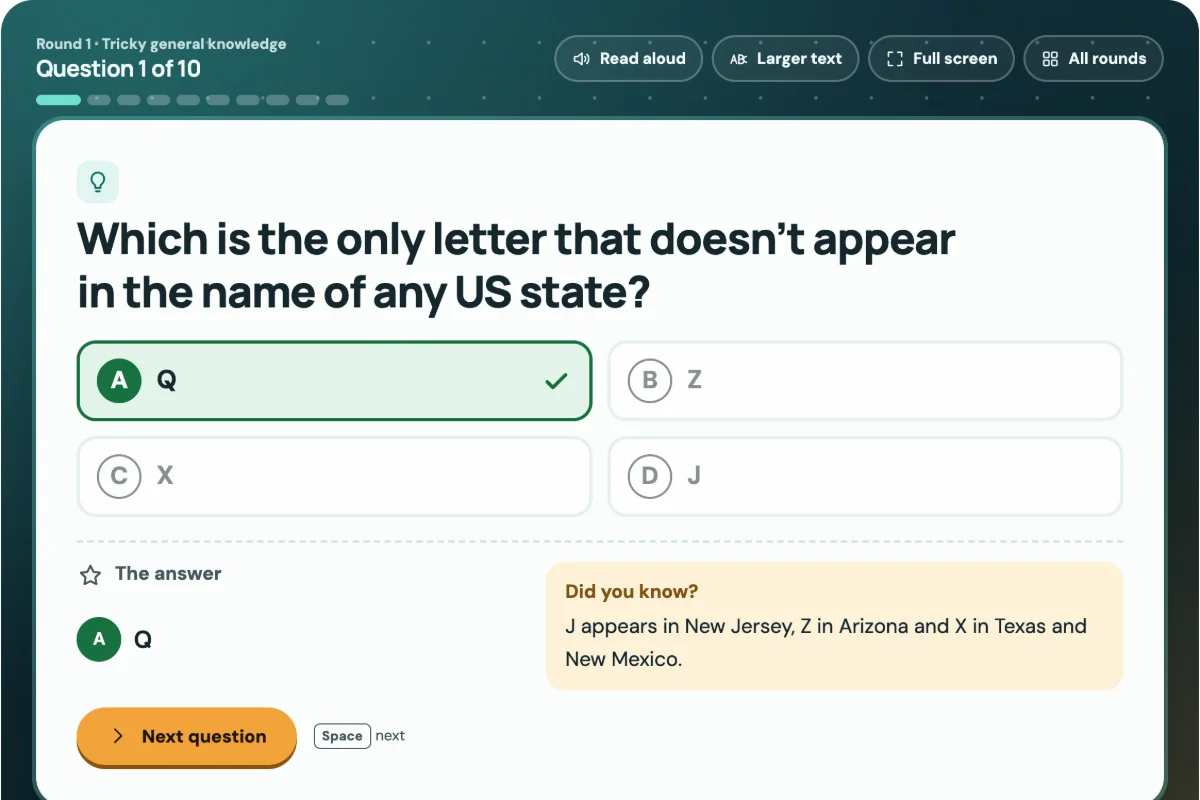
All 60 hard questionsWhich is the only letter that doesn’t appear in the name of any US state?
A. QB. ZC. XD. J
A. Q. J appears in New Jersey, Z in Arizona and X in Texas and New Mexico.
Which part of a cell releases energy from food?
A. The cell wallB. The mitochondriaC. The ribosomesD. The nucleus
B. The mitochondria. Mitochondria even have a small set of their own DNA.
Which river flows through Baghdad?
A. The JordanB. The TigrisC. The EuphratesD. The Nile
B. The Tigris. The Tigris and Euphrates frame the region once called Mesopotamia.
Which ruler of Egypt formed alliances with both Julius Caesar and Mark Antony?
A. HatshepsutB. Ramesses IIC. NefertitiD. Cleopatra
D. Cleopatra. She ruled Egypt for about 21 years, until 30 BC.
Which language gave English the word “kindergarten”?
A. GermanB. DutchC. SwedishD. French
A. German. It means “children’s garden”.
How many lines does a traditional sonnet have?
A. 14B. 10C. 16D. 12
A. 14. Shakespeare wrote 154 of them.
Short, friendly questions for ages 6 to 9, about animals, space, stories and food.
All 60 kids’ questionsWhat is a baby dog called?
A. A kittenB. A cubC. A puppyD. A calf
C. A puppy. Puppies are born with their eyes closed.
What falls from clouds as little balls of ice?
A. WindB. HailC. DewD. Fog
B. Hail. Hailstones grow bigger as they’re tossed up and down inside a storm cloud.
Tacos come from which country?
A. NorwayB. FranceC. MexicoD. India
C. Mexico. Tacos are usually made with soft or crunchy corn tortillas.
In the story Puss in Boots, what kind of animal is Puss?
A. A catB. A foxC. A dogD. A mouse
A. A cat. Charles Perrault published the story in 1697.
What do we call the bones that protect your heart and lungs?
A. AnklesB. ToesC. RibsD. Knuckles
C. Ribs. Most people have 12 pairs of ribs.
Which number comes after 99?
A. 100B. 101C. 999D. 90
A. 100. One hundred is ten tens.
A step up for ages 10 to 12: science, history, myths, sport and technology.
All 60 tweens’ questionsWhat are the three states of matter we see every day?
A. Hot, warm and coldB. Solid, liquid and gasC. Rock, water and airD. Big, medium and small
B. Solid, liquid and gas. Plasma, found in lightning and stars, is often called the fourth state.
In which US state is the Grand Canyon?
A. ColoradoB. NevadaC. UtahD. Arizona
D. Arizona. The Colorado River carved the canyon over millions of years.
Which queen ruled England from 1558 to 1603?
A. Elizabeth IB. Mary IC. VictoriaD. Anne
A. Elizabeth I. Her reign is called the Elizabethan era, the time of William Shakespeare.
In Norse myths, which god carries a mighty hammer?
A. OdinB. FreyaC. LokiD. Thor
D. Thor. Thursday is named after Thor.
In which sport do players hit a puck?
A. GolfB. Ice hockeyC. PoloD. Squash
B. Ice hockey. Hockey pucks are often frozen before games so they slide better and bounce less.
What does GPS help you do?
A. Find out where you areB. Record a songC. Charge a batteryD. Print a photo
A. Find out where you are. GPS works using signals from satellites orbiting Earth.
Grown-up general knowledge: travel, classic films and books, science, food and history.
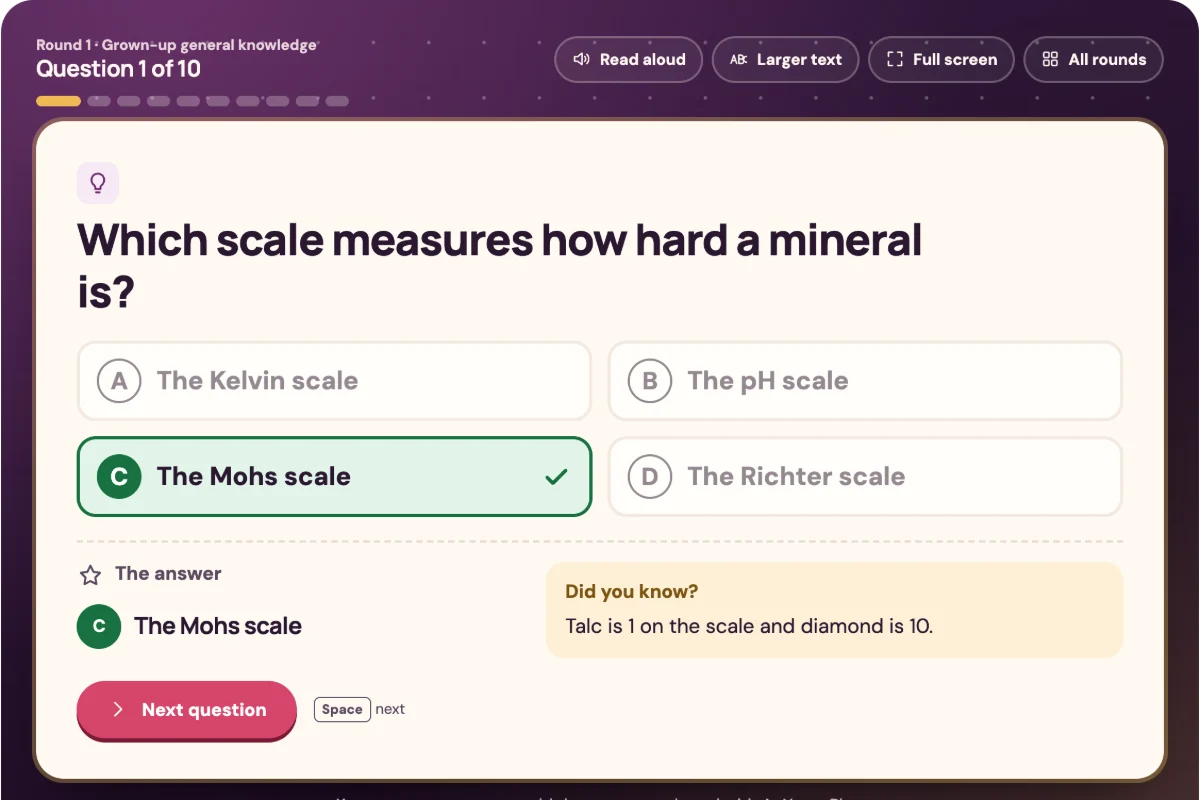
All 60 adults’ questionsWhich scale measures how hard a mineral is?
A. The Kelvin scaleB. The pH scaleC. The Mohs scaleD. The Richter scale
C. The Mohs scale. Talc is 1 on the scale and diamond is 10.
Angkor Wat is in which country?
A. CambodiaB. ThailandC. VietnamD. Laos
A. Cambodia. It appears on Cambodia’s national flag.
Which actor played Atticus Finch in the 1962 film To Kill a Mockingbird?
A. Paul NewmanB. Gregory PeckC. Henry FondaD. James Stewart
B. Gregory Peck. He won the Academy Award for Best Actor for the role.
Which part of the brain is mainly responsible for balance and coordination?
A. The brainstemB. The cerebrumC. The cerebellumD. The hypothalamus
C. The cerebellum. Cerebellum is Latin for “little brain”.
Which pastry is used to make baklava?
A. FiloB. ChouxC. PuffD. Shortcrust
A. Filo. Filo is rolled so thin you can almost see through it.
In which year was the United Nations founded?
A. 1939B. 1950C. 1919D. 1945
D. 1945. Its headquarters are in New York City.
The ten categories above are the ten rounds of Trivia Night. Round 1, general knowledge, is free: play it on this screen, or choose Host on a TV and let teams answer aloud or on paper.
10 questions · A little of everything, to warm up.
Round 1 is free · no account
Getting the questions ready…
The actual pages, free in A4 and US Letter. Print one question sheet per team, and keep the answers for the host.
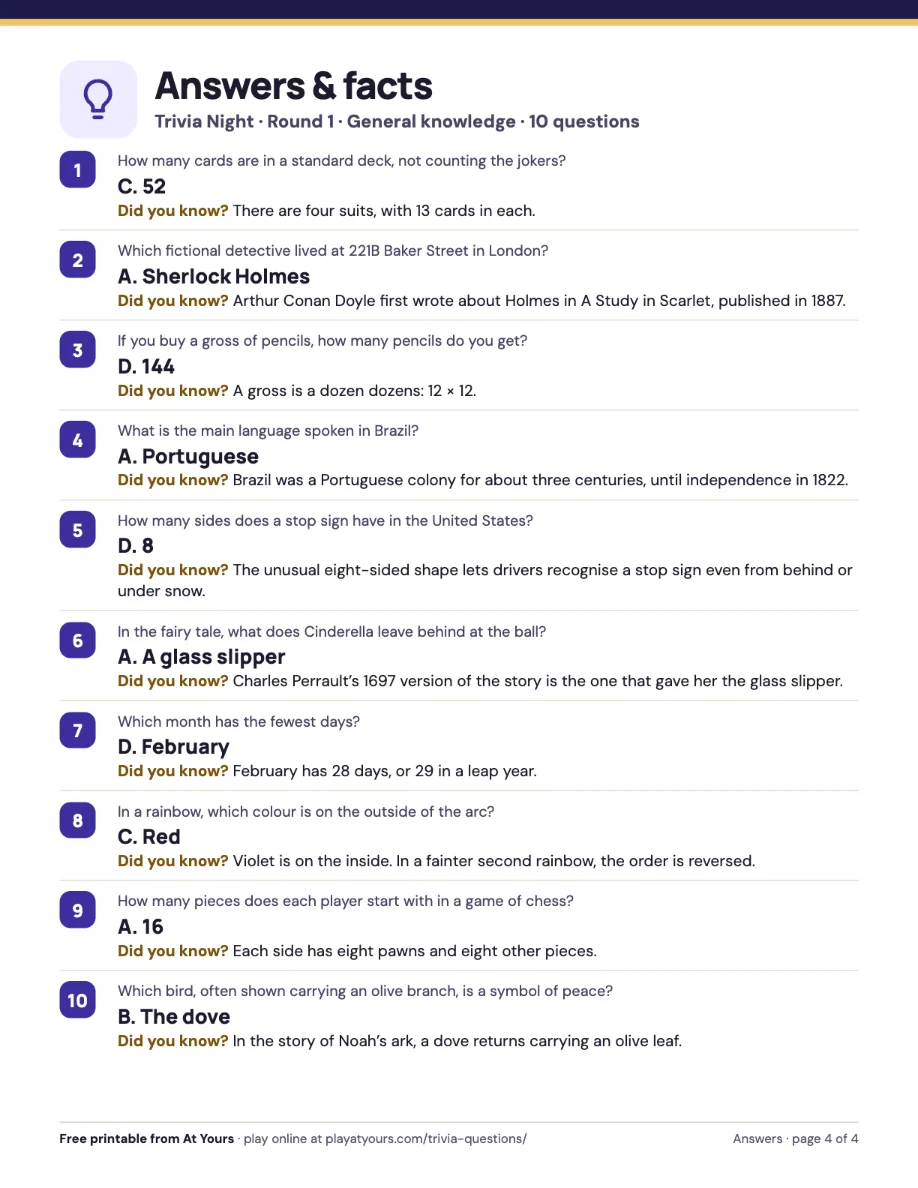
Four pages: round 1’s 10 questions in large print with tick boxes, a team answer sheet, then the answers with every “Did you know?”.
US Letter PDFA4 PDF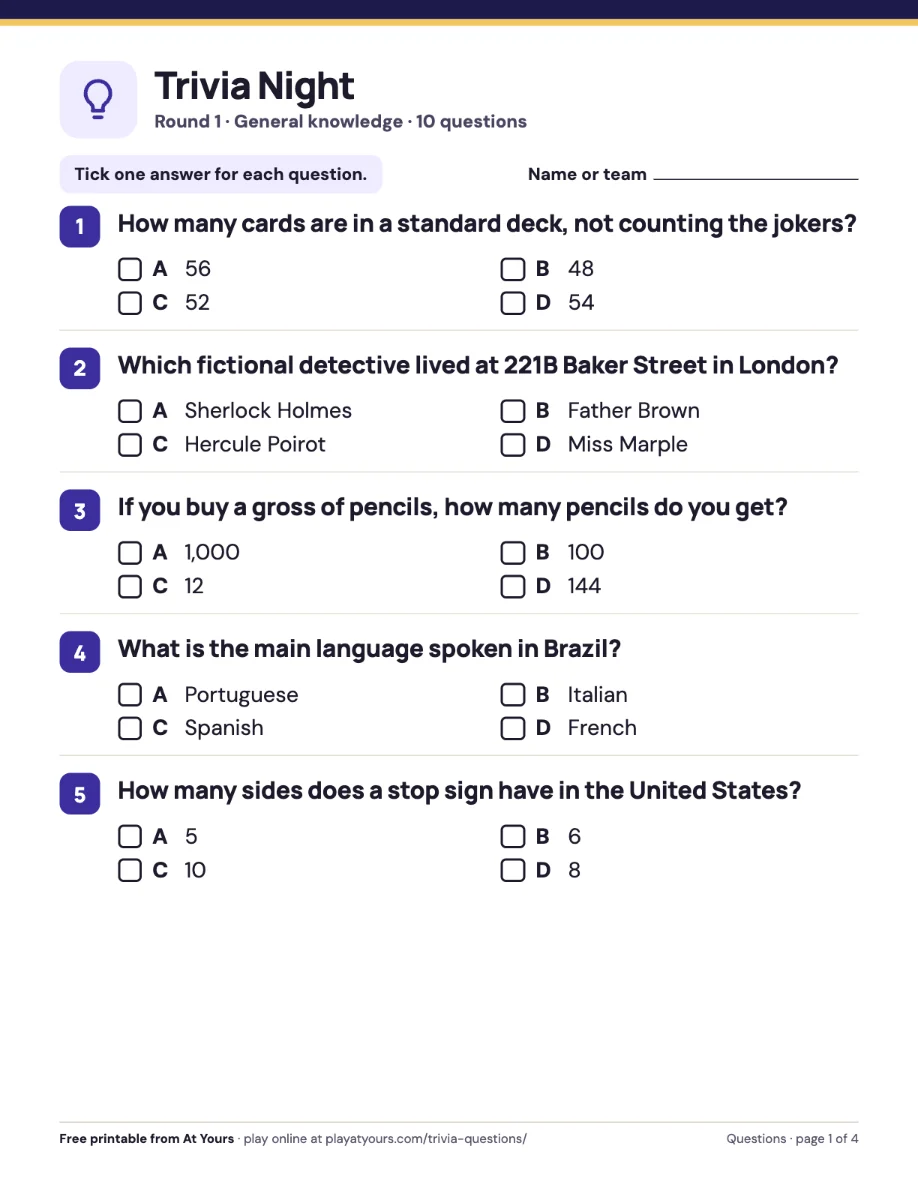
All 10 rounds: 100 questions in large print with tick boxes, each round with an answer page and every “Did you know?”. Printed from your browser on A4 or US Letter.
Six rounds of ten questions fill about an hour. Split into teams, read each question aloud, and give a point for every right answer.
| Time you have | Rounds and questions | How to pace it |
|---|---|---|
| 15 minutes | 1 round · 10 questions | Answered aloud. No paper needed. |
| 30 minutes | 2–3 rounds · 20–30 questions | Teams on paper. Read the scores after each round. |
| 45 minutes | 4 rounds · 40 questions | Take a short break after round 2. |
| About an hour | 6 rounds · 60 questions | A full quiz night. Save a favourite round for last. |
60 silly-sounding questions with completely true answers: cube-shaped droppings, pufflings and words that sound made up. Family-friendly, every one.
60 genuinely tough questions on science, geography, history, language and the arts. Fair, checked and free of trick wording.
Two sets of questions: 60 for kids of about 6 to 9 and 60 for tweens of about 10 to 12. Read them aloud, reveal the answers, or play them as a quiz on one screen.
60 grown-up general knowledge questions: travel, classic films and books, science, food and history. Nothing explicit and no drinking games.
Traditions, films, festive food and winter science, with a TV mode for parties.
Every question on this page is free to read, and round 1 is free to play and print. The host’s At Yours Plus adds all 10 rounds of Trivia Night to play on one screen or a TV, a team scoreboard for 2 to 6 teams, and the full large-print set, plus every other trivia pack, from Christmas to Thanksgiving. One host covers the whole room; guests never pay.
US$4.99/month or US$29/year. The link brings you back here, ready to play.
Questions with one clear answer that people can reason their way towards, even if they aren’t sure: “Which river flows through London?” is better than a date nobody could guess. Mix easy and harder questions, cover several categories, and add a short fact after each answer, because that’s the bit people remember.
For about an hour, plan on 40 to 60 questions: four to six rounds of ten, with a short break in the middle. A single round of ten takes about 10 to 15 minutes in teams. These are estimates; a chatty room takes longer.
Give one point for each right answer and add up each team’s points after every round. Many hosts let each team play one joker round for double points. If teams tie, ask one more question where the closest number wins, such as a year.
Yes. Every list on this page is also a trivia pack. Round 1 is free to play on one screen, or in TV mode for teams, with no account. The host’s At Yours Plus opens every round and a team scoreboard for US$4.99/month or US$29/year.
We checked every answer against standard references and left out anything disputed or likely to change, such as records and “current” holders. If you think we’ve got one wrong, email hello@playatyours.com and we’ll look again.
Yes. Round 1 of each pack is a free large-print PDF in A4 and US Letter: the questions with tick boxes, a team answer sheet, and the answers with every fact. With At Yours Plus, the host can print every round of every pack.
There’s a taste of each list on this page, and every list has its own page: funny trivia questions, hard trivia questions, trivia questions for kids and tweens and trivia questions for adults. For December, there’s Christmas trivia.