Free
- Round 1 of each pack, all ten questions
- Play on one screen, or host it on a TV
- Larger text, read-aloud where your device has a voice, optional timer
- Large-print question and answer sheets, A4 and US Letter
In short: Afternoon Trivia is a gentle quiz for older adults and mixed-age groups, with large type, four big answer buttons and no timer. Play the free 10-question garden round on a tablet or computer, or show it on a TV and answer together. There are no ads, and nothing to install.
Round 1 is free · no account
10 questions · Flowers, birds and things that grow.
Getting the questions ready…
$4.99/month or $29/year (USD). One membership covers the whole table; nobody else needs an account.
Comfortable type, a pace the players set, and questions that start conversations rather than test them.
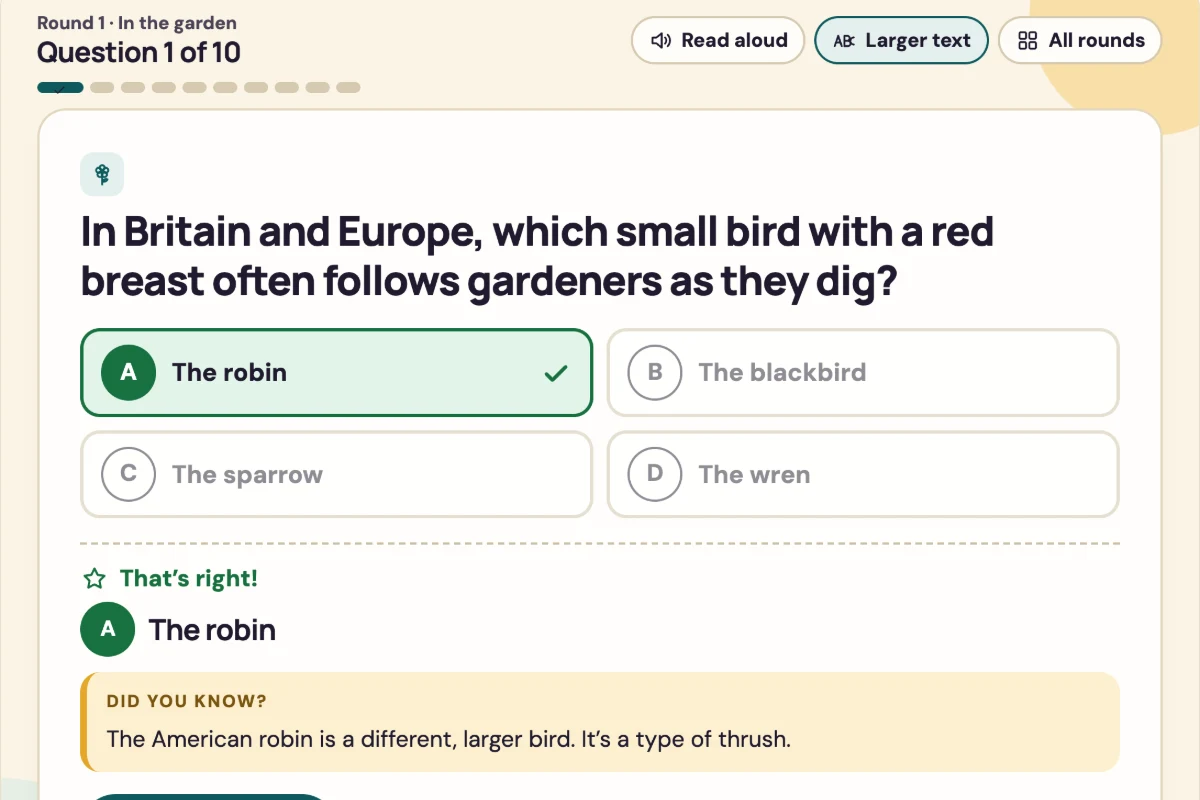
Tap an answer, then “Check my answer”. Nothing happens by accident, and you can change your mind first.
There’s no countdown unless you add one. The next question waits until you’re ready.
Two text sizes, strong contrast and plain layouts. Lettered answers mean colour is never the only clue.
Where your device has a built-in voice, one tap reads the question and the answers.
Each answer ends with a short fact, and each round ends with two easy conversation starters.
A wrong answer simply shows the right one. Hide the score altogether if you’d rather not count.
60 questions about everyday things anyone can reason about. Nothing depends on remembering a particular decade.
| Round | What it covers | Questions | Access |
|---|---|---|---|
| 1. In the garden | Flowers, birds and things that grow. | 10 | Free · play & print |
| 2. In the kitchen | Breads, spices, teas and tastes. | 10 | At Yours Plus |
| 3. Words & sayings | Phrases, puzzles and the stories behind them. | 10 | At Yours Plus |
| 4. Around the world | Famous places, near and far. | 10 | At Yours Plus |
| 5. Music & the arts | Paintings, players and the stage. | 10 | At Yours Plus |
| 6. Nature & the seasons | Skies, seasons and creatures great and small. | 10 | At Yours Plus |
The actual pages, in big, clear type. Print one per person or one per table.
Four pages: the 10 garden questions in large print with tick boxes, a team answer sheet with big writing boxes, then the answers and facts for the host.
US Letter PDFA4 PDF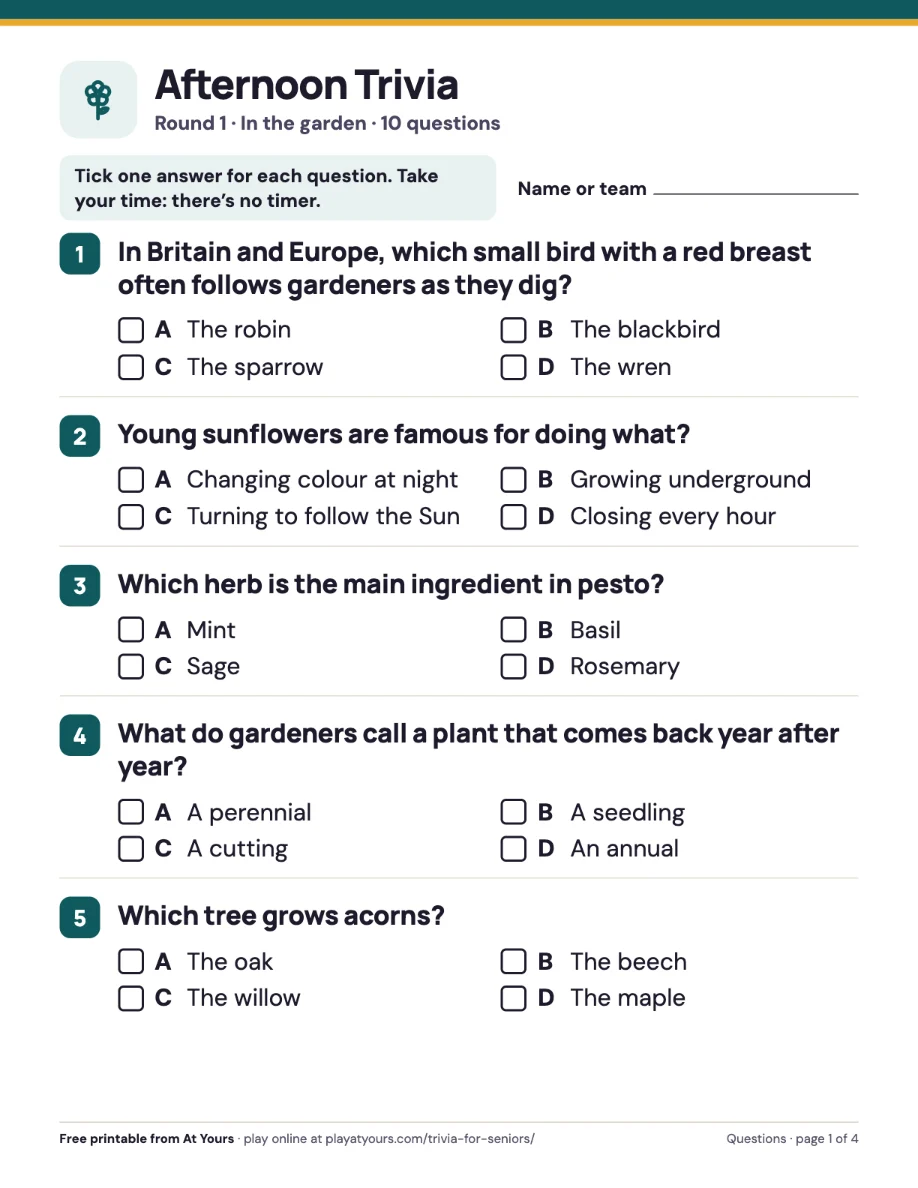
Seat everyone where they can see one large screen, read each question aloud, and let the room talk it through before you reveal the answer. The same plan works for a family afternoon, a club or a care-home activity.
Estimates that leave room for conversation. Stop whenever the room has had enough.
| Time you have | Rounds and questions | How to pace it |
|---|---|---|
| 15–20 minutes | 1 round · 10 questions | The free garden round, with a fact read after each answer. |
| 30–40 minutes | 2 rounds · 20 questions | One round, a conversation starter, then another round. |
| About 45 minutes | 3 rounds · 30 questions | Tea break after round 2. Hand out printed sheets for round 3. |
| A weekly club | 1–2 rounds each week | Six rounds last three to six sessions. |
Afternoon Club is a separate, host-led activity pack designed with older adults in mind: familiar objects, gentle word clues and time for a proper conversation. It has large-type pages, easy and trickier choices, and no compulsory timer or memory scoring. It isn’t a trivia game. It pairs well with one.
See Afternoon ClubGentle word games and familiar objects that get a conversation going.
2–12 or facilitated tables20–45 min
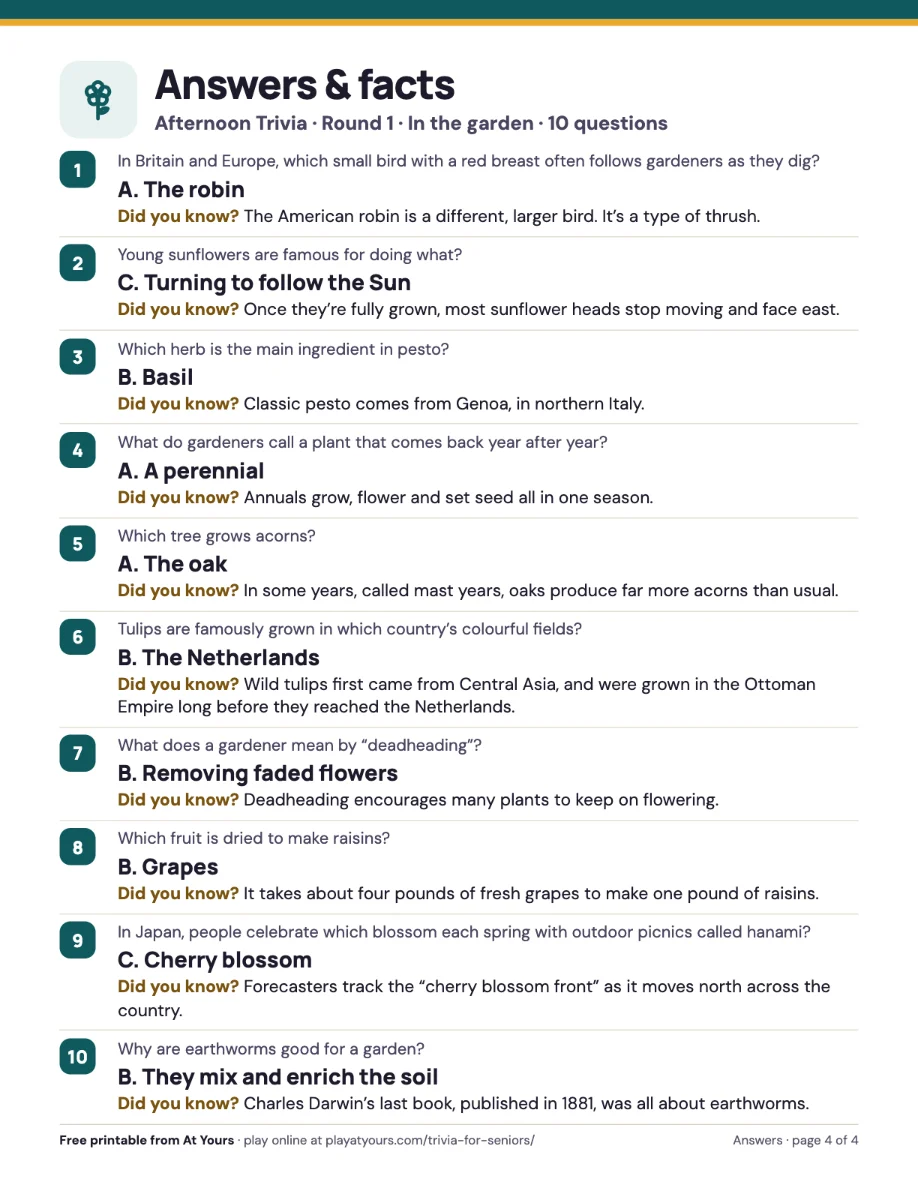
The free round in full: ten garden questions, each with four choices and a fact to share.
In Britain and Europe, which small bird with a red breast often follows gardeners as they dig?
A. The robinB. The blackbirdC. The sparrowD. The wren
A. The robin. The American robin is a different, larger bird. It’s a type of thrush.
Young sunflowers are famous for doing what?
A. Changing colour at nightB. Growing undergroundC. Turning to follow the SunD. Closing every hour
C. Turning to follow the Sun. Once they’re fully grown, most sunflower heads stop moving and face east.
Which herb is the main ingredient in pesto?
A. MintB. BasilC. SageD. Rosemary
B. Basil. Classic pesto comes from Genoa, in northern Italy.
What do gardeners call a plant that comes back year after year?
A. A perennialB. A seedlingC. A cuttingD. An annual
A. A perennial. Annuals grow, flower and set seed all in one season.
Which tree grows acorns?
A. The oakB. The beechC. The willowD. The maple
A. The oak. In some years, called mast years, oaks produce far more acorns than usual.
Tulips are famously grown in which country’s colourful fields?
A. GreeceB. The NetherlandsC. SpainD. Ireland
B. The Netherlands. Wild tulips first came from Central Asia, and were grown in the Ottoman Empire long before they reached the Netherlands.
What does a gardener mean by “deadheading”?
A. Watering at nightB. Removing faded flowersC. Cutting down a treeD. Digging up weeds
B. Removing faded flowers. Deadheading encourages many plants to keep on flowering.
Which fruit is dried to make raisins?
A. CherriesB. GrapesC. FigsD. Plums
B. Grapes. It takes about four pounds of fresh grapes to make one pound of raisins.
In Japan, people celebrate which blossom each spring with outdoor picnics called hanami?
A. Apple blossomB. WisteriaC. Cherry blossomD. Magnolia
C. Cherry blossom. Forecasters track the “cherry blossom front” as it moves north across the country.
Why are earthworms good for a garden?
A. They pollinate flowersB. They mix and enrich the soilC. They scare away birdsD. They eat greenfly
B. They mix and enrich the soil. Charles Darwin’s last book, published in 1881, was all about earthworms.
Word games, picture matching, tiles and bingo that work at any pace.
Questions about things anyone can reason about, whatever their age: gardens, kitchens, words and sayings, famous places, music and nature. Four clear choices help, and so does a friendly fact afterwards. Avoid questions that depend on remembering personal events, or that are mostly about one decade.
Plan on about 15 to 20 minutes for a round of ten if people chat between questions. One to three rounds, with a tea break, fits a typical afternoon activity. These are estimates; let the room set the pace.
Round 1 is free to play and print, with no account. There are no ads, and nothing to install; the printable sheets are an optional download. At Yours Plus opens the other five rounds.
Yes. In TV mode the host reads each question aloud, and every answer has a letter, so people can simply call out “B”. On many devices the Read aloud button uses the built-in voice. The printed sheets use large type with tick boxes.
No. It’s a social quiz with four choices. The questions are general knowledge, not personal memories, and you can hide the score. We don’t make health or memory claims.
Yes. Activity coordinators can run the free round and print the free sheets for the sessions they host. At Yours Plus covers community groups you host; paid events for outside clients need our permission (see licences).
Yes. Share your screen in TV mode, read the questions, and let everyone answer aloud. Reveal together and read the fact.
Yes: phones, tablets and computers in an up-to-date web browser. A tablet gives the biggest answer buttons for the least effort, and you can tap, use a stylus or a keyboard.
Trivia games · Christmas trivia · Afternoon Club · Word search · Free games