Trivia questions
130 original questions with answers: ten categories from general knowledge to art, plus a taste of our funny, hard, kids and grown-up lists. Tap to reveal each answer, or play them as a quiz.
Two sets of questions: 60 for kids of about 6 to 9 and 60 for tweens of about 10 to 12. Read them aloud, reveal the answers, or play them as a quiz on one screen.
Round 1 free to play · No sign-up · Print a free sheet
Trivia questions for kids are short, friendly questions with one clear answer, like “What is a baby frog called?” This page has two sets: 60 for kids of about 6 to 9 and 60 for tweens of about 10 to 12, about animals, space, places, stories, science, sport and how things work. Every question has four options and a fun fact. A grown-up can read them aloud, print a sheet, or put them on a TV.
Pets, farms and the wild.
What is a baby dog called?
A. A kittenB. A cubC. A puppyD. A calf
C. A puppy. Puppies are born with their eyes closed.
Which animal has black and white stripes?
A. A tigerB. A leopardC. A giraffeD. A zebra
D. A zebra. No two zebras have exactly the same stripes.
What do fish use to breathe underwater?
A. GillsB. ScalesC. FinsD. Lungs
A. Gills. Gills take oxygen out of the water.
Which animal says “neigh”?
A. A duckB. A horseC. A pigD. A sheep
B. A horse. A baby horse is called a foal.
Which animal carries its home on its back?
A. A frogB. A mouseC. A rabbitD. A snail
D. A snail. A snail’s shell grows bigger as the snail grows.
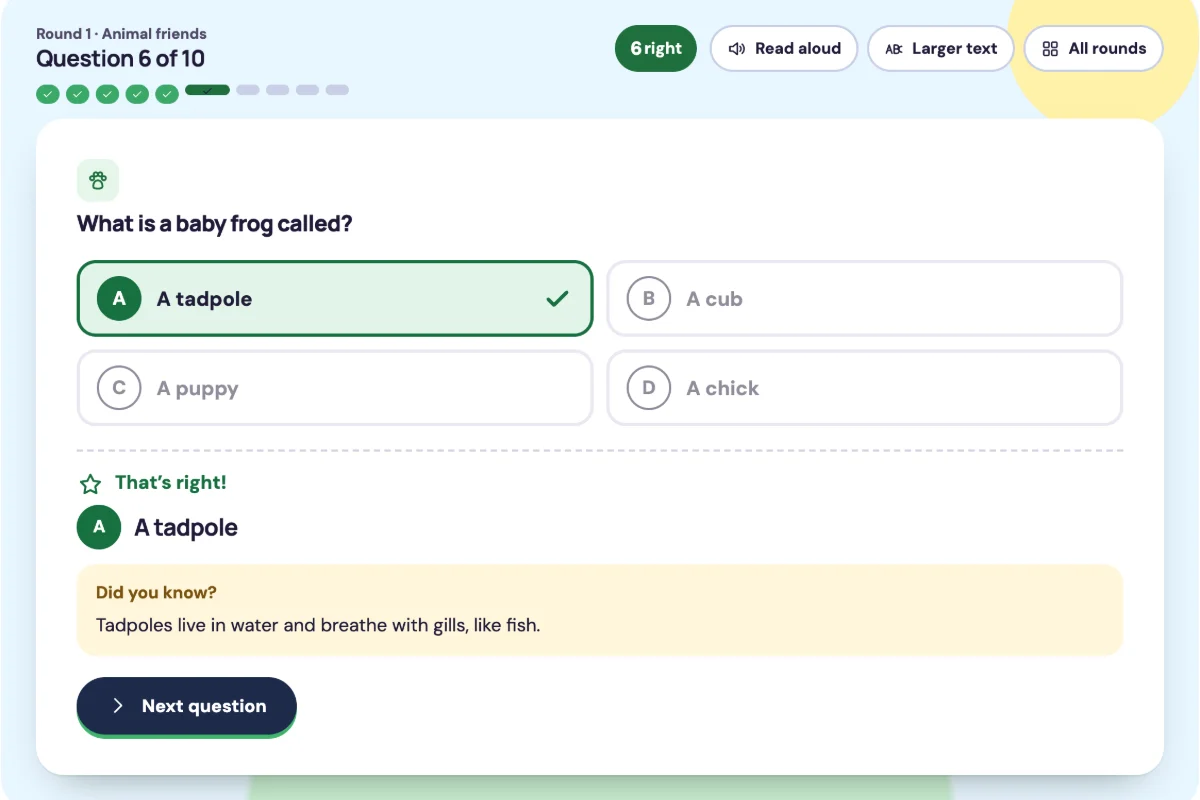
What is a baby frog called?
A. A tadpoleB. A cubC. A puppyD. A chick
A. A tadpole. Tadpoles live in water and breathe with gills, like fish.
Which animal has a very long trunk?
A. A camelB. A rhinoC. A hippoD. An elephant
D. An elephant. An elephant uses its trunk to smell, drink, pick things up and say hello.
Which of these animals is a reptile?
A. A crocodileB. A frogC. A penguinD. A whale
A. A crocodile. Reptiles have dry, scaly skin.
What do we call a big group of fish swimming together?
A. A teamB. A classC. A schoolD. A flock
C. A school. Swimming together helps fish stay safe.
Which animal is famous for its very long neck?
A. A hippoB. A lionC. A giraffeD. A zebra
C. A giraffe. A giraffe has seven bones in its neck, the same number as you.
Planets, weather and growing things.
What is the name of the planet we live on?
A. JupiterB. MarsC. VenusD. Earth
D. Earth. Earth is the only planet we know of that has living things.
Which planet is called the Red Planet?
A. JupiterB. MarsC. NeptuneD. Saturn
B. Mars. Mars looks red because its dust has rusty iron in it.
What do we call the Moon when we can see all of it lit up?
A. A new moonB. A blue moonC. A half moonD. A full moon
D. A full moon. The Moon doesn’t make its own light. It shines because sunlight bounces off it.
What falls from clouds as little balls of ice?
A. WindB. HailC. DewD. Fog
B. Hail. Hailstones grow bigger as they’re tossed up and down inside a storm cloud.
Which season comes after winter?
A. Autumn (fall)B. SummerC. SpringD. Winter again
C. Spring. Many birds build nests and lay eggs in spring.
What do plants need from the Sun to grow?
A. NoiseB. SandC. SnowD. Light
D. Light. Plants use sunlight to make their own food.
What is a scientist who studies stars and planets called?
A. A chefB. An astronomerC. A pilotD. A dentist
B. An astronomer. Astronomers use telescopes to see things that are very far away.
Roughly what shape is the Earth?
A. A triangleB. A ballC. A flat circleD. A cube
B. A ball. Pictures taken from space show Earth as a blue and white ball.
What do we call a group of stars that makes a picture in the sky?
A. A cometB. A planetC. A rainbowD. A constellation
D. A constellation. The Big Dipper is part of a constellation called the Great Bear.
Which of these is NOT a living thing?
A. A wormB. A treeC. A mushroomD. A rock
D. A rock. Living things grow, need food and can make more of themselves.
Flags, food and faraway places.
In which country do kangaroos live in the wild?
A. BrazilB. AustraliaC. IndiaD. Canada
B. Australia. Kangaroos use their strong tails to help them balance.
What is the capital city of the United Kingdom?
A. LondonB. CardiffC. EdinburghD. Manchester
A. London. Big Ben is the nickname of the great bell in London’s famous clock tower.
What do we call a big area of land covered with lots of trees?
A. A beachB. An oceanC. A forestD. A desert
C. A forest. The Amazon rainforest is in South America.
What do we call a very dry place that gets very little rain?
A. A jungleB. A desertC. A lakeD. A swamp
B. A desert. Not all deserts are hot. The Gobi Desert in Asia gets very cold in winter.
Pizza first came from which country?
A. JapanB. MexicoC. EgyptD. Italy
D. Italy. The city of Naples is famous for its pizza.
Which country has a big red circle on a white flag?
A. ChinaB. JapanC. CanadaD. Brazil
B. Japan. The red circle stands for the Sun.
Tacos come from which country?
A. NorwayB. FranceC. MexicoD. India
C. Mexico. Tacos are usually made with soft or crunchy corn tortillas.
What do we call a piece of land with water all around it?
A. A valleyB. A riverC. A mountainD. An island
D. An island. Greenland is the biggest island that isn’t a continent.
In which country is the Statue of Liberty?
A. CanadaB. The United StatesC. EnglandD. France
B. The United States. France gave the statue to the United States as a gift in 1886.
What do people say for “hello” in French?
A. CiaoB. BonjourC. KonnichiwaD. Hola
B. Bonjour. “Merci” means “thank you” in French.
Fairy tales and nursery rhymes.
In the fairy tale, how many dwarfs does Snow White meet?
A. TenB. ThreeC. FiveD. Seven
D. Seven. The Brothers Grimm wrote the story down in 1812.
Who climbs the beanstalk in the fairy tale?
A. HanselB. TomC. JackD. Peter
C. Jack. At the top, Jack finds a giant’s castle.
What did the three little pigs build their houses from?
A. Leaves, stones and mudB. Sand, snow and iceC. Paper, glass and woodD. Straw, sticks and bricks
D. Straw, sticks and bricks. Only the brick house stood up to the wolf’s huffing and puffing.
What does Little Red Riding Hood take to her grandmother?
A. A basket of foodB. A new coatC. A bunch of flowersD. A puppy
A. A basket of food. In some versions, a woodcutter comes to the rescue.
In the nursery rhyme, who sat on a wall and had a great fall?
A. Little Bo PeepB. Old King ColeC. Jack SpratD. Humpty Dumpty
D. Humpty Dumpty. The rhyme began as a riddle, and its answer is an egg.
Which fairy-tale girl had such long hair that a prince could climb it?
A. GoldilocksB. RapunzelC. BelleD. Cinderella
B. Rapunzel. Rapunzel is named after a leafy plant.
In Goldilocks and the Three Bears, whose porridge is “just right”?
A. Father Bear’sB. Nobody’sC. Mother Bear’sD. Baby Bear’s
D. Baby Bear’s. Goldilocks breaks Baby Bear’s chair, too.
In the fable, what do the hare and the tortoise have?
A. A raceB. A swimC. A picnicD. A dance
A. A race. The fable is credited to Aesop, a storyteller from ancient Greece.
In the nursery rhyme “Hey Diddle Diddle”, what does the cow jump over?
A. A fenceB. A starC. The MoonD. A river
C. The Moon. In the same rhyme, the dish runs away with the spoon.
In the story Puss in Boots, what kind of animal is Puss?
A. A catB. A foxC. A dogD. A mouse
A. A cat. Charles Perrault published the story in 1697.
What we eat and how we work.
What are your first, baby teeth often called?
A. Sugar teethB. Bread teethC. Moon teethD. Milk teeth
D. Milk teeth. Most children start losing their baby teeth at about six.
Which part of your body do you smell with?
A. Your elbowsB. Your noseC. Your earsD. Your knees
B. Your nose. Your sense of smell helps you taste your food, too.
What do we call the bones that protect your heart and lungs?
A. AnklesB. ToesC. RibsD. Knuckles
C. Ribs. Most people have 12 pairs of ribs.
Which yellow fruit do you peel before you eat it?
A. A bananaB. A grapeC. A cherryD. A plum
A. A banana. Bananas grow in clusters called hands, and each banana is called a finger.
What is the yellow middle of an egg called?
A. The crustB. The shellC. The yolkD. The white
C. The yolk. The yolk is food for a growing chick.
Which food is made from milk, and sometimes has holes in it?
A. BreadB. CheeseC. RiceD. Jam
B. Cheese. The holes in Swiss cheese are made by tiny bubbles of gas.
Which part of your body do you taste with?
A. Your tongueB. Your kneeC. Your hairD. Your ear
A. Your tongue. Your tongue is covered in tiny bumps, and your taste buds are on them.
Which drink comes from cows?
A. LemonadeB. Orange juiceC. MilkD. Apple juice
C. Milk. Milk has calcium, which helps build strong bones and teeth.
Where does maple syrup come from?
A. BeesB. FlowersC. Sugar beetsD. The sap of maple trees
D. The sap of maple trees. It takes about 40 litres of sap to make 1 litre of syrup.
Which of these is a vegetable?
A. An appleB. BroccoliC. A bananaD. A grape
B. Broccoli. Broccoli looks like a bunch of tiny trees.
Counting, colours and corners.
How many sides does a triangle have?
A. 6B. 5C. 4D. 3
D. 3. A triangle has the fewest straight sides a flat shape can have.
What colour do you get when you mix red and yellow?
A. OrangeB. PurpleC. BrownD. Green
A. Orange. Mixing red and blue makes purple.
How many days are there in a week?
A. 7B. 5C. 6D. 10
A. 7. Sunday is named after the Sun, and Monday after the Moon.
How many legs do two dogs have altogether?
A. 4B. 10C. 6D. 8
D. 8. Dogs walk on their toes.
Which shape has four sides that are all the same length, and four corners?
A. A squareB. A triangleC. A circleD. An oval
A. A square. A square is a special kind of rectangle.
Which number comes after 99?
A. 100B. 101C. 999D. 90
A. 100. One hundred is ten tens.
How many months are there in a year?
A. 12B. 52C. 10D. 7
A. 12. January is named after Janus, a Roman god of beginnings.
If you have 3 apples and eat 1, how many are left?
A. 3B. 1C. 2D. 4
C. 2. There are thousands of different kinds of apple.
What colour are most leaves in summer?
A. PurpleB. GreenC. WhiteD. Blue
B. Green. Leaves make food for the plant using sunlight.
What is half of 10?
A. 2B. 5C. 20D. 4
B. 5. Half means splitting something into two equal parts.
Forces, matter and the solar system.
What are the three states of matter we see every day?
A. Hot, warm and coldB. Solid, liquid and gasC. Rock, water and airD. Big, medium and small
B. Solid, liquid and gas. Plasma, found in lightning and stars, is often called the fourth state.
What is the force that slows things down when they rub together?
A. InertiaB. FrictionC. MagnetismD. Gravity
B. Friction. Friction is why your hands get warm when you rub them together.
How many planets in our solar system have rings?
A. 4B. 8C. 1D. 2
A. 4. Saturn’s rings are the brightest, but Jupiter, Uranus and Neptune have rings too.
What is the name for any animal with a backbone?
A. A vertebrateB. An invertebrateC. An arthropodD. A mollusc
A. A vertebrate. Worms, insects and jellyfish are invertebrates.
What is the chemical symbol for oxygen?
A. OgB. OxC. OmD. O
D. O. Oxygen makes up about a fifth of the air we breathe.
Which part of the eye controls how much light gets in?
A. The lensB. The retinaC. The irisD. The eyelash
C. The iris. The iris is the coloured ring around the pupil.
What does a solar panel use to make electricity?
A. WindB. Moving waterC. SunlightD. Heat from underground
C. Sunlight. Solar panels turn sunlight straight into electricity.
Which of these metals is attracted to a magnet?
A. CopperB. IronC. AluminiumD. Gold
B. Iron. Nickel and cobalt are attracted to magnets too.
What is usually the first link in a food chain?
A. A fishB. A lionC. An eagleD. A plant
D. A plant. Plants are called producers because they make their own food.
About how long does Earth take to travel once around the Sun?
A. 7 daysB. 30 daysC. 24 hoursD. 365 days
D. 365 days. The extra quarter of a day each year is why we add 29 February in leap years.
Oceans, volcanoes and maps.
What is the capital of Spain?
A. BarcelonaB. SevilleC. MadridD. Valencia
C. Madrid. Madrid is close to the middle of Spain.
Which ocean lies between Africa and Australia?
A. The Pacific OceanB. The Indian OceanC. The Atlantic OceanD. The Arctic Ocean
B. The Indian Ocean. Madagascar, Sri Lanka and the Maldives are all in the Indian Ocean.
What do you call a mountain that can erupt with lava?
A. A volcanoB. A plateauC. A canyonD. A glacier
A. A volcano. The word comes from Vulcan, the Roman god of fire.
In which US state is the Grand Canyon?
A. ColoradoB. NevadaC. UtahD. Arizona
D. Arizona. The Colorado River carved the canyon over millions of years.
In which country is the city of Rio de Janeiro?
A. MexicoB. ArgentinaC. PortugalD. Brazil
D. Brazil. A huge statue, Christ the Redeemer, stands on a mountain above the city.
What do we call a huge mass of ice that moves slowly over land?
A. A fjordB. An icebergC. A glacierD. A tundra
C. A glacier. An iceberg is a chunk that has broken off a glacier or an ice shelf into the sea.
On which continent is Kenya?
A. AsiaB. EuropeC. South AmericaD. Africa
D. Africa. Kenya is named after Mount Kenya, its highest mountain.
What are the lines that run from the North Pole to the South Pole on a map called?
A. Lines of longitudeB. Contour linesC. Time linesD. Lines of latitude
A. Lines of longitude. Lines of latitude run east to west, parallel to the equator.
Which of these countries has no coastline?
A. GreeceB. PortugalC. SwitzerlandD. Denmark
C. Switzerland. Switzerland borders France, Germany, Austria, Liechtenstein and Italy.
What is the capital of the United States?
A. New York CityB. Los AngelesC. Washington, D.C.D. Chicago
C. Washington, D.C. “D.C.” stands for District of Columbia.
Ancient worlds and big inventions.
Which Roman town was buried by the eruption of Mount Vesuvius in AD 79?
A. AthensB. CarthageC. PompeiiD. Sparta
C. Pompeii. The ash preserved streets, houses and even loaves of bread.
What did the ancient Egyptians use to make an early kind of paper?
A. Papyrus reedsB. Tree barkC. CottonD. Rice
A. Papyrus reeds. The English word “paper” comes from “papyrus”.
Where did the Vikings come from?
A. SpainB. ChinaC. ScandinaviaD. Egypt
C. Scandinavia. Viking ships could cross the open sea and also sail up shallow rivers.
In 1492, Christopher Columbus sailed across which ocean?
A. The AtlanticB. The PacificC. The IndianD. The Arctic
A. The Atlantic. His three ships were the Niña, the Pinta and the Santa María.
Which language did the ancient Romans speak?
A. LatinB. ItalianC. GreekD. French
A. Latin. Lots of English words, like “aquarium” and “video”, come from Latin.
What do we call the metal suits that knights wore in battle?
A. RobesB. ArmourC. TunicsD. Cloaks
B. Armour. A full suit of plate armour could weigh about 15–25 kg (33–55 lb).
Which queen ruled England from 1558 to 1603?
A. Elizabeth IB. Mary IC. VictoriaD. Anne
A. Elizabeth I. Her reign is called the Elizabethan era, the time of William Shakespeare.
Around 1450, Johannes Gutenberg in Germany developed a new kind of what?
A. PencilB. TelescopeC. Steam engineD. Printing press
D. Printing press. Movable type had been used even earlier in China and Korea.
Which scientist came up with the theory of relativity?
A. Isaac NewtonB. Charles DarwinC. Galileo GalileiD. Albert Einstein
D. Albert Einstein. His famous equation E = mc² links mass and energy.
Who was known as “the Lady with the Lamp”?
A. Florence NightingaleB. Edith CavellC. Clara BartonD. Mary Seacole
A. Florence Nightingale. She improved hygiene in army hospitals during the Crimean War.
Greek gods, pirates and Neverland.
In Greek myth, what happened to everything King Midas touched?
A. It turned to goldB. It became invisibleC. It caught fireD. It turned to stone
A. It turned to gold. Even his food turned to gold, so his wish became a big problem.
Who was the Greek god of the sea?
A. PoseidonB. HermesC. ApolloD. Zeus
A. Poseidon. The Romans called him Neptune.
Who wrote Alice’s Adventures in Wonderland?
A. Beatrix PotterB. Roald DahlC. J. M. BarrieD. Lewis Carroll
D. Lewis Carroll. Lewis Carroll was the pen name of Charles Lutwidge Dodgson.
In Treasure Island, what is the name of the pirate with one leg?
A. Captain HookB. BlackbeardC. Captain FlintD. Long John Silver
D. Long John Silver. Robert Louis Stevenson’s novel came out as a book in 1883.
What is the name of the winged horse in Greek myths?
A. The HydraB. PegasusC. CerberusD. The Minotaur
B. Pegasus. Pegasus sprang from Medusa when the hero Perseus defeated her.
In The Wonderful Wizard of Oz, what does the Scarecrow want?
A. A homeB. A brainC. CourageD. A heart
B. A brain. L. Frank Baum’s book was published in 1900.
Which monster in Greek myths had snakes for hair?
A. MedusaB. The SphinxC. The CyclopsD. Cerberus
A. Medusa. Anyone who looked at her was said to turn to stone.
In The Jungle Book stories, what kind of animal is Baloo?
A. A bearB. A wolfC. A tigerD. A panther
A. A bear. Rudyard Kipling’s The Jungle Book was published in 1894.
Who is the boy from Neverland who never grows up?
A. Tom SawyerB. PinocchioC. Peter PanD. Oliver Twist
C. Peter Pan. J. M. Barrie first put him on stage in a play in 1904.
In Norse myths, which god carries a mighty hammer?
A. OdinB. FreyaC. LokiD. Thor
D. Thor. Thursday is named after Thor.
Rules every fan should know.
In which sport can you hit a home run?
A. RugbyB. CricketC. BaseballD. Hockey
C. Baseball. A home run lets the batter run all the way around all four bases.
In basketball, how many points is a free throw worth?
A. 3B. 5C. 1D. 2
C. 1. Free throws are taken from a line 15 feet (4.6 m) from the backboard.
In which sport do players hit a puck?
A. GolfB. Ice hockeyC. PoloD. Squash
B. Ice hockey. Hockey pucks are often frozen before games so they slide better and bounce less.
In rugby union, how many players does each team have on the field?
A. 15B. 13C. 11D. 9
A. 15. Rugby league teams have 13 players.
How often are the Summer Olympics usually held?
A. Every four yearsB. Every ten yearsC. Every yearD. Every two years
A. Every four years. The Tokyo 2020 Games were held a year late, in 2021.
In chess, which piece can only move diagonally?
A. The knightB. The rookC. The bishopD. The king
C. The bishop. Each player starts with one bishop on light squares and one on dark squares.
In tennis, what are the four biggest tournaments called together?
A. The Triple CrownB. The Big FourC. The World SeriesD. The Grand Slam
D. The Grand Slam. They are the Australian Open, the French Open, Wimbledon and the US Open.
In ten-pin bowling, how many pins stand at the end of the lane?
A. 9B. 8C. 10D. 12
C. 10. Knocking them all down with your first ball is called a strike.
How long is a professional soccer match, not counting added time?
A. 60 minutesB. 100 minutesC. 80 minutesD. 90 minutes
D. 90 minutes. It’s played in two halves of 45 minutes.
Which swimming stroke is done lying on your back?
A. BackstrokeB. BreaststrokeC. Front crawlD. Butterfly
A. Backstroke. In races, backstroke is the only stroke that starts in the water.
Computers, machines and how things work.
What does a computer’s CPU do?
A. Carries out instructionsB. Shows pictures on the screenC. Stores photos foreverD. Cools the computer
A. Carries out instructions. CPU stands for central processing unit.
What do we call a program that copies itself and can harm a computer?
A. A virusB. A browserC. A keyboardD. A pixel
A. A virus. Antivirus software looks for harmful programs and removes them.
What are the tiny dots that make up a picture on a screen called?
A. BytesB. AtomsC. CellsD. Pixels
D. Pixels. The word pixel is short for “picture element”.
Which scientist described three laws of motion in 1687?
A. Galileo GalileiB. Marie CurieC. Albert EinsteinD. Isaac Newton
D. Isaac Newton. He published them in a book usually called the Principia.
What is the binary number system made of?
A. Letters and numbersB. Only even numbersC. Only 0s and 1sD. The numbers 1 to 10
C. Only 0s and 1s. Computers store everything, from songs to photos, as binary.
What does GPS help you do?
A. Find out where you areB. Record a songC. Charge a batteryD. Print a photo
A. Find out where you are. GPS works using signals from satellites orbiting Earth.
Which machine did James Watt famously improve in the 1700s?
A. The steam engineB. The carC. The telescopeD. The bicycle
A. The steam engine. The watt, a unit of power, is named after him.
What does a microscope help you do?
A. See very small thingsB. See things very far awayC. Hear quiet soundsD. Measure heat
A. See very small things. A telescope is the one for seeing things far away.
What is the main job of a battery?
A. Keeping things coolB. Making soundC. Storing energyD. Measuring time
C. Storing energy. A battery turns stored chemical energy into electricity.
Which material is made by heating sand until it melts?
A. SteelB. PaperC. PlasticD. Glass
D. Glass. Glass is made mostly from silica, the main ingredient of sand.
Choose kids (about 6 to 9) or tweens (about 10 to 12). Round 1 of each set is free: play it on this screen, or put it on a TV for a party or classroom.
10 questions · Pets, farms and the wild.
Round 1 is free · no account
Getting the questions ready…
10 questions · Forces, matter and the solar system.
Round 1 is free · no account
Getting the questions ready…
The actual pages, free in A4 and US Letter. Print one question sheet per team, and keep the answers for the host.
Four pages: round 1’s 10 questions in large print with tick boxes, a team answer sheet, then the answers with every “Did you know?”.
US Letter PDFA4 PDF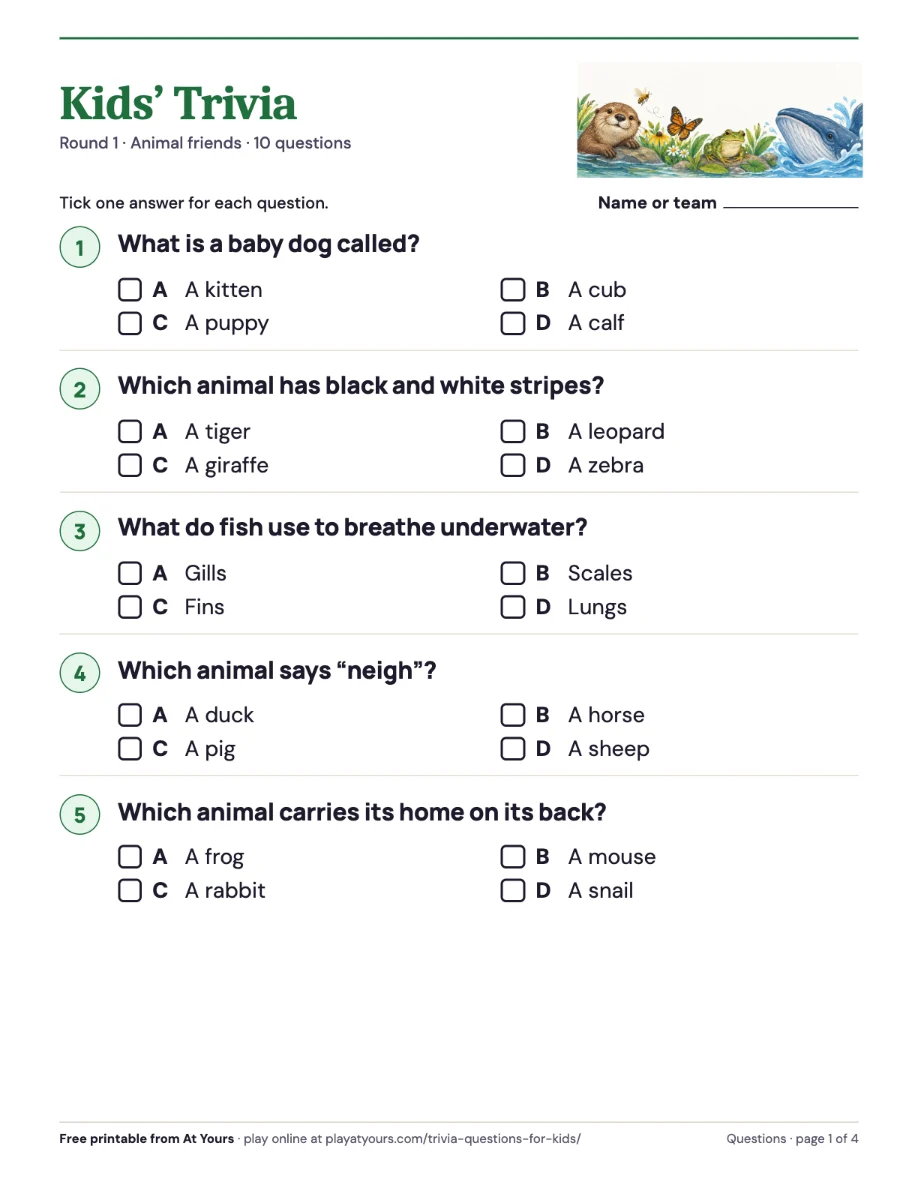
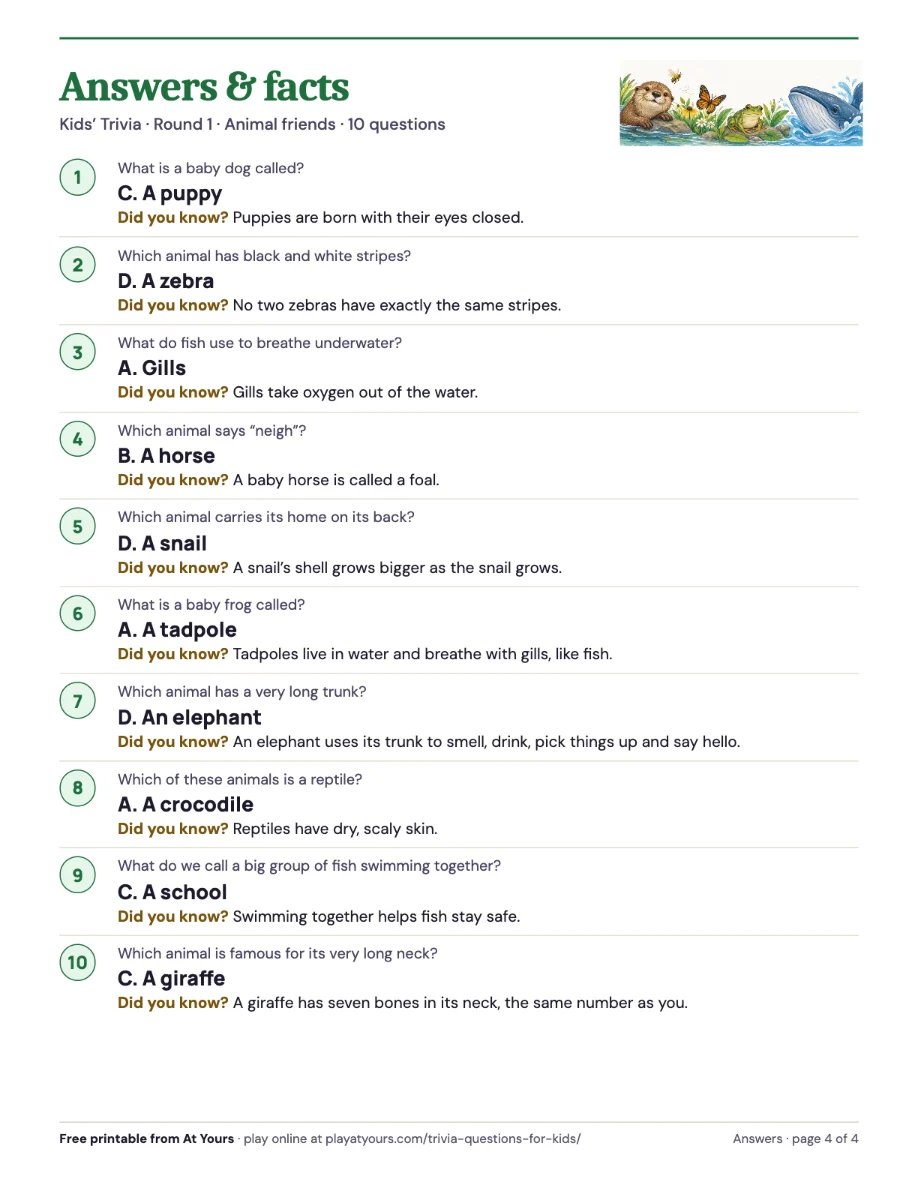
All 6 rounds: 60 questions in large print with tick boxes, each round with an answer page and every “Did you know?”. Printed from your browser on A4 or US Letter.
Four pages: round 1’s 10 questions in large print with tick boxes, a team answer sheet, then the answers with every “Did you know?”.
US Letter PDFA4 PDF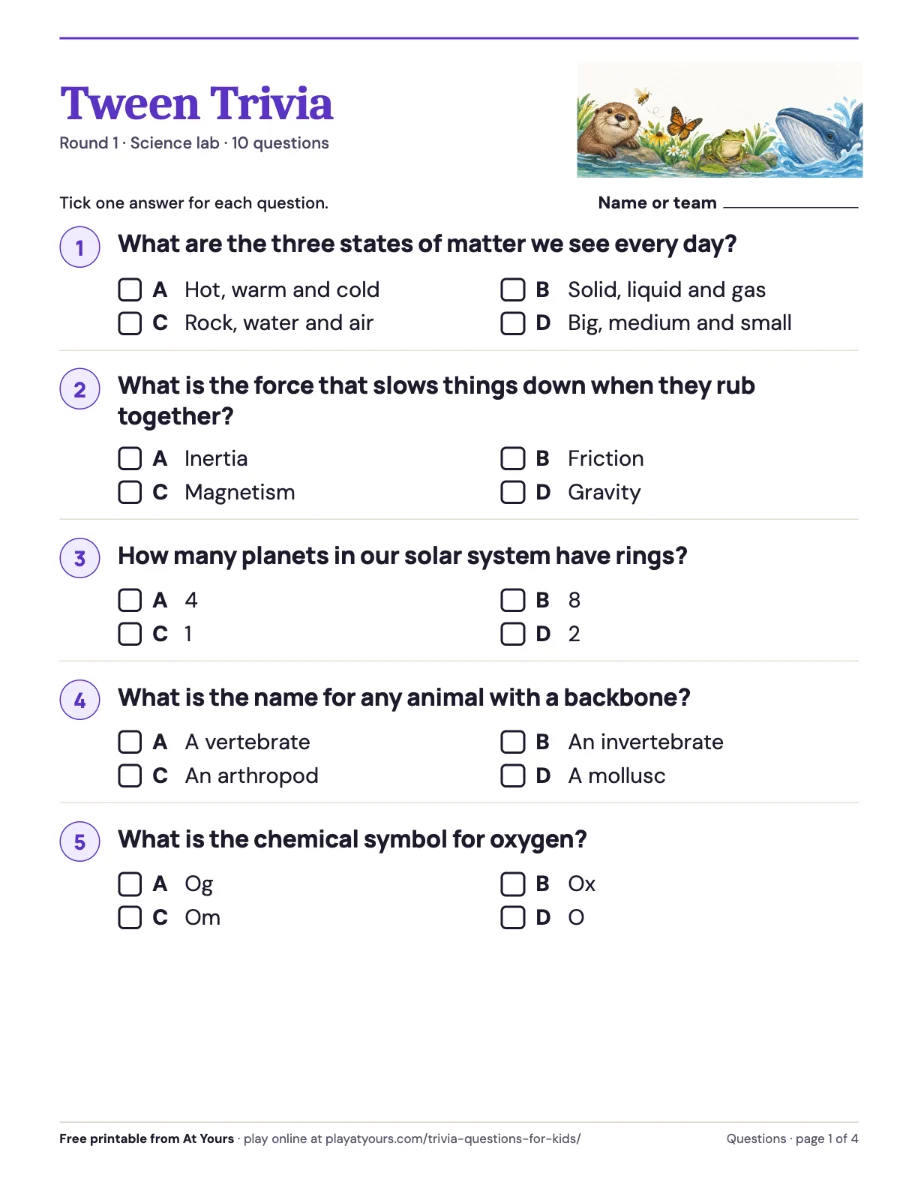
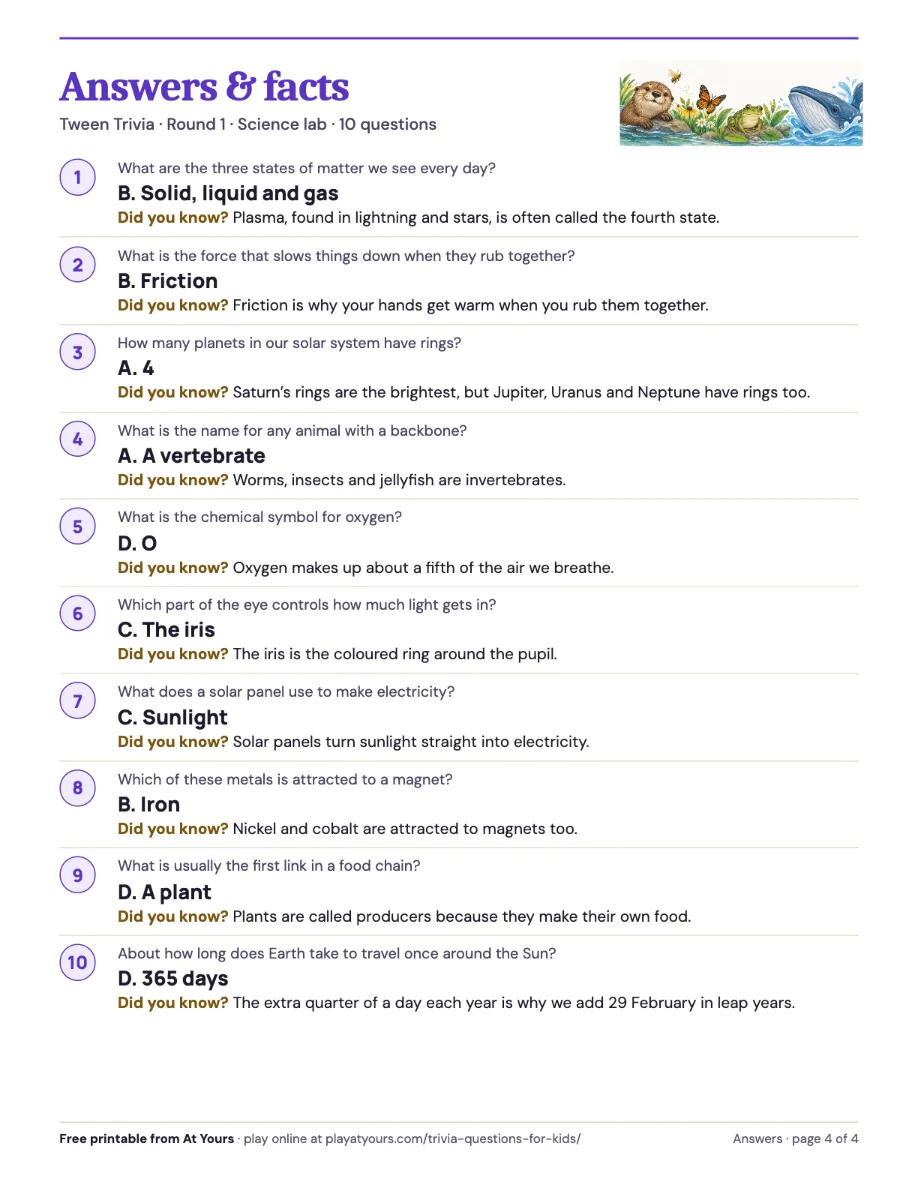
All 6 rounds: 60 questions in large print with tick boxes, each round with an answer page and every “Did you know?”. Printed from your browser on A4 or US Letter.
Keep rounds short, read every question aloud, and let children answer in teams so nobody is on the spot. A round of ten takes about 10 minutes.
| Time you have | Rounds and questions | How to pace it |
|---|---|---|
| 15 minutes | 1 round · 10 questions | Answered aloud. No paper needed. |
| 30 minutes | 2–3 rounds · 20–30 questions | Teams on paper. Read the scores after each round. |
| 45 minutes | 4 rounds · 40 questions | Take a short break after round 2. |
| About an hour | 6 rounds · 60 questions | A full quiz night. Save a favourite round for last. |
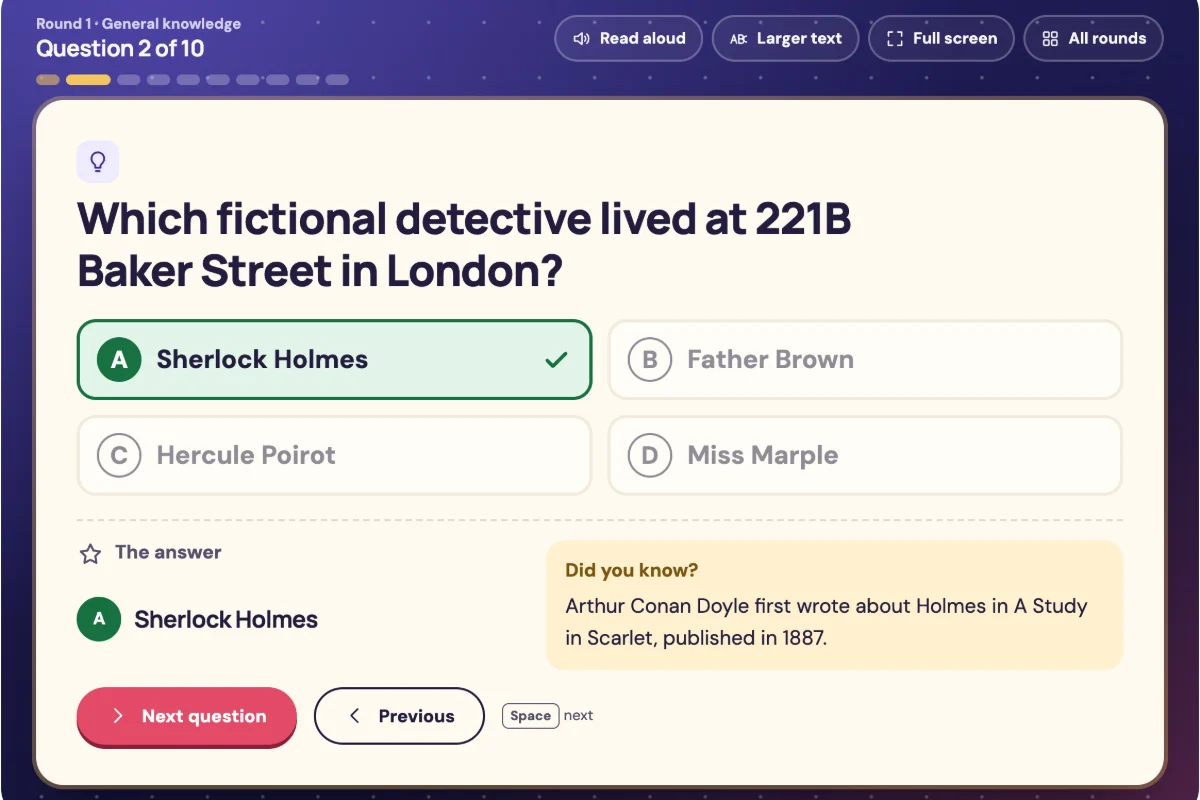
130 original questions with answers: ten categories from general knowledge to art, plus a taste of our funny, hard, kids and grown-up lists. Tap to reveal each answer, or play them as a quiz.
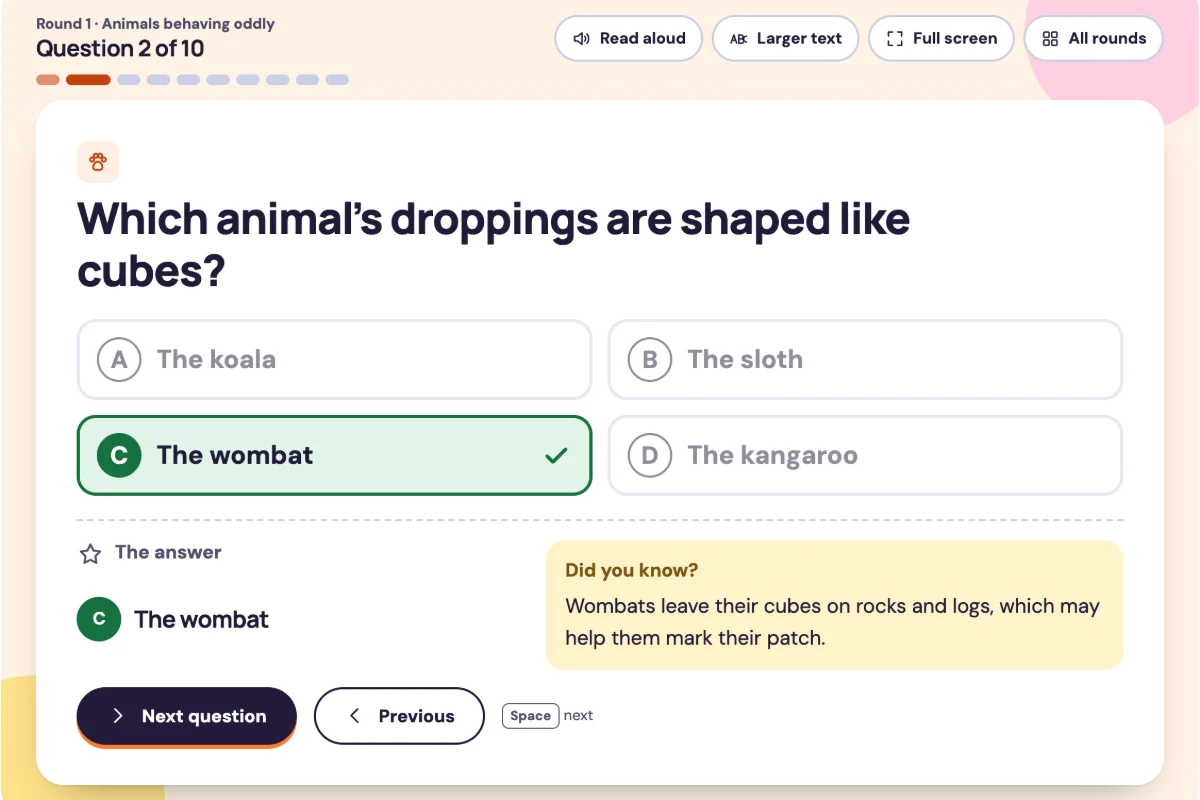
60 silly-sounding questions with completely true answers: cube-shaped droppings, pufflings and words that sound made up. Family-friendly, every one.
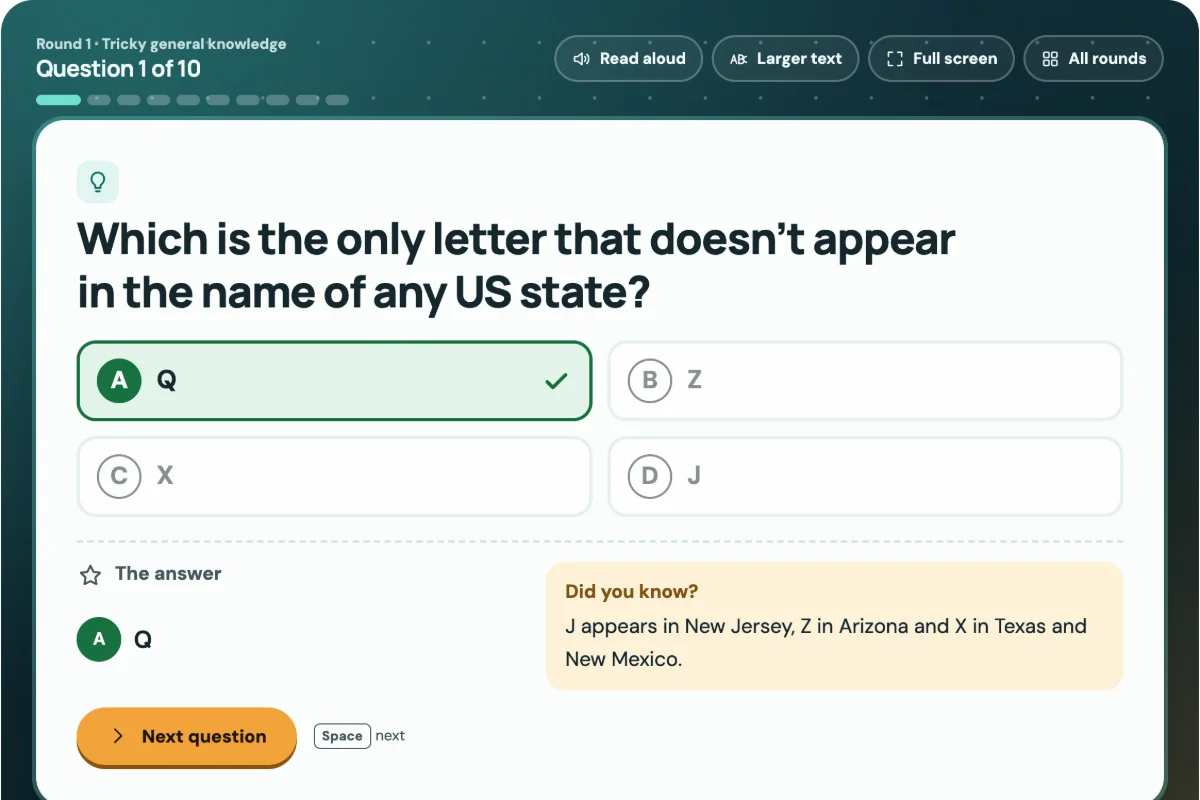
60 genuinely tough questions on science, geography, history, language and the arts. Fair, checked and free of trick wording.
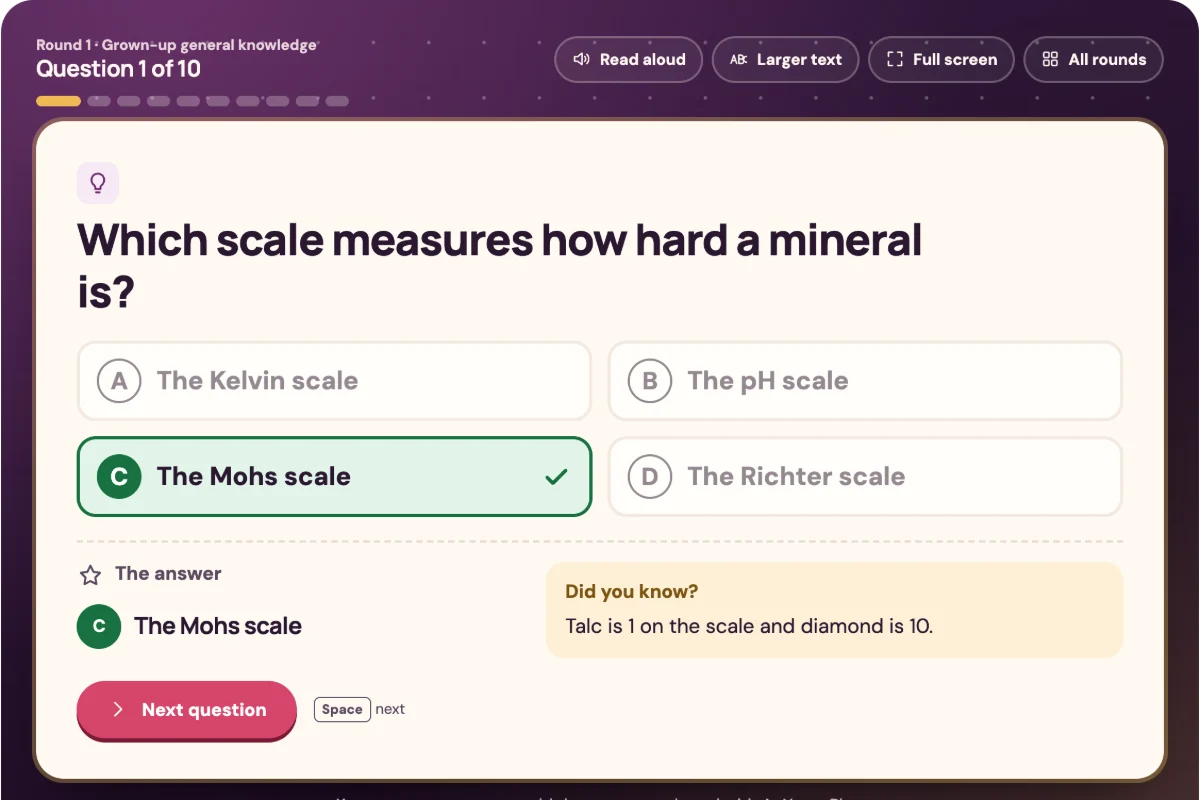
60 grown-up general knowledge questions: travel, classic films and books, science, food and history. Nothing explicit and no drinking games.
Every question on this page is free to read, and round 1 is free to play and print. The host’s At Yours Plus adds all 12 rounds of Kids’ Trivia and Tween Trivia to play on one screen or a TV, a team scoreboard for 2 to 6 teams, and the full large-print set, plus every other trivia pack, from Christmas to Thanksgiving. One host covers the whole room; guests never pay.
US$4.99/month or US$29/year. The link brings you back here, ready to play.
Short questions about things children know and love, with one clear answer: animals, space, food, stories and places. Four answer choices help younger players, and a fun fact afterwards keeps everyone interested, even when they get one wrong.
The kids set suits children of about 6 to 9, with a grown-up reading for younger ones. The tweens set is a step up for about 10 to 12: science, history, myths, sport and technology. Ages are a guide; many families mix both.
Yes. The tweens set has 60 questions that feel grown-up without being too hard: volcanoes and glaciers, Pompeii and printing presses, Greek myths, sport rules and how computers work. Every question has four options, so a good guess still has a chance.
Split children into small teams, read each question aloud, and let teams whisper before they answer. Show the question on a TV or whiteboard if you can. Give everyone a cheer for the fact, not just the right answer.
Yes, with a grown-up. Open this page and play on one screen: there’s no account, no chat and nothing to publish. A grown-up can choose larger text and hide the score in the settings.
Yes. Round 1 of each set is a free large-print PDF in A4 and US Letter, with a team answer sheet and an answer page. Teachers and parents can print it for the children they’re playing with. With At Yours Plus, the host can print every round.