Trivia questions
130 original questions with answers: ten categories from general knowledge to art, plus a taste of our funny, hard, kids and grown-up lists. Tap to reveal each answer, or play them as a quiz.
60 genuinely tough questions on science, geography, history, language and the arts. Fair, checked and free of trick wording.
Round 1 free to play · No sign-up · Print a free sheet
Hard trivia questions test what you really know rather than tricking you, like “Which is the only letter that doesn’t appear in the name of any US state?” Here are 60 in six rounds: tricky general knowledge, science, geography, history, language, and arts and literature. Each has four options, so even a tough one can be reasoned out, and each answer comes with a short fact.
Numbers, letters and things you half remember.
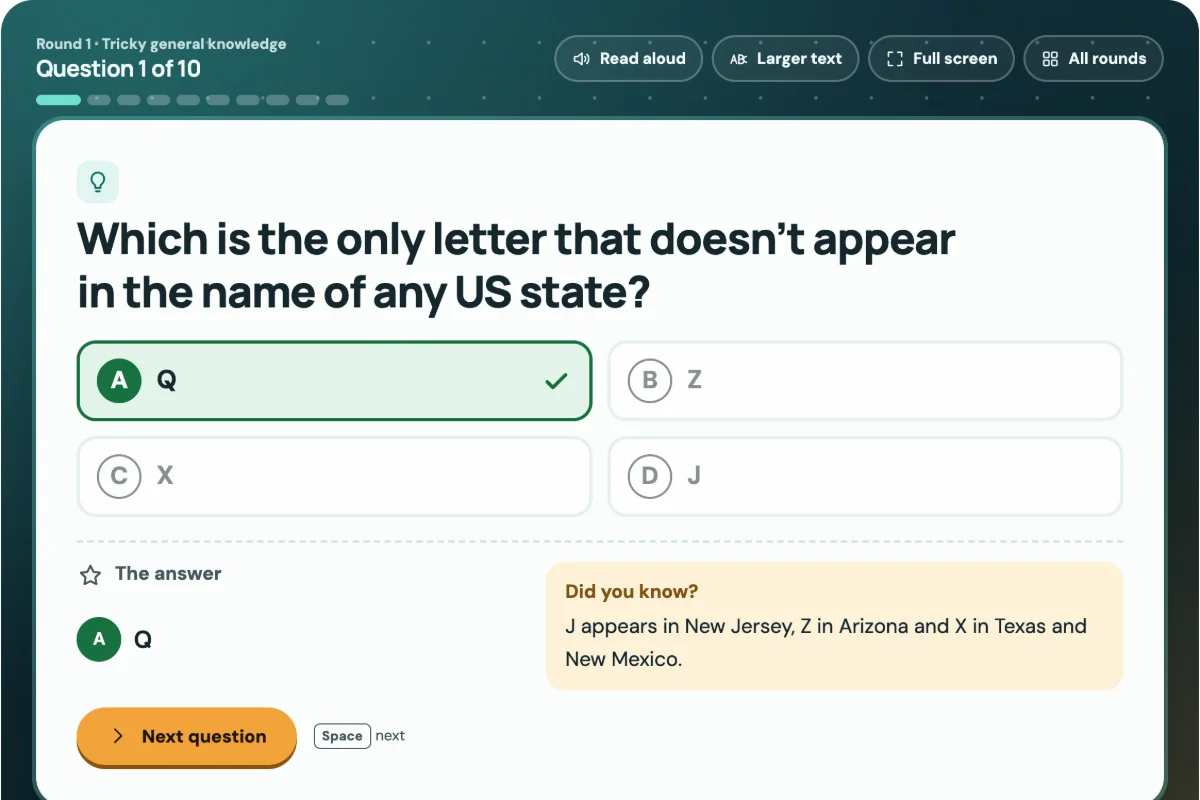
Which is the only letter that doesn’t appear in the name of any US state?
A. QB. ZC. XD. J
A. Q. J appears in New Jersey, Z in Arizona and X in Texas and New Mexico.
In Roman numerals, what year is MCMLXXX?
A. 1960B. 2080C. 1890D. 1980
D. 1980. M = 1,000, CM = 900, L = 50 and XXX = 30.
What is the smallest prime number?
A. 2B. 0C. 3D. 1
A. 2. 2 is also the only even prime number.
A googol is 1 followed by how many zeros?
A. 1,000B. 100C. 50D. 10
B. 100. The name was suggested by a nine-year-old, Milton Sirotta, the nephew of mathematician Edward Kasner.
How many faces does an octahedron have?
A. 12B. 6C. 10D. 8
D. 8. A cube has 6 faces, and a tetrahedron has 4.
Which wedding anniversary is traditionally the “golden” one?
A. 40thB. 60thC. 25thD. 50th
D. 50th. The 25th is silver, and the 40th is ruby.
China is wide enough to span five geographical time zones. How many official time zones does it use?
A. 3B. 1C. 4D. 5
B. 1. All of China officially runs on Beijing Time.
In heraldry, what colour is “sable”?
A. GreenB. RedC. GoldD. Black
D. Black. Red is “gules”, blue is “azure” and green is “vert”.
How many sides does a dodecagon have?
A. 12B. 10C. 11D. 20
A. 12. Its 3D cousin, the dodecahedron, has 12 faces.
What is measured in knots?
A. The strength of ropeB. The speed of ships and aircraftC. The height of wavesD. The depth of the sea
B. The speed of ships and aircraft. One knot is one nautical mile per hour, about 1.85 km/h.
Elements, cells and the speed of light.
What is the chemical symbol for potassium?
A. KB. PoC. PD. Pt
A. K. K comes from “kalium”, the element’s Latin name.
Which gas makes up most of the air we breathe?
A. Carbon dioxideB. ArgonC. NitrogenD. Oxygen
C. Nitrogen. Nitrogen is about 78% of the air, and oxygen about 21%.
What is the longest bone in the human body?
A. The humerusB. The femurC. The tibiaD. The fibula
B. The femur. Your femur is roughly a quarter of your height.
Which part of a cell releases energy from food?
A. The cell wallB. The mitochondriaC. The ribosomesD. The nucleus
B. The mitochondria. Mitochondria even have a small set of their own DNA.
Roughly how fast does light travel in a vacuum?
A. 300,000 km per hourB. 3,000 km per secondC. 300,000 km per secondD. 30,000 km per second
C. 300,000 km per second. At that speed, light could circle Earth about seven and a half times in one second.
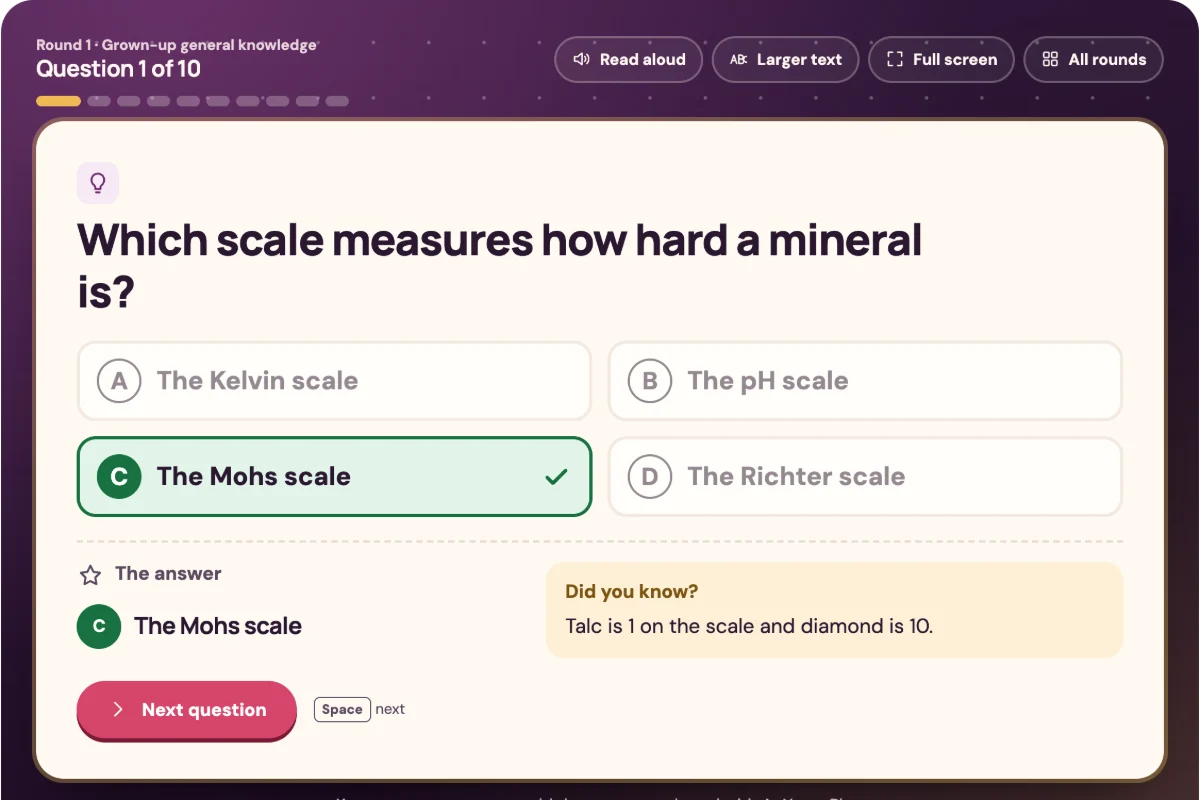
What is absolute zero on the Celsius scale?
A. −180 °CB. −459.67 °CC. −273.15 °CD. −100 °C
C. −273.15 °C. It’s the coldest temperature possible: zero on the Kelvin scale.
What is it called when plants lose water through tiny pores in their leaves?
A. RespirationB. PhotosynthesisC. GerminationD. Transpiration
D. Transpiration. Most of the water a plant takes up from the soil escapes this way.
What type of rock forms when lava or magma cools?
A. MetamorphicB. SedimentaryC. IgneousD. Limestone
C. Igneous. Granite and basalt are both igneous rocks.
What does DNA stand for?
A. Dynamic nuclear acidB. Deoxyribonucleic acidC. Dinitrogen acidD. Deoxyribose nitrate
B. Deoxyribonucleic acid. Its double-helix structure was described in 1953.
Which blood type is known as the universal donor for red blood cells?
A. AB positiveB. A negativeC. B positiveD. O negative
D. O negative. AB positive is known as the universal recipient.
Capitals, straits and rivers that aren’t the obvious ones.
What is the capital of New Zealand?
A. ChristchurchB. QueenstownC. AucklandD. Wellington
D. Wellington. Wellington took over from Auckland as the capital in 1865.
Which country was formerly known as Abyssinia?
A. SomaliaB. EritreaC. EthiopiaD. Sudan
C. Ethiopia. Ethiopia’s capital, Addis Ababa, means “new flower”.
What is the capital of Turkey?
A. IzmirB. IstanbulC. AnkaraD. Antalya
C. Ankara. Ankara became the capital in 1923, the year the Turkish Republic was founded.
Which strait separates Asia from North America?
A. The Strait of HormuzB. The Strait of GibraltarC. The Strait of MalaccaD. The Bering Strait
D. The Bering Strait. At its narrowest, it’s about 82 km (51 miles) wide.
Which sea has no coastline at all?
A. The Sargasso SeaB. The Dead SeaC. The Caspian SeaD. The Coral Sea
A. The Sargasso Sea. It lies in the Atlantic, and is bounded by ocean currents instead of land.
Lake Titicaca lies on the border between Peru and which other country?
A. ChileB. ColombiaC. EcuadorD. Bolivia
D. Bolivia. It sits about 3,800 m (12,500 feet) above sea level.
Which river flows through Baghdad?
A. The JordanB. The TigrisC. The EuphratesD. The Nile
B. The Tigris. The Tigris and Euphrates frame the region once called Mesopotamia.
In which country is Mount Kilimanjaro?
A. UgandaB. KenyaC. TanzaniaD. Ethiopia
C. Tanzania. Kilimanjaro is a dormant volcano with three volcanic cones.
The Atacama Desert lies mostly in which country?
A. BoliviaB. ArgentinaC. PeruD. Chile
D. Chile. Some parts of the Atacama go years without measurable rain.
Which of these capital cities stands on the River Danube?
A. WarsawB. BudapestC. BerlinD. Prague
B. Budapest. The Danube also flows through Vienna, Bratislava and Belgrade.
From Hastings to independence.
In which year was the Battle of Hastings?
A. 1066B. 1215C. 1415D. 966
A. 1066. William of Normandy defeated King Harold II there.
Who was the first woman to win a Nobel Prize?
A. Marie CurieB. Bertha von SuttnerC. Jane AddamsD. Mother Teresa
A. Marie Curie. She won twice: for physics in 1903 and for chemistry in 1911.
Which ancient wonder stood at the harbour of Rhodes?
A. The Hanging GardensB. The ColossusC. The LighthouseD. The Mausoleum
B. The Colossus. The giant bronze statue stood for only about half a century before an earthquake toppled it.
Which treaty, signed in 1919, formally ended the First World War with Germany?
A. The Treaty of VersaillesB. The Treaty of ParisC. The Treaty of UtrechtD. The Treaty of Ghent
A. The Treaty of Versailles. It was signed in the Hall of Mirrors at the Palace of Versailles.
The Rosetta Stone helped scholars decode which writing system?
A. Maya glyphsB. CuneiformC. Egyptian hieroglyphsD. Linear B
C. Egyptian hieroglyphs. Jean-François Champollion announced his breakthrough in 1822.
Which expedition completed the first voyage all the way around the world, in 1522?
A. Christopher Columbus’sB. James Cook’sC. Vasco da Gama’sD. The one begun by Ferdinand Magellan
D. The one begun by Ferdinand Magellan. Magellan was killed in the Philippines; Juan Sebastián Elcano led the last ship home.
What was the ancient network of trade routes linking China with the Mediterranean called?
A. The Spice LineB. The Jade TrailC. The Silk RoadD. The Amber Way
C. The Silk Road. The name “Silk Road” was coined by a German geographer in 1877.
Who was the first emperor of Rome?
A. NeroB. CaligulaC. Julius CaesarD. Augustus
D. Augustus. Julius Caesar was never emperor. His adopted heir, Octavian, became Augustus in 27 BC.
In which year did India gain independence from Britain?
A. 1950B. 1935C. 1962D. 1947
D. 1947. Jawaharlal Nehru became the country’s first prime minister.
Which ruler of Egypt formed alliances with both Julius Caesar and Mark Antony?
A. HatshepsutB. Ramesses IIC. NefertitiD. Cleopatra
D. Cleopatra. She ruled Egypt for about 21 years, until 30 BC.
Latin phrases, word origins and the names for things.
What does the Latin phrase “carpe diem” mean?
A. Know yourselfB. Love conquers allC. Time fliesD. Seize the day
D. Seize the day. The words come from a poem by the Roman poet Horace.
What is a “sesquipedalian” word?
A. A made-up wordB. A borrowed wordC. A rude wordD. A very long word
D. A very long word. Sesquipedalian literally means “a foot and a half long”.
Which language gave English the word “kindergarten”?
A. GermanB. DutchC. SwedishD. French
A. German. It means “children’s garden”.
What is a pangram?
A. A sentence that uses every letter of the alphabetB. A word that sounds like its meaningC. A poem with no rhymesD. A word with no vowels
A. A sentence that uses every letter of the alphabet. “The quick brown fox jumps over the lazy dog” is the best-known one.
What is a word that imitates the sound it describes, like “buzz” or “sizzle”, an example of?
A. MetaphorB. HyperboleC. AlliterationD. Onomatopoeia
D. Onomatopoeia. The word comes from Greek words meaning “name” and “make”.
Which word comes from the Arabic “al-jabr”?
A. AlchemyB. AlcoholC. AlgebraD. Alcove
C. Algebra. Al-jabr appears in the title of a 9th-century maths book by al-Khwarizmi.
What is the “&” symbol called?
A. An ampersandB. An asteriskC. A pilcrowD. An octothorpe
A. An ampersand. It grew out of the Latin word “et”, meaning “and”.
What does the abbreviation “e.g.” stand for?
A. Exactly givenB. Ergo generalisC. Et generaD. Exempli gratia
D. Exempli gratia. It means “for example”. “I.e.” stands for “id est”, meaning “that is”.
The word “robot” first appeared in a 1920 play by a writer from which country?
A. RussiaB. CzechoslovakiaC. GermanyD. Poland
B. Czechoslovakia. Karel Čapek’s play R.U.R. took the word from the Czech for forced labour.
What do you call a word blended from two others, like “brunch” or “smog”?
A. An acronymB. A portmanteauC. A homonymD. A spoonerism
B. A portmanteau. Lewis Carroll used the word portmanteau this way in Through the Looking-Glass.
Novels, operas and paintings.
Who wrote the novel One Hundred Years of Solitude?
A. Pablo NerudaB. Gabriel García MárquezC. Isabel AllendeD. Jorge Luis Borges
B. Gabriel García Márquez. It follows several generations of the Buendía family in the town of Macondo.
Which composer wrote the opera The Barber of Seville, first performed in 1816?
A. Wolfgang Amadeus MozartB. Gioachino RossiniC. Giacomo PucciniD. Giuseppe Verdi
B. Gioachino Rossini. Mozart’s earlier opera The Marriage of Figaro continues the same characters’ story.
In which city can you see Rembrandt’s The Night Watch?
A. AmsterdamB. The HagueC. BrusselsD. Antwerp
A. Amsterdam. It hangs in the Rijksmuseum.
Who wrote Pride and Prejudice?
A. Charlotte BrontëB. George EliotC. Jane AustenD. Mary Shelley
C. Jane Austen. It was published in 1813.
Who painted The Birth of Venus?
A. Sandro BotticelliB. RaphaelC. TitianD. Caravaggio
A. Sandro Botticelli. It hangs in the Uffizi Gallery in Florence.
How many lines does a traditional sonnet have?
A. 14B. 10C. 16D. 12
A. 14. Shakespeare wrote 154 of them.
Which Russian author wrote War and Peace?
A. Leo TolstoyB. Anton ChekhovC. Ivan TurgenevD. Fyodor Dostoevsky
A. Leo Tolstoy. It follows Russian families through the Napoleonic Wars.
Which artist made The Scream?
A. Gustav KlimtB. Egon SchieleC. Edvard MunchD. Wassily Kandinsky
C. Edvard Munch. Munch made several versions, in paint and in pastel.
Which poet wrote “The Raven”?
A. Robert FrostB. Walt WhitmanC. Emily DickinsonD. Edgar Allan Poe
D. Edgar Allan Poe. It was first published in 1845.
How many different notes are in a chromatic scale before it repeats?
A. 8B. 12C. 10D. 7
B. 12. An octave is made of 12 semitones.
Six rounds of ten. Round 1, tricky general knowledge, is free: play it on this screen, or choose Host on a TV for teams.
10 questions · Numbers, letters and things you half remember.
Round 1 is free · no account
Getting the questions ready…
The actual pages, free in A4 and US Letter. Print one question sheet per team, and keep the answers for the host.
Four pages: round 1’s 10 questions in large print with tick boxes, a team answer sheet, then the answers with every “Did you know?”.
US Letter PDFA4 PDF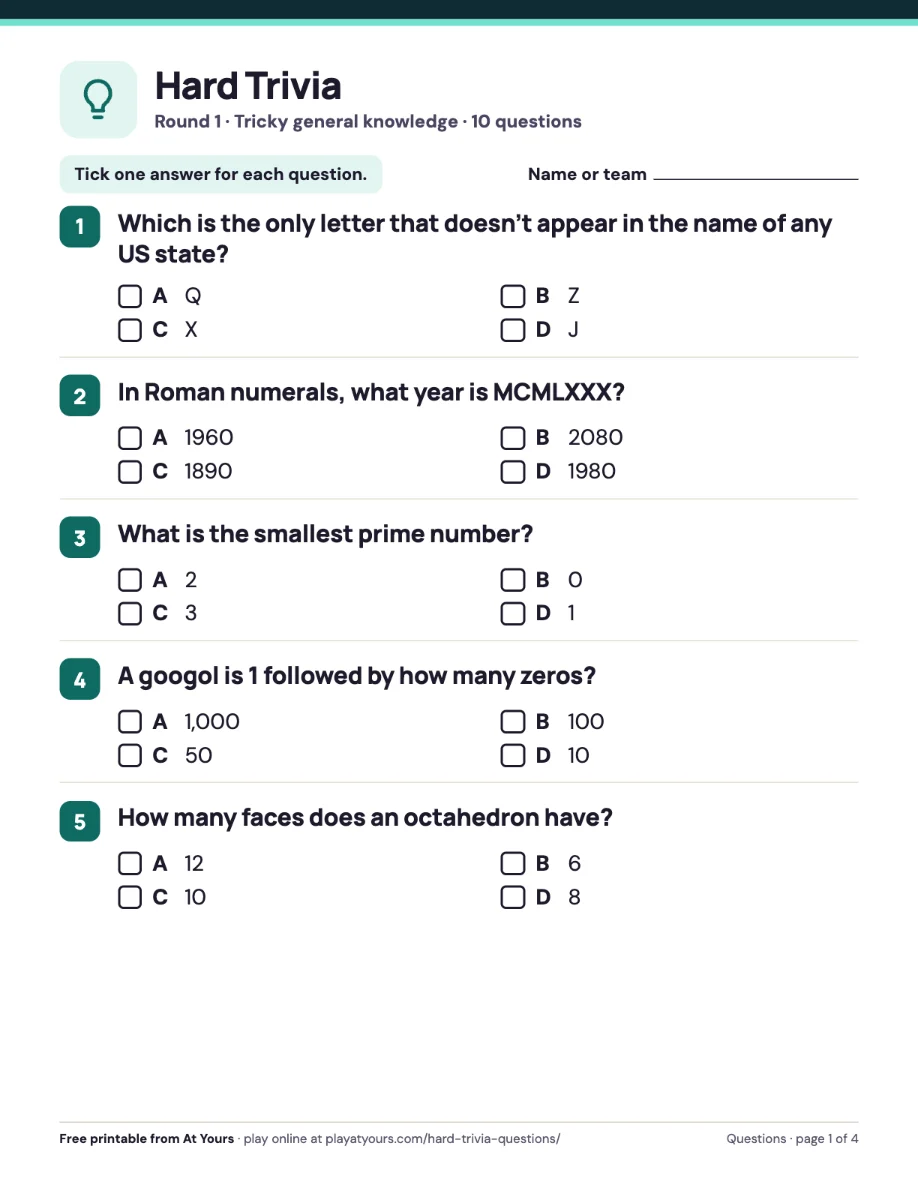
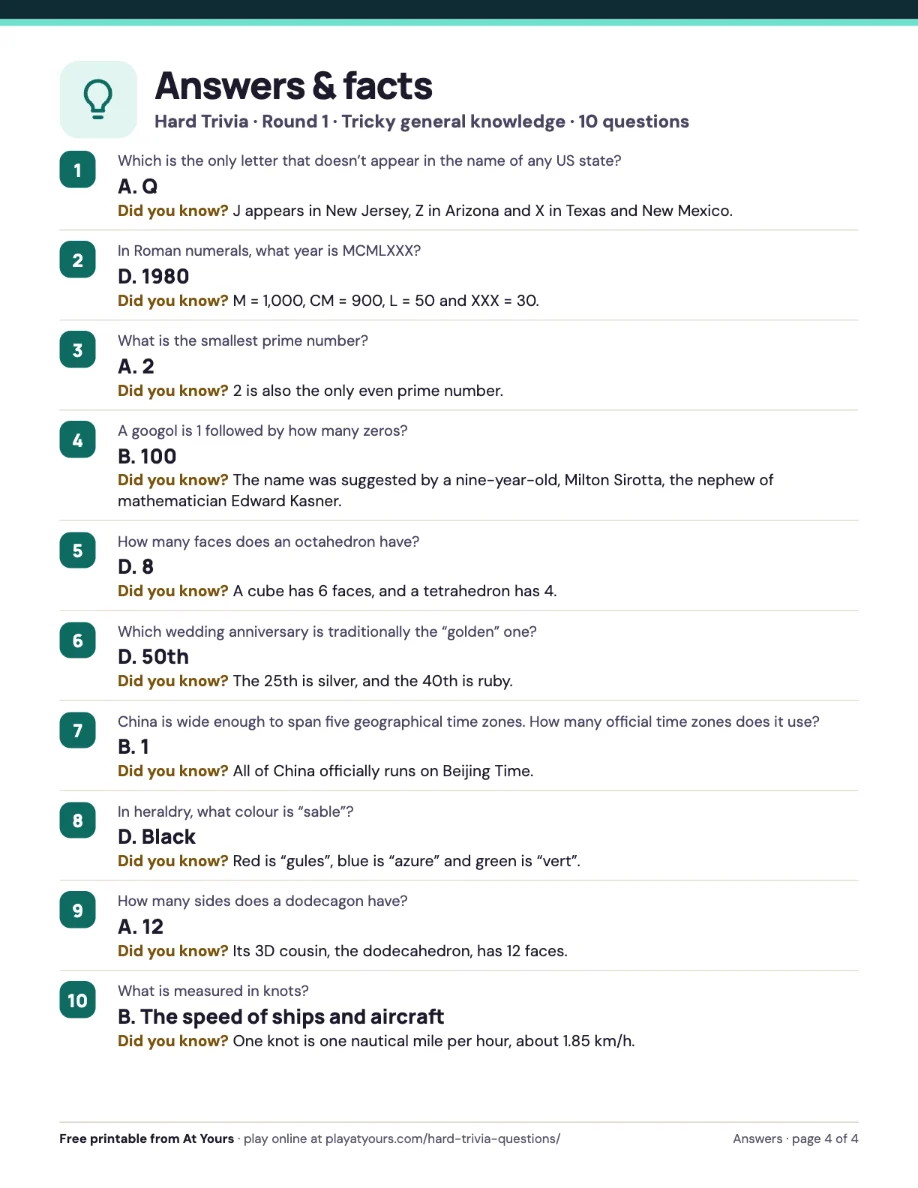
All 6 rounds: 60 questions in large print with tick boxes, each round with an answer page and every “Did you know?”. Printed from your browser on A4 or US Letter.
Hard questions land best between easier ones. Open with a round everyone can score in, then bring out the tough rounds when teams are warmed up.
| Time you have | Rounds and questions | How to pace it |
|---|---|---|
| 15 minutes | 1 round · 10 questions | Answered aloud. No paper needed. |
| 30 minutes | 2–3 rounds · 20–30 questions | Teams on paper. Read the scores after each round. |
| 45 minutes | 4 rounds · 40 questions | Take a short break after round 2. |
| About an hour | 6 rounds · 60 questions | A full quiz night. Save a favourite round for last. |
130 original questions with answers: ten categories from general knowledge to art, plus a taste of our funny, hard, kids and grown-up lists. Tap to reveal each answer, or play them as a quiz.
60 grown-up general knowledge questions: travel, classic films and books, science, food and history. Nothing explicit and no drinking games.
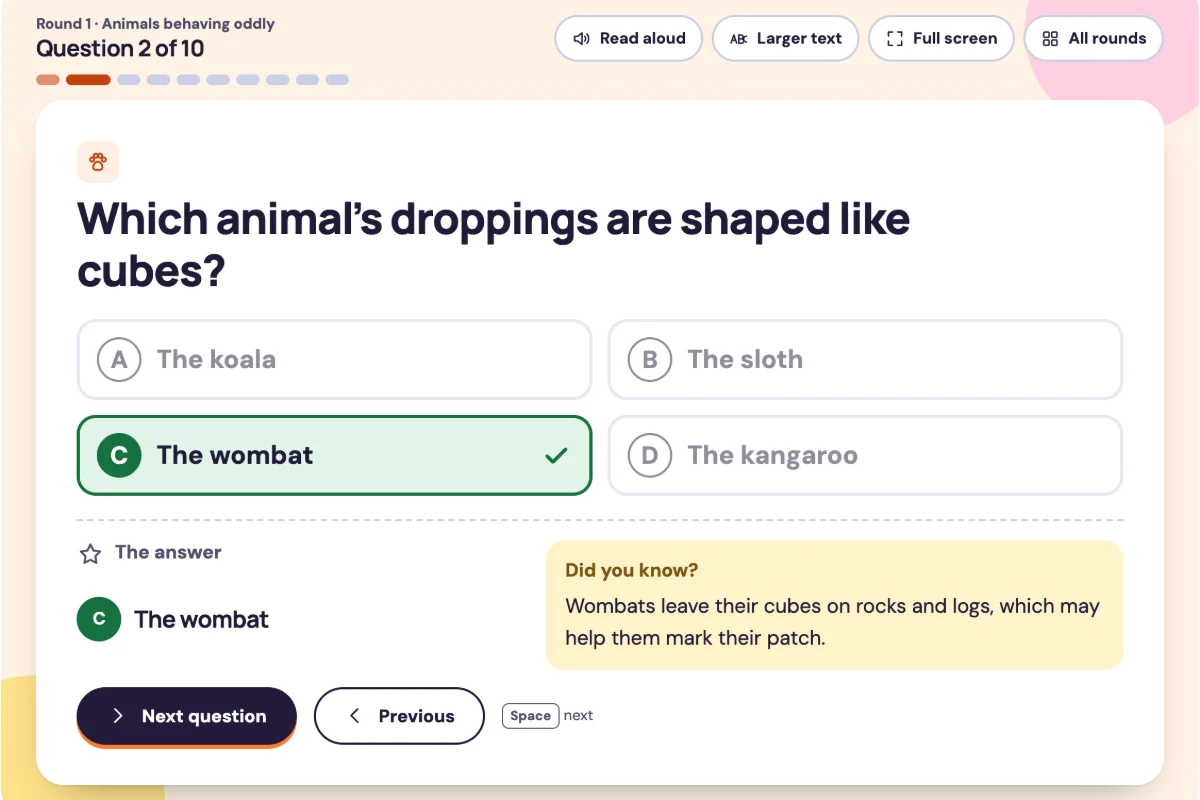
60 silly-sounding questions with completely true answers: cube-shaped droppings, pufflings and words that sound made up. Family-friendly, every one.
Two sets of questions: 60 for kids of about 6 to 9 and 60 for tweens of about 10 to 12. Read them aloud, reveal the answers, or play them as a quiz on one screen.
Every question on this page is free to read, and round 1 is free to play and print. The host’s At Yours Plus adds all 6 rounds of Hard Trivia to play on one screen or a TV, a team scoreboard for 2 to 6 teams, and the full large-print set, plus every other trivia pack, from Christmas to Thanksgiving. One host covers the whole room; guests never pay.
US$4.99/month or US$29/year. The link brings you back here, ready to play.
A hard question needs real knowledge or careful reasoning, not a trick. “What is the capital of New Zealand?” is hard because many people guess the biggest city. A fair hard question still has one clear answer that you recognise when you hear it.
Some will be. For a mixed room, play one hard round between easier ones from the main trivia questions, or let teams work together. Four options mean even a wild guess has a one-in-four chance.
We checked every answer against standard references, and left out anything disputed or likely to change, such as records and rankings. If you think one is wrong, email hello@playatyours.com and we’ll look again.
One point per right answer works well. Some hosts give hard rounds double points, or let each team play one joker round for double. If two teams tie, ask one more question where the closest year or number wins.
60, in six rounds of ten. Round 1 is free to play and print. The host’s At Yours Plus opens the other five rounds, the team scoreboard and the full printable set.