Trivia questions
130 original questions with answers: ten categories from general knowledge to art, plus a taste of our funny, hard, kids and grown-up lists. Tap to reveal each answer, or play them as a quiz.
60 silly-sounding questions with completely true answers: cube-shaped droppings, pufflings and words that sound made up. Family-friendly, every one.
Round 1 free to play · No sign-up · Print a free sheet
Funny trivia questions are real questions with surprising, true answers, like “Which animal’s droppings are shaped like cubes?” Here are 60 in six rounds: odd animals, strange food, words that sound made up, everyday oddities, weird science and strange-but-true facts. Every answer was checked, and every question is family-friendly. Reveal the answers one at a time, or play them as a quiz on one screen or a TV.
Pufflings, cubes and very sleepy dolphins.
What is a group of flamingos called?
A. A sparkleB. A giggleC. A flamboyanceD. A pinkness
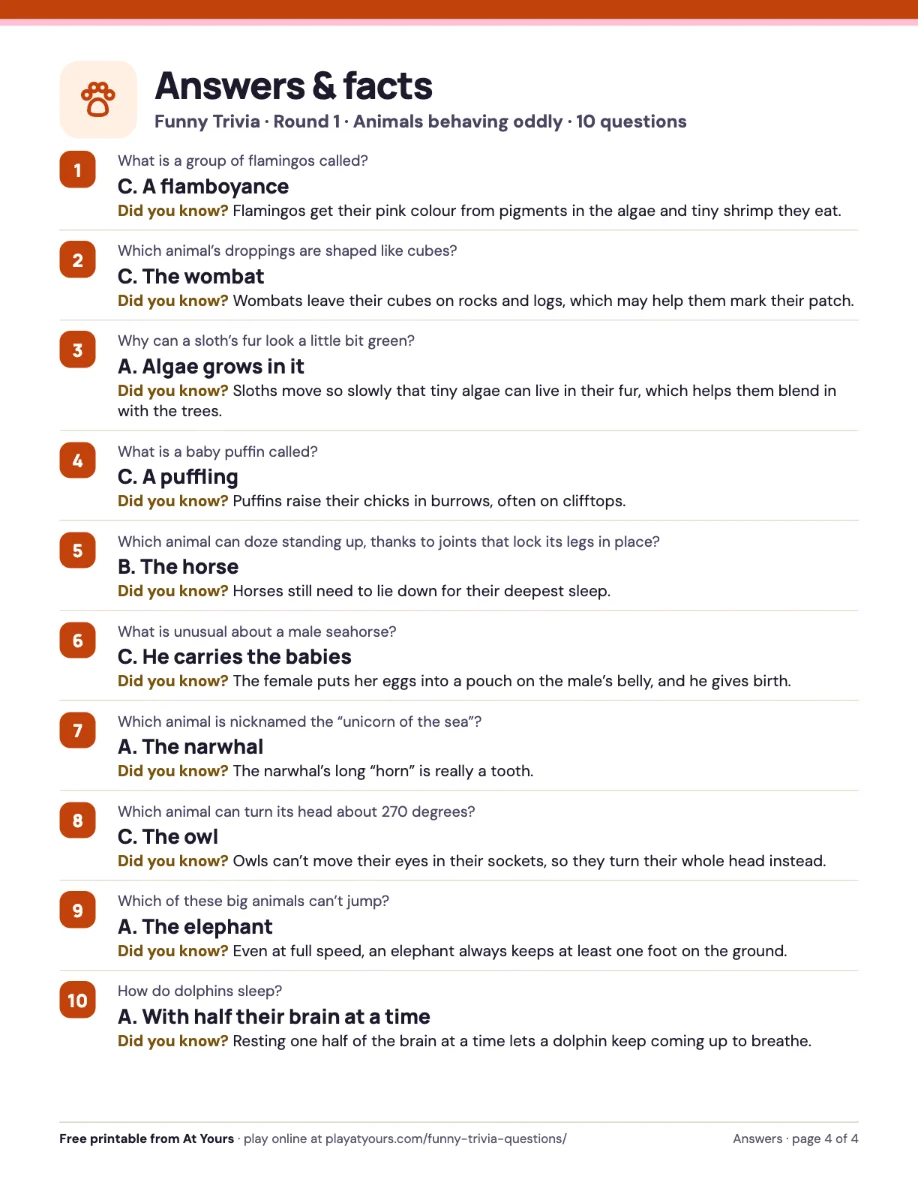
C. A flamboyance. Flamingos get their pink colour from pigments in the algae and tiny shrimp they eat.
Which animal’s droppings are shaped like cubes?
A. The koalaB. The slothC. The wombatD. The kangaroo
C. The wombat. Wombats leave their cubes on rocks and logs, which may help them mark their patch.
Why can a sloth’s fur look a little bit green?
A. Algae grows in itB. It changes colour like a chameleonC. It rolls in grassD. It eats green leaves
A. Algae grows in it. Sloths move so slowly that tiny algae can live in their fur, which helps them blend in with the trees.
What is a baby puffin called?
A. A puffballB. A puffkinC. A pufflingD. A pufflet
C. A puffling. Puffins raise their chicks in burrows, often on clifftops.
Which animal can doze standing up, thanks to joints that lock its legs in place?
A. The rabbitB. The horseC. The dogD. The cat
B. The horse. Horses still need to lie down for their deepest sleep.
What is unusual about a male seahorse?
A. He can live on landB. He can flyC. He carries the babiesD. He changes into a female every spring
C. He carries the babies. The female puts her eggs into a pouch on the male’s belly, and he gives birth.
Which animal is nicknamed the “unicorn of the sea”?
A. The narwhalB. The dolphinC. The swordfishD. The manatee
A. The narwhal. The narwhal’s long “horn” is really a tooth.
Which animal can turn its head about 270 degrees?
A. The frogB. The catC. The owlD. The parrot
C. The owl. Owls can’t move their eyes in their sockets, so they turn their whole head instead.
Which of these big animals can’t jump?
A. The elephantB. The kangarooC. The horseD. The deer
A. The elephant. Even at full speed, an elephant always keeps at least one foot on the ground.
How do dolphins sleep?
A. With half their brain at a timeB. Floating upside downC. They never sleepD. Hanging from rocks
A. With half their brain at a time. Resting one half of the brain at a time lets a dolphin keep coming up to breathe.
The surprising truth about lunch.
Botanically speaking, which of these is a berry?
A. A blackberryB. A strawberryC. A bananaD. A raspberry
C. A banana. Strawberries and raspberries aren’t true berries, but bananas, grapes and tomatoes are.
Before orange ones became common, what colour were most carrots?
A. Black or whiteB. Blue or greenC. Purple or yellowD. Pink or grey
C. Purple or yellow. Orange carrots were developed by growers in the Netherlands in the 1600s.
The Italian dessert tiramisu gets its name from a phrase meaning what?
A. Pick me upB. Sweet dreamsC. Grandma’s secretD. Little cloud
A. Pick me up. It layers coffee-soaked biscuits with a creamy mascarpone mixture.
A cashew nut grows at the bottom of which fruit?
A. A cashew berryB. A cashew plumC. A cashew pearD. A cashew apple
D. A cashew apple. Each cashew apple has just one nut hanging beneath it.
Which pasta’s name means “little worms” in Italian?
A. SpaghettiB. VermicelliC. LinguineD. Fusilli
B. Vermicelli. Spaghetti means “little strings”, and linguine means “little tongues”.
Where do pineapples grow?
A. On tall palm treesB. On a low, leafy plant on the groundC. Underground, like potatoesD. On climbing vines
B. On a low, leafy plant on the ground. A pineapple plant usually grows one fruit at a time, and it can take well over a year.
The Aztecs prized which frothy, often spicy drink?
A. Coconut milkB. ChocolateC. TeaD. Coffee
B. Chocolate. Cacao beans were so valuable to the Aztecs that they were used as money.
Why does chopping an onion make your eyes water?
A. Its smell is sadB. It releases a gas that stings your eyesC. Its skin is sharpD. Its juice is salty
B. It releases a gas that stings your eyes. Chilling an onion before you cut it can make it less of a tear-jerker.
Brussels sprouts are named after Brussels, the capital of which country?
A. FranceB. BelgiumC. The NetherlandsD. Luxembourg
B. Belgium. Sprouts grow in tight spirals up a tall, thick stalk.
A “Bombay duck” is actually what?
A. A dumplingB. A duckC. A pickleD. A fish
D. A fish. It’s a lizardfish, often eaten dried and salted.
Real words, honestly.
What is the little plastic or metal tip on the end of a shoelace called?
A. An agletB. A grommetC. A widgetD. A doohickey
A. An aglet. Aglets stop the lace from fraying and make it easier to thread.
What is the dot over a lowercase “i” or “j” called?
A. A speckB. A blipC. A tittleD. A jot
C. A tittle. The old phrase “every jot and tittle” means every tiny detail.
What is the rumbling sound your stomach makes called?
A. RumbilusB. BorborygmusC. HiccupitisD. Gurglation
B. Borborygmus. It comes from a Greek word that imitates the sound itself.
What is the little groove between your nose and your upper lip called?
A. The philtrumB. The palateC. The lobuleD. The septum
A. The philtrum. Most mammals have a philtrum.
What is a “snollygoster”?
A. A kind of snowballB. A winter coatC. A small sea snailD. A clever, sneaky schemer
D. A clever, sneaky schemer. It’s old American slang, often aimed at crafty politicians.
What would you do with a “bumbershoot”?
A. Wear it on your feetB. Keep the rain offC. Play it like a drumD. Eat it for breakfast
B. Keep the rain off. Bumbershoot is an old, playful American word for an umbrella.
If you feel “discombobulated”, how do you feel?
A. HungryB. ConfusedC. SleepyD. Brave
B. Confused. The word was made up as a playful, fancy-sounding word in 1800s America.
What is the 36-letter joke word for a fear of long words?
A. ClaustrophobiaB. HippopotomonstrosesquippedaliophobiaC. AcrophobiaD. Arachnophobia
B. Hippopotomonstrosesquippedaliophobia. It isn’t a medical term. It’s a joke built partly from “hippopotamus” and “monster”.
If a picture hangs “cattywampus”, how is it hanging?
A. Very highB. Perfectly straightC. CrookedD. Upside down
C. Crooked. It’s a folksy American word, also spelled “catawampus”.
What is the smooth patch of skin between your eyebrows called?
A. The browletB. The nosebridgeC. The glabellaD. The forelock
C. The glabella. Doctors use the word glabella for that spot just above the nose.
The surprising stories behind ordinary things.
Bubble wrap was first tried as what?
A. Textured wallpaperB. A swimming pool coverC. A raincoatD. A pillow
A. Textured wallpaper. Its inventors tried selling it as wallpaper in 1957 before it found its true job: packing.
Why do many pen caps have a small hole in the top?
A. So air can pass through if a cap is swallowedB. To make a whistleC. To help the ink dryD. To make the pen lighter
A. So air can pass through if a cap is swallowed. The hole is a safety feature, to reduce the risk of choking.
The tiny pocket inside the front pocket of jeans was first meant for what?
A. MatchesB. Bus ticketsC. A pocket watchD. A lucky charm
C. A pocket watch. Today it’s more likely to hold coins, keys or a guitar pick.
In 1974, the first product ever scanned at a US supermarket checkout was what?
A. A pack of chewing gumB. A box of eggsC. A can of soupD. A loaf of bread
A. A pack of chewing gum. It was scanned in Troy, Ohio, and the pack is now in the Smithsonian.
Before rubber erasers, what did people often use to rub out pencil marks?
A. SoapB. BreadC. ButterD. Cheese
B. Bread. Rubber got its English name because it could “rub out” pencil.
Which was invented first: the tin can or the can opener?
A. The tin canB. The can openerC. Neither: they came together in one boxD. Both in the same year
A. The tin can. Early cans were opened with a hammer and chisel. Can openers came decades later.
What does the “Q” in QR code stand for?
A. QualityB. QuickC. QuestionD. Queue
B. Quick. QR codes were invented in 1994 to track car parts in Japanese factories.
Why do golf balls have dimples?
A. They help the ball fly fartherB. They make it lighterC. They stop it rolling awayD. They are just for decoration
A. They help the ball fly farther. The dimples change how air flows around the ball and cut down drag.
The idea for hook-and-loop fasteners came from what?
A. Burrs stuck to a dog’s furB. Fish scalesC. A spider’s webD. A bird’s nest
A. Burrs stuck to a dog’s fur. Swiss engineer George de Mestral noticed the clingy burrs after a walk in 1941.
What is the metal band that holds an eraser on the end of a pencil called?
A. A rivetB. A grommetC. A ferruleD. An aglet
C. A ferrule. Ferrules also hold the bristles on paintbrushes.
Hiccups, goosebumps and brain freeze.
What causes hiccups?
A. Air trapped in your earsB. Sudden squeezes of the diaphragmC. Swallowing a flyD. Eating too much salt
B. Sudden squeezes of the diaphragm. The “hic” sound comes from your vocal cords snapping shut.
Which weighs more: a kilogram of feathers or a kilogram of bricks?
A. The bricksB. The feathersC. It depends on the weatherD. They weigh the same
D. They weigh the same. A kilogram is a kilogram, whatever it’s made of. The feathers just take up more room.
What are goosebumps for, in furry animals?
A. Cooling them downB. Growing new furC. Fluffing up their fur to keep warmD. Helping them hear
C. Fluffing up their fur to keep warm. In people, goosebumps are left over from our much hairier ancestors.
Why does your voice sound strange when you hear a recording of it?
A. You normally hear it partly through the bones of your headB. Microphones change its pitchC. Recordings are slowed downD. Your ears are blocked while you talk
A. You normally hear it partly through the bones of your head. Bones carry the lower tones, so your own voice usually sounds deeper to you.
What causes a “brain freeze” when you eat ice cream fast?
A. Your teeth shrinkingB. Your brain actually freezingC. Sugar rushing to your headD. Blood vessels in your mouth reacting to the cold
D. Blood vessels in your mouth reacting to the cold. Pressing your tongue to the roof of your mouth can help it pass.
Why can’t sound travel through space?
A. It moves too fastB. There’s no air to carry itC. The Sun blocks itD. It’s too cold
B. There’s no air to carry it. Sound needs something to travel through, such as air, water or a solid wall.
Why does the sky look blue on a sunny day?
A. It reflects the oceansB. Space is blueC. Air scatters blue light more than other coloursD. Clouds are blue inside
C. Air scatters blue light more than other colours. At sunset, light passes through more air, so more blue is scattered away and reds and oranges are left.
Why can’t you tickle yourself?
A. Your brain predicts your own touchB. You laugh too earlyC. Your skin is too thickD. Your fingers are too warm
A. Your brain predicts your own touch. The brain dulls the feeling of movements it is expecting.
What is the scientific word for the tingling “pins and needles” feeling?
A. SciaticaB. InsomniaC. VertigoD. Paresthesia
D. Paresthesia. It often happens when pressure on a nerve briefly squashes its signals.
Why does a cut apple turn brown?
A. The knife was dirtyB. Its flesh reacts with oxygen in the airC. It’s going mouldyD. Sunlight bleaches it
B. Its flesh reacts with oxygen in the air. A squeeze of lemon juice slows the browning down.
Facts that sound like fibs.
Which country has more ancient pyramids than Egypt?
A. SudanB. ItalyC. PeruD. Greece
A. Sudan. The pyramids of the ancient kingdom of Kush, in Sudan, are smaller and steeper than Egypt’s.
What is the national animal of Scotland?
A. The dragonB. The phoenixC. The unicornD. The griffin
C. The unicorn. Wales has a red dragon on its flag.
Which is wider: Australia or the Moon?
A. AustraliaB. It changes with the seasonsC. They’re exactly the sameD. The Moon
A. Australia. Australia is about 4,000 km (2,500 miles) across; the Moon is about 3,475 km (2,160 miles).
Which of these words can you type using only the top row of letters on a standard keyboard?
A. QuestionB. TypewriterC. KeyboardD. Computer
B. Typewriter. Every letter in “typewriter” sits on the Q-W-E-R-T-Y-U-I-O-P row.
Why can the Eiffel Tower be a few centimetres taller in summer?
A. It sinks in winterB. Its iron expands in the heatC. Its lift is raisedD. It’s repainted every summer
B. Its iron expands in the heat. Metal expands as it warms and shrinks again as it cools.
In which country is there a city called Batman?
A. CanadaB. ItalyC. JapanD. Turkey
D. Turkey. Batman is a city and province in southeastern Turkey, named after the Batman River.
Which country’s flag is not a rectangle?
A. BrazilB. NepalC. BhutanD. Japan
B. Nepal. Nepal’s flag is made of two stacked triangles.
On a film set, what is a “best boy”?
A. A chief assistant on the lighting or rigging crewB. The youngest actorC. The director’s favourite takeD. A stunt double
A. A chief assistant on the lighting or rigging crew. The best boy works with the gaffer, who is in charge of the lights.
How did the sandwich get its name?
A. From picnics on sandy beachesB. From a town of bakersC. From the Earl of SandwichD. From a Roman emperor
C. From the Earl of Sandwich. The 4th Earl of Sandwich is said to have liked meat between bread so he could eat without stopping what he was doing.
Which planet is less dense than water, so it would float in a big enough bath?
A. EarthB. SaturnC. JupiterD. Mars
B. Saturn. Saturn is made mostly of hydrogen and helium.
Six rounds of ten. Round 1, animals behaving oddly, is free: play it on this screen, or choose Host on a TV for teams.
10 questions · Pufflings, cubes and very sleepy dolphins.
Round 1 is free · no account
Getting the questions ready…
The actual pages, free in A4 and US Letter. Print one question sheet per team, and keep the answers for the host.
Four pages: round 1’s 10 questions in large print with tick boxes, a team answer sheet, then the answers with every “Did you know?”.
US Letter PDFA4 PDF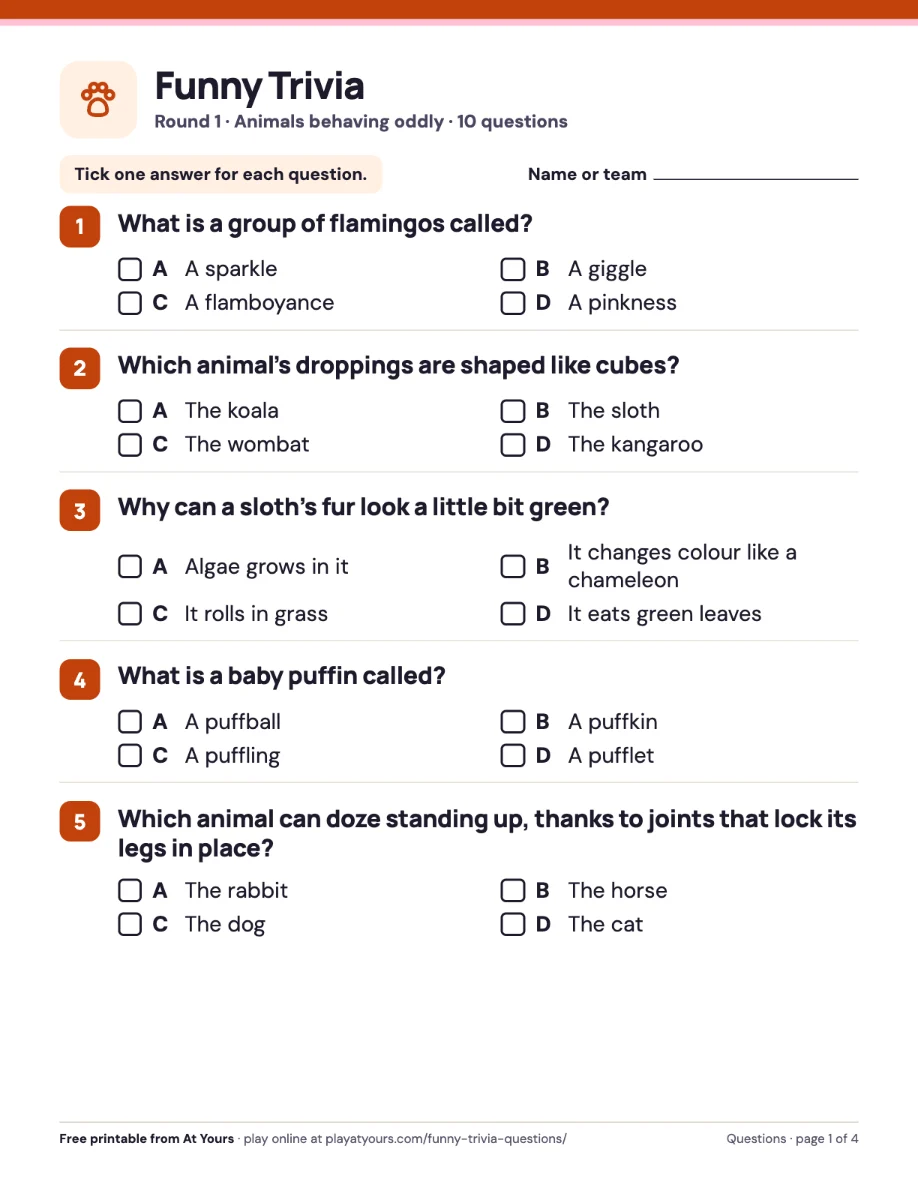
All 6 rounds: 60 questions in large print with tick boxes, each round with an answer page and every “Did you know?”. Printed from your browser on A4 or US Letter.
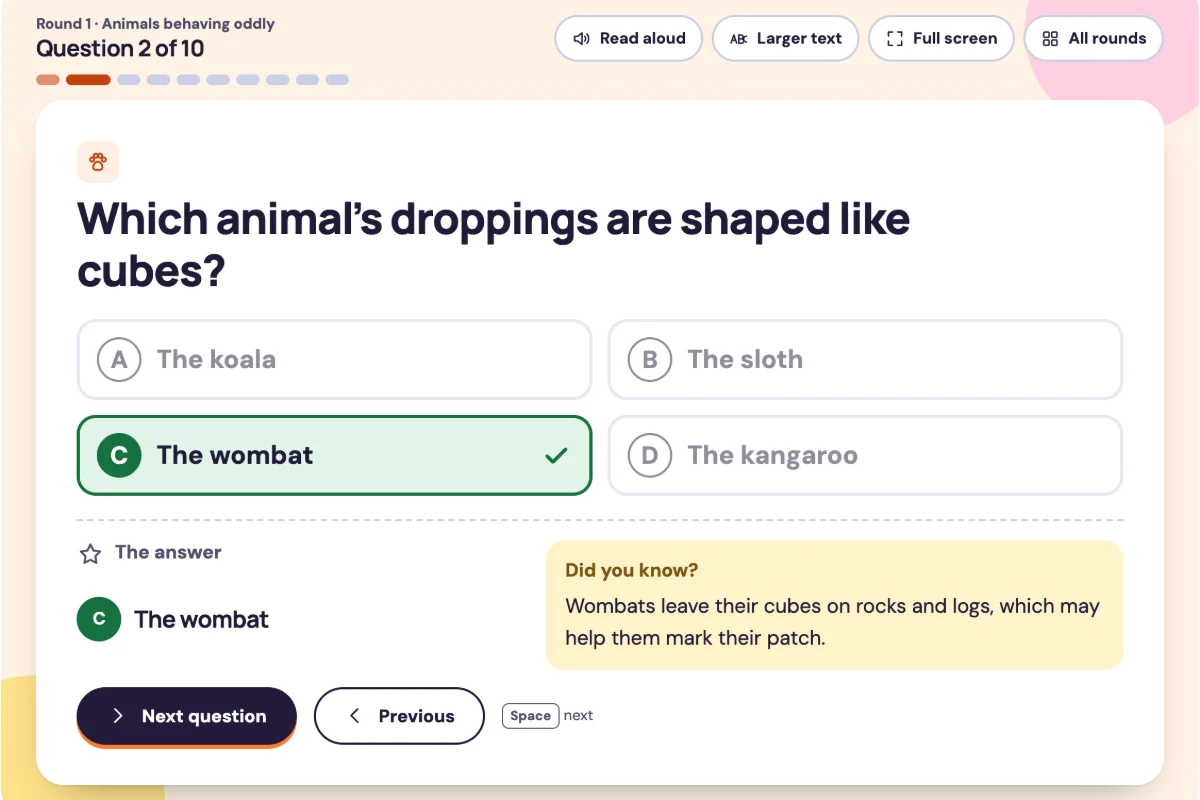
Funny questions are best read aloud, with a pause before the reveal so the room can argue. A round of ten takes about 10 to 15 minutes.
| Time you have | Rounds and questions | How to pace it |
|---|---|---|
| 15 minutes | 1 round · 10 questions | Answered aloud. No paper needed. |
| 30 minutes | 2–3 rounds · 20–30 questions | Teams on paper. Read the scores after each round. |
| 45 minutes | 4 rounds · 40 questions | Take a short break after round 2. |
| About an hour | 6 rounds · 60 questions | A full quiz night. Save a favourite round for last. |
130 original questions with answers: ten categories from general knowledge to art, plus a taste of our funny, hard, kids and grown-up lists. Tap to reveal each answer, or play them as a quiz.
60 genuinely tough questions on science, geography, history, language and the arts. Fair, checked and free of trick wording.
Two sets of questions: 60 for kids of about 6 to 9 and 60 for tweens of about 10 to 12. Read them aloud, reveal the answers, or play them as a quiz on one screen.
60 grown-up general knowledge questions: travel, classic films and books, science, food and history. Nothing explicit and no drinking games.
Every question on this page is free to read, and round 1 is free to play and print. The host’s At Yours Plus adds all 6 rounds of Funny Trivia to play on one screen or a TV, a team scoreboard for 2 to 6 teams, and the full large-print set, plus every other trivia pack, from Christmas to Thanksgiving. One host covers the whole room; guests never pay.
US$4.99/month or US$29/year. The link brings you back here, ready to play.
Questions with a surprising true answer: which animal’s droppings are cube-shaped (the wombat), what a baby puffin is called (a puffling), or which country has more ancient pyramids than Egypt (Sudan). The laugh comes from the answer, not from anyone being put on the spot.
Every answer here is true, and we checked each one. We left out popular “facts” that turn out to be myths, such as pink hippo milk or goldfish with three-second memories.
Yes. They are family-friendly, with nothing rude or mean, and most suit confident readers of about 8 and up. For younger children, try the trivia questions for kids.
Read a question aloud, let teams argue for a minute, then reveal the answer and read the fact. Or put TV mode on the biggest screen and let teams call out a letter. One round of ten fits between courses or while people arrive.
60, in six rounds of ten. Round 1 is free to play and print. The host’s At Yours Plus opens the other five rounds, the team scoreboard and the full printable set.
Yes. Round 1 is a free large-print PDF in A4 and US Letter, with a team answer sheet and an answer page. With At Yours Plus, the host can print all six rounds.