Trivia questions
130 original questions with answers: ten categories from general knowledge to art, plus a taste of our funny, hard, kids and grown-up lists. Tap to reveal each answer, or play them as a quiz.
60 grown-up general knowledge questions: travel, classic films and books, science, food and history. Nothing explicit and no drinking games.
Round 1 free to play · No sign-up · Print a free sheet
Trivia questions for adults are grown-up general knowledge: questions for a quiz night with friends, a team social or a long dinner, like “Which organ makes insulin?” Here are 60 in six rounds, from travel and classic films to science, food and history. Nothing explicit, no drinking games and nothing that puts anyone on the spot. Reveal the answers one by one, or play them as a quiz on one screen or a TV.
Scales, standards and everyday terms.
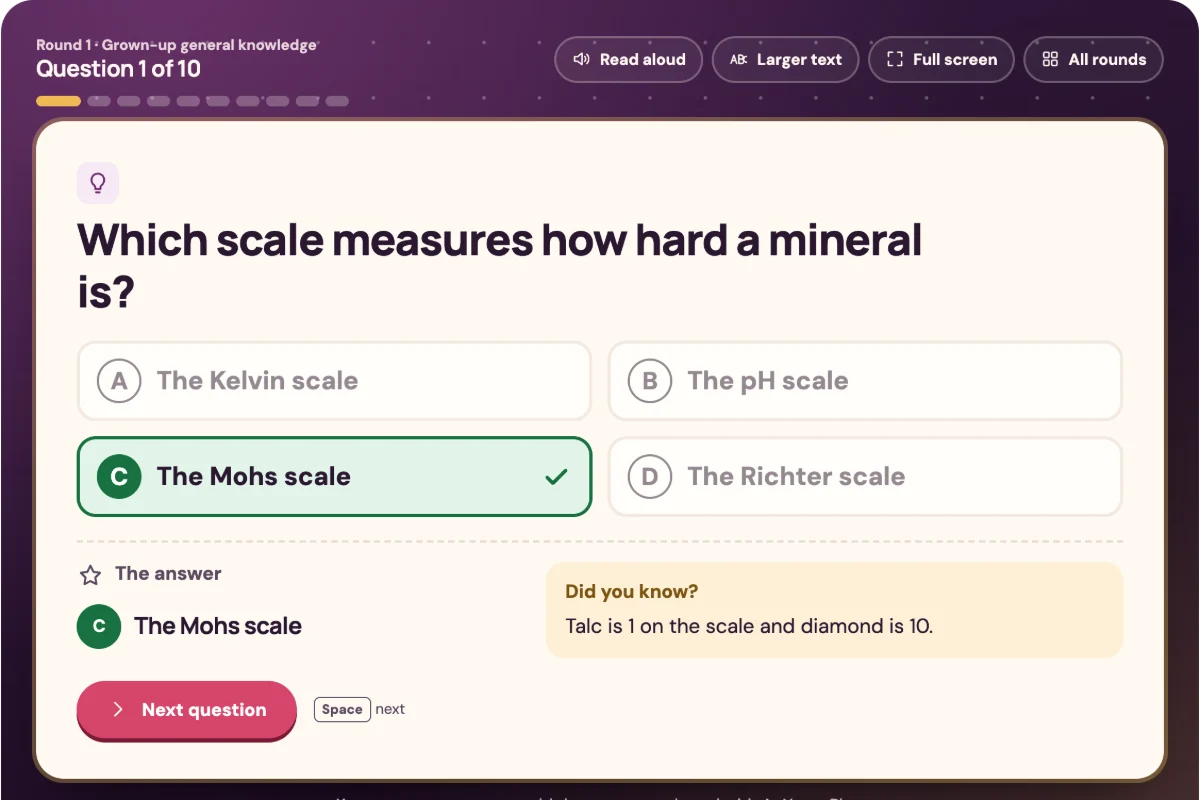
Which scale measures how hard a mineral is?
A. The Kelvin scaleB. The pH scaleC. The Mohs scaleD. The Richter scale
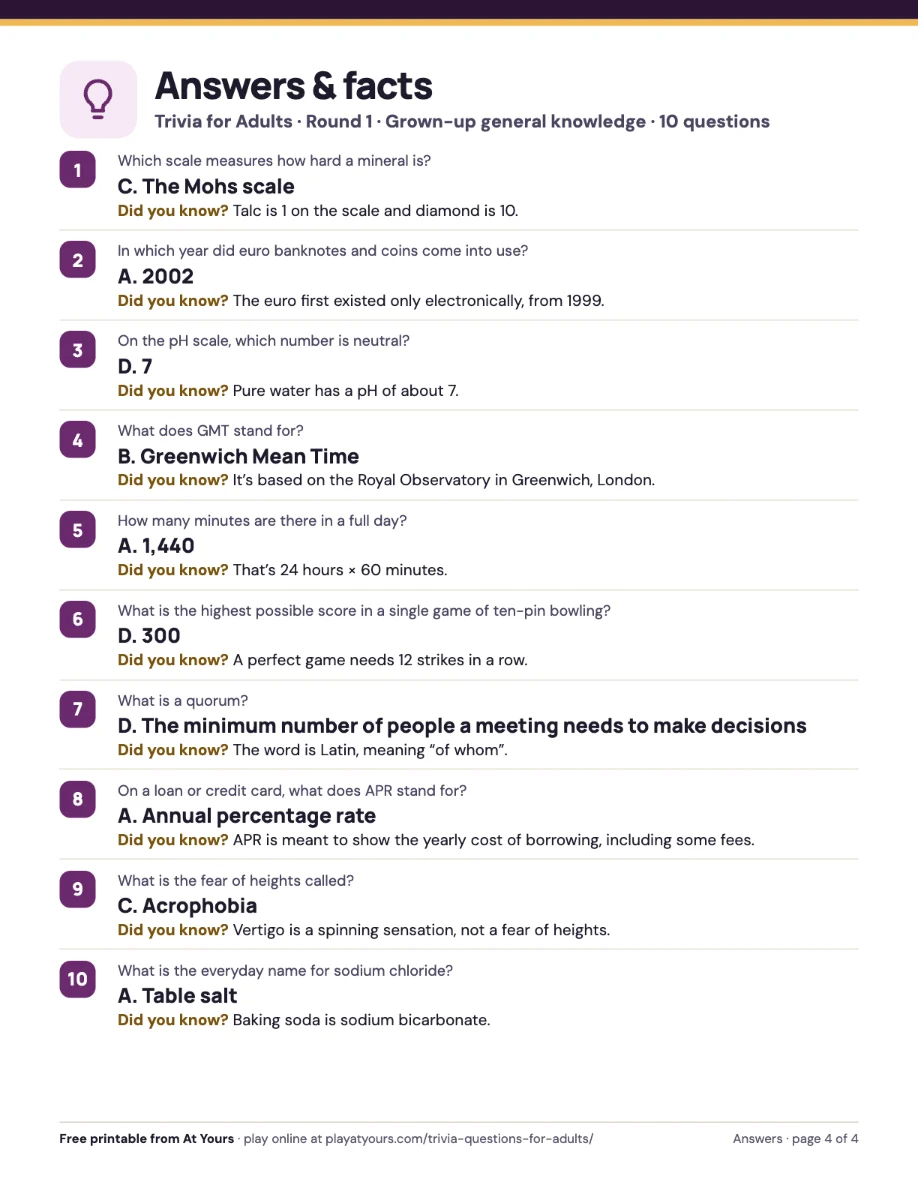
C. The Mohs scale. Talc is 1 on the scale and diamond is 10.
In which year did euro banknotes and coins come into use?
A. 2002B. 1995C. 1999D. 2008
A. 2002. The euro first existed only electronically, from 1999.
On the pH scale, which number is neutral?
A. 10B. 14C. 0D. 7
D. 7. Pure water has a pH of about 7.
What does GMT stand for?
A. General Meridian TimeB. Greenwich Mean TimeC. Great Mean TimeD. Global Measured Time
B. Greenwich Mean Time. It’s based on the Royal Observatory in Greenwich, London.
How many minutes are there in a full day?
A. 1,440B. 1,600C. 1,240D. 2,400
A. 1,440. That’s 24 hours × 60 minutes.
What is the highest possible score in a single game of ten-pin bowling?
A. 200B. 250C. 350D. 300
D. 300. A perfect game needs 12 strikes in a row.
What is a quorum?
A. A type of taxB. The chair of a committeeC. A secret ballotD. The minimum number of people a meeting needs to make decisions
D. The minimum number of people a meeting needs to make decisions. The word is Latin, meaning “of whom”.
On a loan or credit card, what does APR stand for?
A. Annual percentage rateB. Average payment rateC. Annual payment returnD. Applied principal ratio
A. Annual percentage rate. APR is meant to show the yearly cost of borrowing, including some fees.
What is the fear of heights called?
A. ArachnophobiaB. ClaustrophobiaC. AcrophobiaD. Agoraphobia
C. Acrophobia. Vertigo is a spinning sensation, not a fear of heights.
What is the everyday name for sodium chloride?
A. Table saltB. Baking sodaC. ChalkD. Bleach
A. Table salt. Baking soda is sodium bicarbonate.
Landmarks, currencies and customs.
In which city would you find the Sagrada Família?
A. BarcelonaB. SevilleC. LisbonD. Madrid
A. Barcelona. Antoni Gaudí worked on the basilica for more than 40 years.
What is the currency of Japan?
A. The yuanB. The wonC. The yenD. The baht
C. The yen. The won is used in South Korea, and the baht in Thailand.
In which country is the ancient city of Petra?
A. LebanonB. EgyptC. JordanD. Morocco
C. Jordan. Much of Petra is carved straight into rose-coloured sandstone cliffs.
Angkor Wat is in which country?
A. CambodiaB. ThailandC. VietnamD. Laos
A. Cambodia. It appears on Cambodia’s national flag.
What is the capital of Iceland?
A. HelsinkiB. ReykjavíkC. OsloD. Nuuk
B. Reykjavík. Its name is often translated as “smoky bay”.
The Acropolis overlooks which city?
A. AthensB. IstanbulC. NaplesD. Rome
A. Athens. Its most famous temple, the Parthenon, was dedicated to the goddess Athena.
In which city do the Blue Mosque and Hagia Sophia face each other?
A. TehranB. IstanbulC. CairoD. Jerusalem
B. Istanbul. The city was officially called Constantinople until 1930.
Which language do most people speak in the Canadian province of Quebec?
A. ItalianB. SpanishC. FrenchD. English
C. French. Old Quebec, the historic heart of Quebec City, is still ringed by stone walls.
What is the Japanese art of folding paper called?
A. IkebanaB. HaikuC. OrigamiD. Bonsai
C. Origami. Ikebana is flower arranging, and bonsai is growing miniature trees.
What is another name for the northern lights?
A. The zodiacal lightB. The green flashC. The aurora australisD. The aurora borealis
D. The aurora borealis. In the Southern Hemisphere, the same glow is called the aurora australis.
Stories that have lasted.
Who directed the 1960 film Psycho?
A. Billy WilderB. Orson WellesC. Stanley KubrickD. Alfred Hitchcock
D. Alfred Hitchcock. Its famous score, by Bernard Herrmann, is played only by strings.
Which novel begins “It was the best of times, it was the worst of times”?
A. A Tale of Two CitiesB. Oliver TwistC. Bleak HouseD. Great Expectations
A. A Tale of Two Cities. Charles Dickens published it in 1859.
In Casablanca (1942), what is the name of Humphrey Bogart’s character?
A. Rick BlaineB. Victor LaszloC. Philip MarloweD. Sam Spade
A. Rick Blaine. Rick runs a nightclub called Rick’s Café Américain.
Who wrote the novel Nineteen Eighty-Four?
A. H. G. WellsB. Aldous HuxleyC. Ray BradburyD. George Orwell
D. George Orwell. George Orwell was the pen name of Eric Arthur Blair.
Which 1939 film features the song “Over the Rainbow”?
A. Mr. Smith Goes to WashingtonB. The Wizard of OzC. StagecoachD. Gone with the Wind
B. The Wizard of Oz. The song won the Academy Award for Best Original Song.
Who wrote The Great Gatsby?
A. William FaulknerB. Ernest HemingwayC. John SteinbeckD. F. Scott Fitzgerald
D. F. Scott Fitzgerald. It was published in 1925 and is set on Long Island.
Which actor played Atticus Finch in the 1962 film To Kill a Mockingbird?
A. Paul NewmanB. Gregory PeckC. Henry FondaD. James Stewart
B. Gregory Peck. He won the Academy Award for Best Actor for the role.
Who wrote Frankenstein?
A. Jane AustenB. Mary ShelleyC. Emily BrontëD. Bram Stoker
B. Mary Shelley. She began the story during a ghost-story contest by Lake Geneva in 1816.
In Moby-Dick, what is the name of the ship’s captain?
A. QueegB. HookC. NemoD. Ahab
D. Ahab. The novel’s famous first line is “Call me Ishmael.”
Which silent film star created the character known as the Tramp?
A. Charlie ChaplinB. Stan LaurelC. Harold LloydD. Buster Keaton
A. Charlie Chaplin. The Tramp first appeared on screen in 1914.
How we work, and who found out.
Which blood vessels carry blood away from the heart?
A. Lymph vesselsB. ArteriesC. CapillariesD. Veins
B. Arteries. Veins carry blood back towards the heart.
Which organ makes insulin?
A. The pancreasB. The liverC. The spleenD. The kidneys
A. The pancreas. Insulin helps the body’s cells take in sugar from the blood.
Who wrote On the Origin of Species, published in 1859?
A. Isaac NewtonB. Charles DarwinC. Louis PasteurD. Gregor Mendel
B. Charles Darwin. Alfred Russel Wallace came up with a similar idea independently.
What is the unit of electrical resistance?
A. The ohmB. The wattC. The voltD. The amp
A. The ohm. It’s named after the German physicist Georg Ohm.
A lack of which vitamin causes scurvy?
A. Vitamin CB. Vitamin DC. Vitamin AD. Vitamin B12
A. Vitamin C. Sailors once carried citrus fruit on long voyages to prevent it.
What does a Geiger counter detect?
A. EarthquakesB. RadiationC. HumidityD. Air pressure
B. Radiation. It clicks each time it detects a particle of radiation.
Who discovered penicillin in 1928?
A. Alexander FlemingB. Louis PasteurC. Edward JennerD. Joseph Lister
A. Alexander Fleming. He noticed a mould killing bacteria in a dish in his London laboratory.
How many chromosomes does a typical human cell have?
A. 64B. 48C. 46D. 23
C. 46. They come in 23 pairs: one of each pair from each parent.
Which gas makes up most of the Sun?
A. HeliumB. OxygenC. CarbonD. Hydrogen
D. Hydrogen. In its core, the Sun fuses hydrogen into helium.
Which part of the brain is mainly responsible for balance and coordination?
A. The brainstemB. The cerebrumC. The cerebellumD. The hypothalamus
C. The cerebellum. Cerebellum is Latin for “little brain”.
Kitchen terms and world dishes.
What does “al dente” mean when you’re cooking pasta?
A. Firm to the biteB. Very softC. Served coldD. Cooked in butter
A. Firm to the bite. It’s Italian for “to the tooth”.
What is a roux made from?
A. Eggs and sugarB. Flour and fatC. Rice and waterD. Milk and lemon
B. Flour and fat. A roux thickens sauces such as béchamel.
Which pastry is used to make baklava?
A. FiloB. ChouxC. PuffD. Shortcrust
A. Filo. Filo is rolled so thin you can almost see through it.
What is the French term for having all your ingredients prepared and in place before you cook?
A. Mise en placeB. Bon appétitC. Amuse-boucheD. Sous vide
A. Mise en place. Professional kitchens rely on mise en place to cook quickly.
Kimchi, a fermented vegetable dish, is a staple of which cuisine?
A. ThaiB. JapaneseC. VietnameseD. Korean
D. Korean. Napa cabbage is the most common base for kimchi.
What gives sourdough bread its tangy flavour?
A. Extra saltB. Added vinegarC. Wild yeasts and bacteria in the starterD. Lemon juice
C. Wild yeasts and bacteria in the starter. A sourdough starter can be kept alive and fed for years.
What is umami?
A. A savoury tasteB. A sweet dessertC. A cooking knifeD. A type of rice
A. A savoury taste. The word was coined by the Japanese chemist Kikunae Ikeda in 1908.
Pad thai comes from which country?
A. VietnamB. ThailandC. MalaysiaD. Indonesia
B. Thailand. It’s stir-fried rice noodles, often with tamarind, egg and peanuts.
Which part of the vanilla plant is used for flavouring?
A. The petalsB. The leafC. The rootD. The seed pod
D. The seed pod. Vanilla comes from an orchid, and its flowers are often pollinated by hand.
What are the small plates of food served in Spanish bars called?
A. AntipastiB. MezzeC. TapasD. Dim sum
C. Tapas. Mezze are the small dishes of the eastern Mediterranean and the Middle East.
Documents, revolutions and leaders.
How many amendments make up the US Bill of Rights?
A. 12B. 5C. 10D. 27
C. 10. They were ratified in 1791.
Which document begins with the words “We the People”?
A. The Magna CartaB. The US ConstitutionC. The Gettysburg AddressD. The Declaration of Independence
B. The US Constitution. It was signed in Philadelphia in 1787.
Who was the first woman to be prime minister of the United Kingdom?
A. Margaret ThatcherB. Theresa MayC. Shirley WilliamsD. Barbara Castle
A. Margaret Thatcher. She held office from 1979 to 1990.
Which Paris fortress was stormed on 14 July 1789, now France’s national day?
A. VersaillesB. The BastilleC. Notre-DameD. The Louvre
B. The Bastille. The Bastille was used as a state prison.
Which empire was ruled from Constantinople for more than a thousand years?
A. The Persian EmpireB. The Ottoman EmpireC. The Byzantine EmpireD. The Holy Roman Empire
C. The Byzantine Empire. It’s also called the Eastern Roman Empire, and it lasted until 1453.
In which year was the United Nations founded?
A. 1939B. 1950C. 1919D. 1945
D. 1945. Its headquarters are in New York City.
Who wrote the first draft of the US Declaration of Independence?
A. Thomas JeffersonB. Benjamin FranklinC. George WashingtonD. John Adams
A. Thomas Jefferson. Congress adopted the final version on 4 July 1776.
What was the economic slump that followed the 1929 Wall Street Crash called?
A. The Dust BowlB. The Great DepressionC. The Gilded AgeD. The Long Recession
B. The Great Depression. At its worst, about a quarter of American workers were unemployed.
Who became South Africa’s first Black president, in 1994?
A. Desmond TutuB. Thabo MbekiC. Steve BikoD. Nelson Mandela
D. Nelson Mandela. He had spent 27 years in prison before his release in 1990.
Which ancient Greek city-state was famous for its warrior culture?
A. SpartaB. TroyC. CorinthD. Thebes
A. Sparta. Sparta and Athens fought the Peloponnesian War from 431 to 404 BC.
Six rounds of ten. Round 1, grown-up general knowledge, is free: play it on this screen, or choose Host on a TV for teams.
10 questions · Scales, standards and everyday terms.
Round 1 is free · no account
Getting the questions ready…
The actual pages, free in A4 and US Letter. Print one question sheet per team, and keep the answers for the host.
Four pages: round 1’s 10 questions in large print with tick boxes, a team answer sheet, then the answers with every “Did you know?”.
US Letter PDFA4 PDF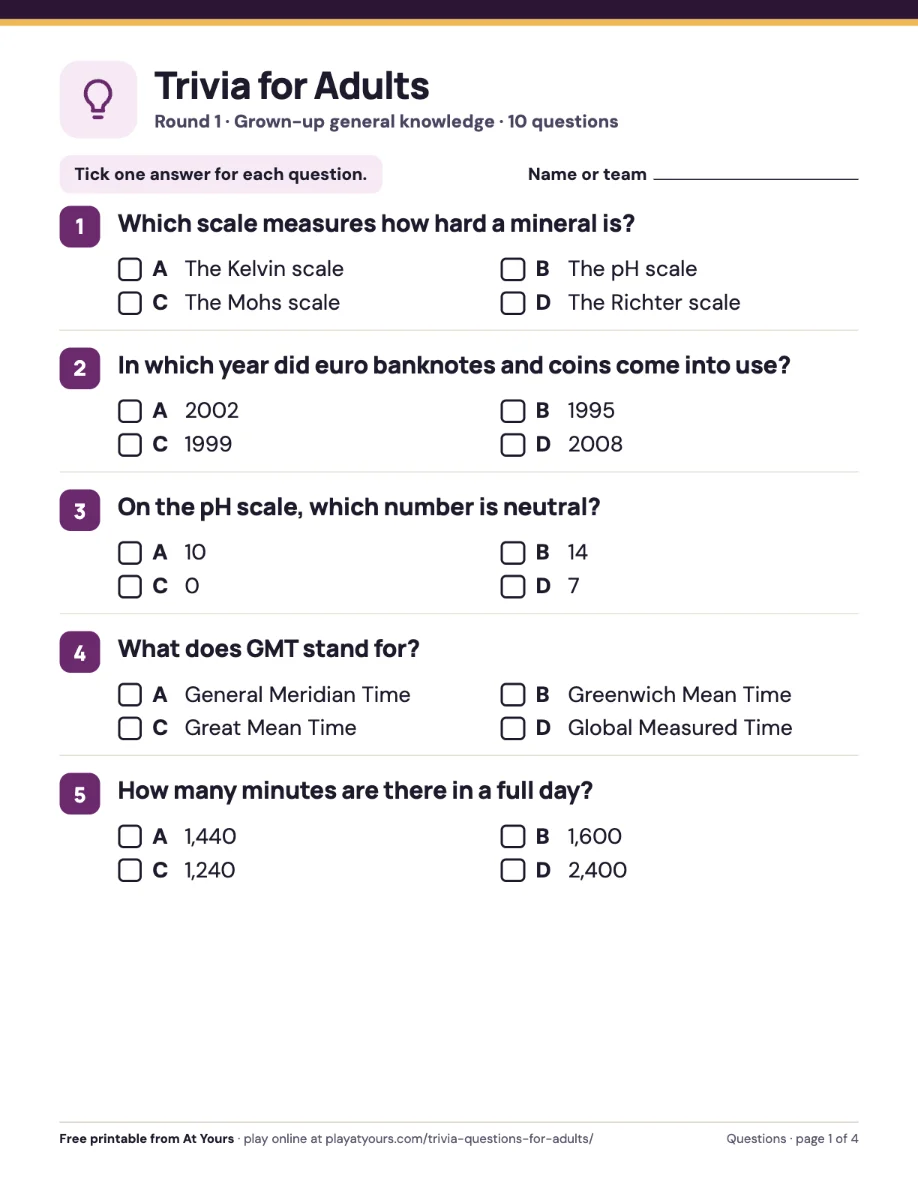
All 6 rounds: 60 questions in large print with tick boxes, each round with an answer page and every “Did you know?”. Printed from your browser on A4 or US Letter.
Adults like a proper quiz: teams, a printed answer sheet, a scoreboard and a break in the middle. Six rounds of ten fill about an hour.
| Time you have | Rounds and questions | How to pace it |
|---|---|---|
| 15 minutes | 1 round · 10 questions | Answered aloud. No paper needed. |
| 30 minutes | 2–3 rounds · 20–30 questions | Teams on paper. Read the scores after each round. |
| 45 minutes | 4 rounds · 40 questions | Take a short break after round 2. |
| About an hour | 6 rounds · 60 questions | A full quiz night. Save a favourite round for last. |
130 original questions with answers: ten categories from general knowledge to art, plus a taste of our funny, hard, kids and grown-up lists. Tap to reveal each answer, or play them as a quiz.
60 genuinely tough questions on science, geography, history, language and the arts. Fair, checked and free of trick wording.
60 silly-sounding questions with completely true answers: cube-shaped droppings, pufflings and words that sound made up. Family-friendly, every one.
Traditions, films, festive food and winter science, with a TV mode for parties.
Every question on this page is free to read, and round 1 is free to play and print. The host’s At Yours Plus adds all 6 rounds of Trivia for Adults to play on one screen or a TV, a team scoreboard for 2 to 6 teams, and the full large-print set, plus every other trivia pack, from Christmas to Thanksgiving. One host covers the whole room; guests never pay.
US$4.99/month or US$29/year. The link brings you back here, ready to play.
Questions that draw on a grown-up’s general knowledge: travel, classic films and books, science, food and history. They should be challenging without being obscure, and never rely on anything explicit or embarrassing. A mix of categories keeps every team in the game.
Yes. There’s nothing explicit, political or personal, and no drinking. They suit a team social, an office quiz or a video call. For quick warm-ups, see our icebreaker games.
Make teams of two to six, give each team an answer sheet, and play four to six rounds of ten with a break in the middle. Show the questions in TV mode, read them aloud, and reveal the answers together. One point per right answer; closest number wins a tiebreak.
Yes. The host shares their screen in TV mode and reads each question; everyone answers aloud or in the chat, then the host reveals the answer and the fact.
60, in six rounds of ten. Round 1 is free to play and print. The host’s At Yours Plus opens the other five rounds, the team scoreboard and the full printable set.