Your train
Only you can play on it while it is closed. Its locomotive stands flat at the station.
Build your own train out of the station, slip awkward tiles onto the shared Mexican Train, and cover every double before it becomes everybody’s problem.
1–7 computer players, or 2–8 people online · phone, tablet or computer · no sign-up
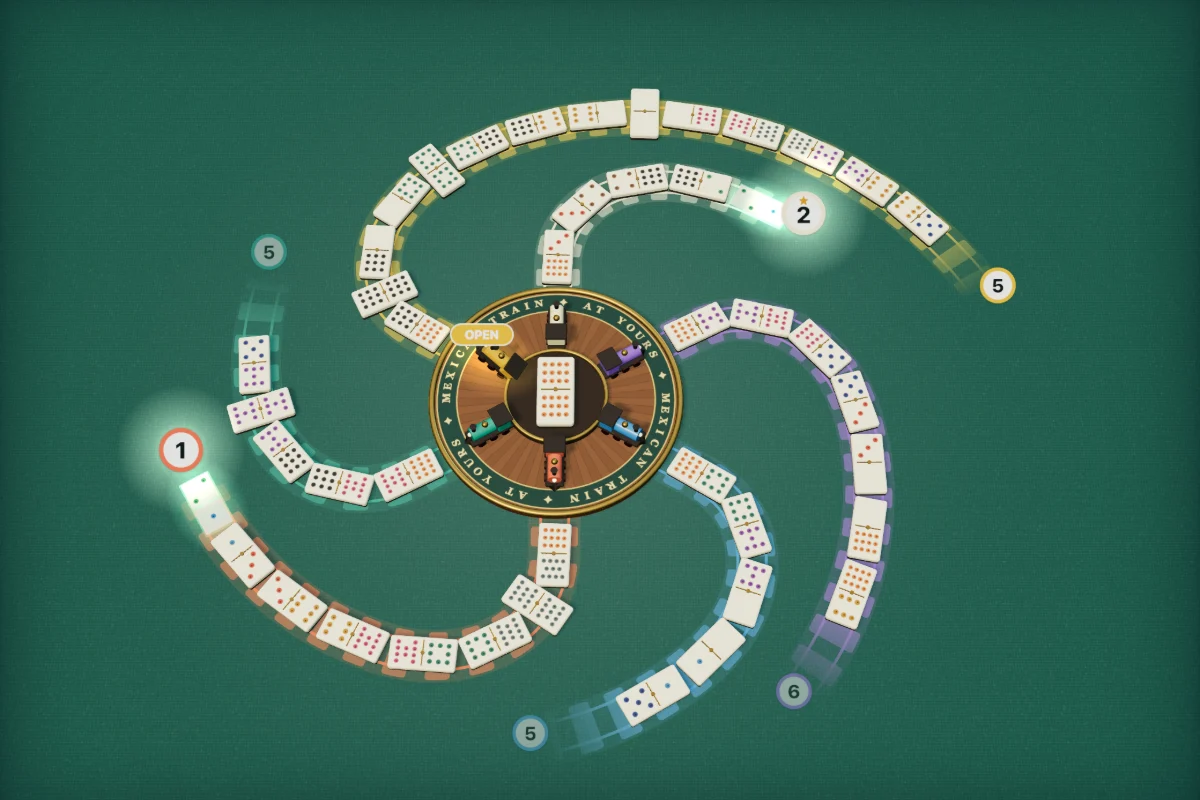
In shortMexican Train is a dominoes game for 2–8 players played with a double-twelve set. Each round starts from a double in the central station; on your turn you add one matching tile to your own train, to the shared Mexican Train, or to any train with a marker on it. Doubles must be covered, the first player to empty their hand ends the round, and after the last round the lowest total wins.
Each screen only receives its own hand. Draws stay private: everyone sees how many tiles you hold and every tile that is played, never the tiles in your hand.
The room checks every moveTurn order, matching ends, markers, the boneyard and doubles that must be covered are all enforced by the room. Out-of-turn and illegal plays are refused.
Computer playersIn the lobby the host can add Relaxed or Sharp computer players to fill seats, up to eight in all. They play straight away, and every screen replays their moves one at a time.
RoomsRooms last two hours, and the host can add time in the final 30 minutes. Reopen your invitation in the same browser to get your seat back, or save your private recovery code from Room options. Room data is removed when the room closes or expires.
You match tiles to open ends, one tile per turn, trying to empty your hand before anyone else. These are the common rules we use at this table; families often have their own house rules.
Fifteen tiles each for two to four players, twelve for five or six, and ten for seven or eight. The starting double sits in the station, so 90 tiles are dealt from.
| Players | Tiles each | Left in the boneyard |
|---|---|---|
| 2 | 15 | 60 |
| 3 | 15 | 45 |
| 4 | 15 | 30 |
| 5 | 12 | 30 |
| 6 | 12 | 18 |
| 7 | 10 | 20 |
| 8 | 10 | 10 |
You play again straight away, and that tile must cover the double. If you can’t cover it, draw one tile; if that doesn’t fit either, pass and put a marker on your train. The next player must then cover the double, and so on round the table: no tile may be played anywhere else until it is covered. The table rings the waiting double, locks the other trains and tells you which number is needed.
A marker means a train is open to everyone. You get one on your own train whenever you have to pass, and it comes off the moment you play on your own train again. While it is there, any player may add tiles to your train. The Mexican Train is always open.
Only you can play on it while it is closed. Its locomotive stands flat at the station.
The locomotive tips up and the train is marked open. Anyone may play on it until its owner plays there again.
The shared train with the gold star. Anyone may start it, once per round, and anyone may extend it.
When a round ends, every player adds up the pips on the tiles left in their hand, and that number is added to their total. The player who went out scores nothing for the round. The 0–0 counts 50 points, a common house rule that makes the blank double a tile to get rid of. If the round is blocked, everyone still counts their hand. After the last round (round 4 in the free game, round 13 in the full game, ending with the 0–0 engine), the lowest total wins.
The Mexican Train is the shared train in Mexican Train dominoes. Anyone may start it from the central station on their turn, once per round, and after that anyone may add to it. It is a safe place for a tile that doesn’t fit your own train. On our table it is the ivory track with a gold star on its locomotive.
You play again, and your next tile must cover the double: it goes on the double’s open end. If you can’t cover it, draw one tile and play it if it fits; if it still doesn’t, pass and put a marker on your train. Until someone covers the double, every player must play on it and nowhere else. A double played as your last tile ends the round.
Two to eight. Against the computer you play with 1–7 computer players. In a private online room 2–8 people join on their own devices, and the host can add computer players to fill empty seats, up to eight players in all.
A double-twelve set: 91 tiles with ends from 0 to 12. Each round takes its starting double out of the set and puts it in the station: 12–12 in round 1, 11–11 in round 2 and so on. With 2–4 players everyone gets 15 tiles, with 5–6 players 12, and with 7–8 players 10.
It depends on the group, so treat these as estimates. Against the computer, the free 4-round game usually takes about 15–25 minutes and the full 13 rounds about an hour. Online with friends, allow a little longer for each round. There is no turn timer.
Yes. A complete 4-round game (12–12 down to 9–9) is free against the computer and in a private room, with no account or download. At Yours Plus adds the full 13-round game down to 0–0, 7-round games and a private game-night series. At Yours Plus is $4.99/month or $29/year (USD); in a room only the host needs it, and guests join free.
Yes. Tap a tile, then tap a glowing end on the table or in the Open ends row; there is no dragging. Every open end shows its number in large type. On a keyboard, use the arrow keys and Enter to pick a tile, number keys to choose a train, D to draw and P to pass. A flat table appears if your device can’t show 3D, and reduced-motion settings are respected.
Draw and Block dominoes for 2–4 · Hearts · Euchre · Cribbage · Yacht Dice · Two-player games · Classic games · All games
Family gathering coming up? Mexican Train seats up to eight, so it suits Thanksgiving games and Christmas games nights too.