The boring lie
- I have more than 30 cousins.True
- I once got stuck on a ski lift for 40 minutes.True
- I’ve never broken a bone.The lie
Both truths sound like stories, so the room hunts for the lie among them. The plain one slips through.
Everything you need for the classic icebreaker: how to play, 110+ ideas for truths and lies, tips for a lie nobody spots, and a free room where everyone writes and votes on their own phone.
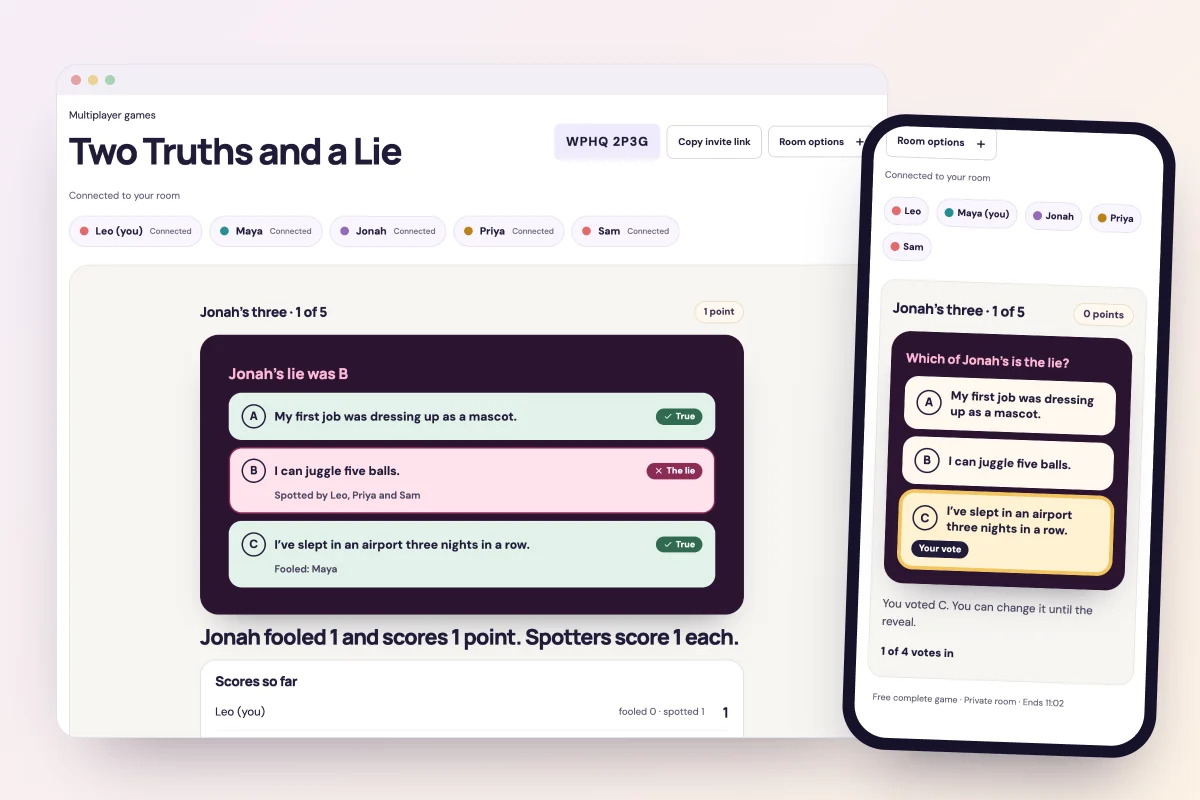
Two Truths and a Lie is an icebreaker where each player shares three statements about themselves, two true and one made up, and everyone else guesses the lie. Spotters score a point, and so does the author for everyone they fool. The best lies are ordinary and specific. Below are the rules, 110+ ideas by theme, worked examples and a free online room for 3–8 players.
Three statements, one lie, and a room full of detectives. These are the standard rules, with the scoring most groups use.
Each person writes three short statements about themselves: two true, one made up. Online, everyone writes at once on their own phone.
In person, read all three in the same tone. Online, the room shows each person’s three in a shuffled order, so the lie isn’t always last.
Everyone except the author picks the statement they think is false. Votes stay hidden until the reveal.
The author reveals the lie. Spotters score 1 point each; the author scores 1 point for each person fooled.
When everyone has had a turn, the highest score wins. Play another round with new statements if the room wants more.
Statements to borrow and bend. Each one can be a truth or a lie: keep the ones that are true for you, and twist one into your lie.
Small facts about you that sound believable either way. The best lie here is a boring one.
Places make great truths because they come with details. Give your lie a detail too.
Everyone has strong food opinions, so a food lie is easy to sell.
For an office icebreaker or a first day: safe, specific and nothing anyone could look up.
Childhood stories are hard to check, which makes them perfect for both truths and lies.
A surprising skill is the classic truth. Claim one you don’t have and watch the room believe you.
Ready for a Christmas party, a Thanksgiving table or a summer barbecue.
Four sets as a player might write them, and why each lie works.
Both truths sound like stories, so the room hunts for the lie among them. The plain one slips through.
A small, believable claim about good habits. People rarely doubt something that sounds like a mild boast.
Every statement sounds a little unlikely, so nothing stands out. Three odd ones are harder to split than one.
The lie borrows a real pet and adds one invented skill. One changed detail is easier to defend than a whole made-up story.
The trick isn’t a wild lie. It’s three statements that sound like they came from the same person.
Similar length, similar tone and a similar amount of detail. If one statement is twice as long, everyone looks at it.
The best rounds have one truth so unlikely that the room is sure it’s the lie. Lead with your strangest real story.
Take a true memory and change one detail: the place, the number or who was there. It’s easier to answer questions about it.
“Three nights”, “40 people”, “ten years”. Specific numbers make every statement sound remembered, not invented.
A dull lie is hard to spot. “I’ve never broken a bone” fools more people than “I’ve met a famous astronaut.”
If someone in the room was there, or it’s on your social media, it won’t survive the vote.
One about food, one about travel, one about a skill. Three from the same story give each other away.
Your statements are about you. No lies about other people in the room, and nothing anyone would rather keep private.
Nobody sees your three until it’s your turn, and nobody sees which is the lie until the reveal. The room shuffles the order, so a lie written last doesn’t sit last.
Keep it kindWrite about yourself. Nothing private, and no lies about other people in the room.
RoomsRooms last two hours, and the host can add time in the final 30 minutes. Reopen your invitation in the same browser to get your seat back. Statements are removed when the room closes.
One host’s At Yours Plus covers everyone in the room, and guests never pay. US$4.99/month or US$29/year. It also includes our other full room games and their printable companions.
See At Yours Plus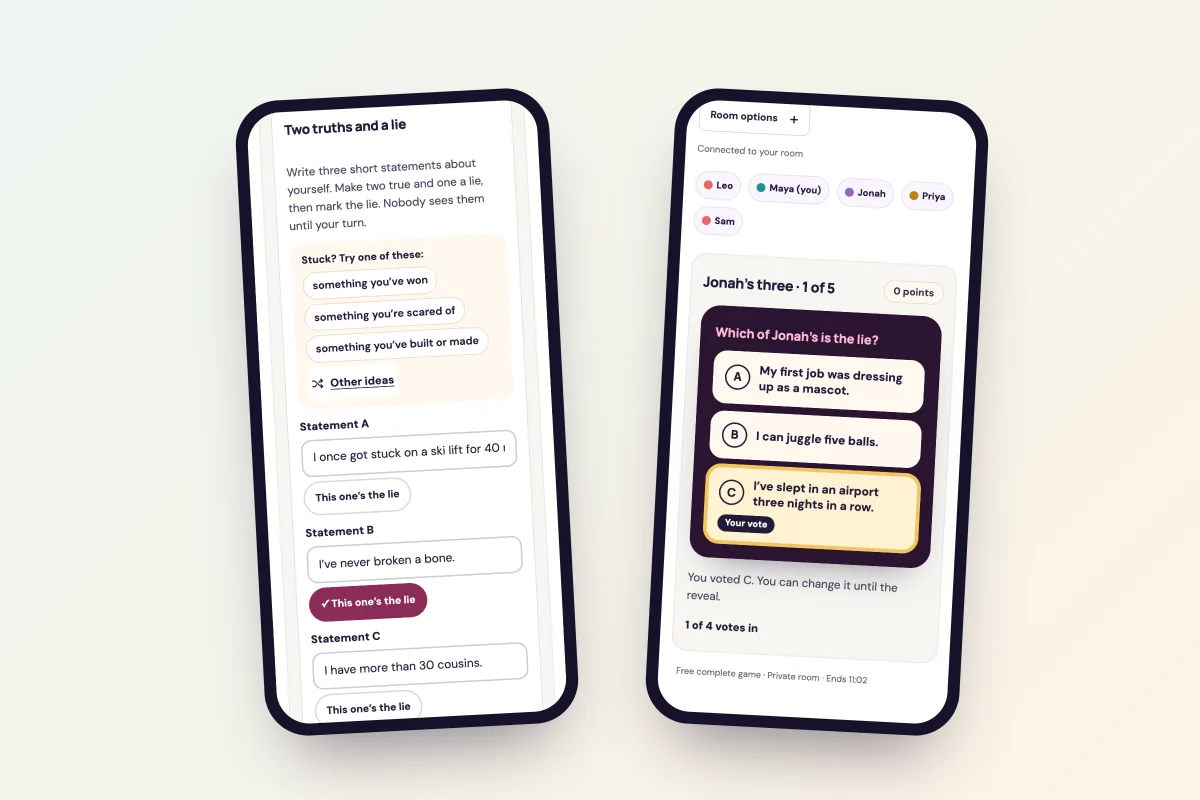
It’s a gentle first-day game: everyone shares something, but chooses what.
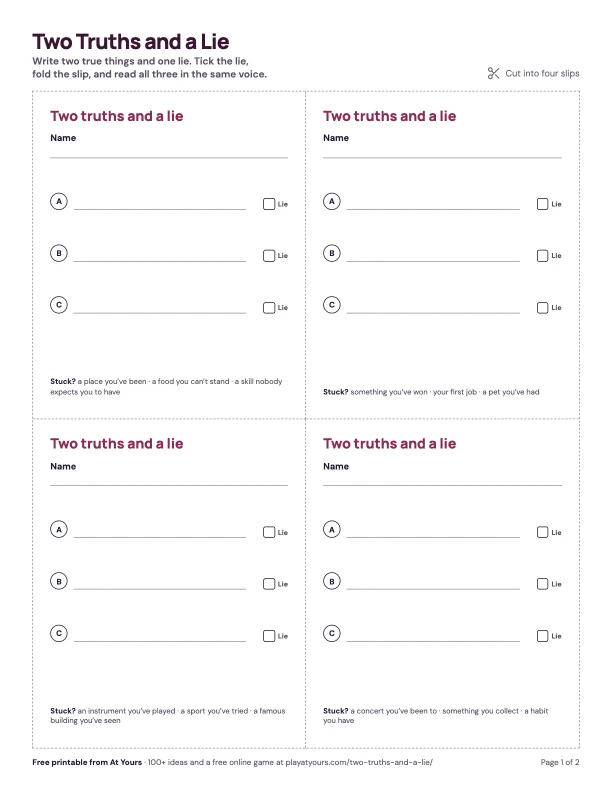
One page to cut into four slips, each with three lines and a box to tick the lie, plus a scoring grid for up to 12 players. Hand out the slips, collect them in a bowl and read them out.
Free to print for your team, class or party.
Each player says three statements about themselves: two true and one made up. Everyone else guesses which one is the lie, then the player reveals the answer. You score a point for each lie you spot, and a point for each person your lie fools. It works for any group of three or more, in person or online.
Pick statements that sound equally likely: a place you’ve been, a food you can’t stand, a skill nobody expects, a job you’ve had. The best sets hide one surprising truth, so the room picks it as the lie. There are more than 100 ideas by theme on this page, from travel and food to work and the holidays.
Keep it ordinary and specific. Change one detail of a real memory (the place, the number or who was there), match the length and tone of your truths, and avoid anything someone in the room could check. A dull lie fools more people than a wild one.
Yes. Everyone shares something about themselves, but they choose what, and nobody is put on the spot. Ask for work-safe statements (no private or sensitive topics), give people a few minutes to write, and keep a list of prompts handy. Online, the room collects everyone’s statements at once, so a team of ten finishes in about 15 minutes.
Open a free room on this page and share the link in your meeting chat. Everyone writes their three on their own phone or laptop, in private. Then each person’s three appear in an order the room shuffles, everyone votes for the lie, and the reveal shows who spotted it. Free rooms hold 8 players; the host’s At Yours Plus opens rooms for up to 24.
Three or more, so every set has at least two people guessing. It works best with 4–12. A free online room holds up to 8, and the host’s At Yours Plus raises that to 24 with two- or three-round games.
Yes. Children of about 7 and up enjoy it, especially with prompts like a pet, a favorite food or a place they’ve been. Keep statements kind and about yourself, and let younger players whisper theirs to a grown-up who writes them down.
Every idea, example and tip here is free, with a free printable sheet and free rooms for 8 players, one round each with the everyday prompts. The host’s At Yours Plus (US$4.99/month or US$29/year) adds rooms for up to 24, two- or three-round games and the work, family and holiday prompt packs. One host covers the whole room; guests never pay.