Set up a room in three steps
- Choose a host, three to eight players and one device each. Create a free Who Said That? room and copy the invitation.
- Players join with nicknames and press Ready. No guest accounts or payments are needed. If remote, use your usual voice call; cameras are optional.
- Explain that passing is welcome. Keep answers suitable for this group. The host starts, and everyone answers the same prompt privately.
A free session has three complete rounds, including the final double-point round. Start with that finish line rather than promising a fixed duration; your group’s writing and conversation determine the pace.
Write, match, reveal
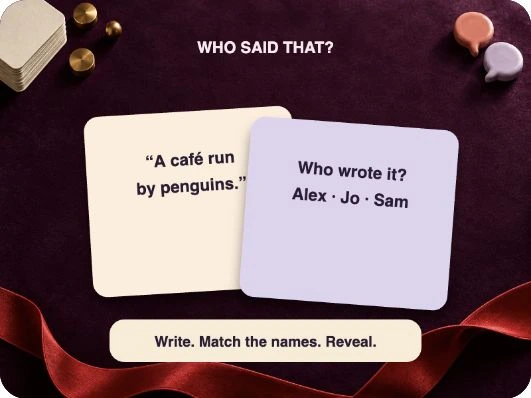
Write 2–120 characters without putting your name in the answer. After everyone submits or passes, the room shuffles the cards. Match every card that is not yours to an author. Lock your guesses, then reveal together. Each correct match earns one point; the final round earns two per match. Highest total wins, with shared wins for ties.
Identical answers share one card. Either author is correct, and anyone whose own answer is on that card sits out guessing it. A person who skips writing can still guess other cards. There is no penalty beyond the points they do not earn.
For a paper version, ask one non-playing host to collect and number anonymous answers, keep an author key and read the cards aloud. Players write their guesses before the host reveals the key. Rotate the host next time so nobody permanently loses a seat.
Five prompts that do not demand personal disclosure
- What would you name a café on the moon?
- What tiny everyday task deserves its own medal?
- What completely unnecessary button would you add to a keyboard?
- What fictional job would a very organized penguin be good at?
- What harmless object would be a terrible office mascot?
Use preferences and imaginary situations. Skip prompts about health, salaries, relationships, religion or someone’s work performance. The purpose is a shared game, not an assessment of employees.
Keep the room comfortable and moving
The host can hide an answer before its author is revealed. Hiding a card clears guesses so everyone plays the same remaining ballot. After one minute, the host can skip unfinished turns. Passing a whole round reveals no answers and awards no points.
If a person must be removed, the match is discarded and the remaining players return to the lobby. Say that before using removal, so the group knows its scores will reset. Answers remain inside the private room and are deleted when it closes or expires; shared result links do not include them.
Adapt the plan for a larger remote team
For nine or more, split into rooms of three to eight, with one host and one call breakout per room. Keep the same short number of rounds and regroup afterwards. Each paid room needs a host with access; free rooms need no paid account. Do not try to stretch an eight-seat game by sharing anonymous identities.
All Access gives a host 3-, 6- or 9-round sessions from 60 workplace prompts or 30 friends-and-family prompts. It costs $4.99/month or $29/year USD; guests stay free. For another kind of interaction, switch to office drawing telephone or a secret-bidding match. The remote game-night planner respects each game’s seat limit.
Find your next game night.
Explore the collection, or start with a free sample.
More games for your team Try a free game