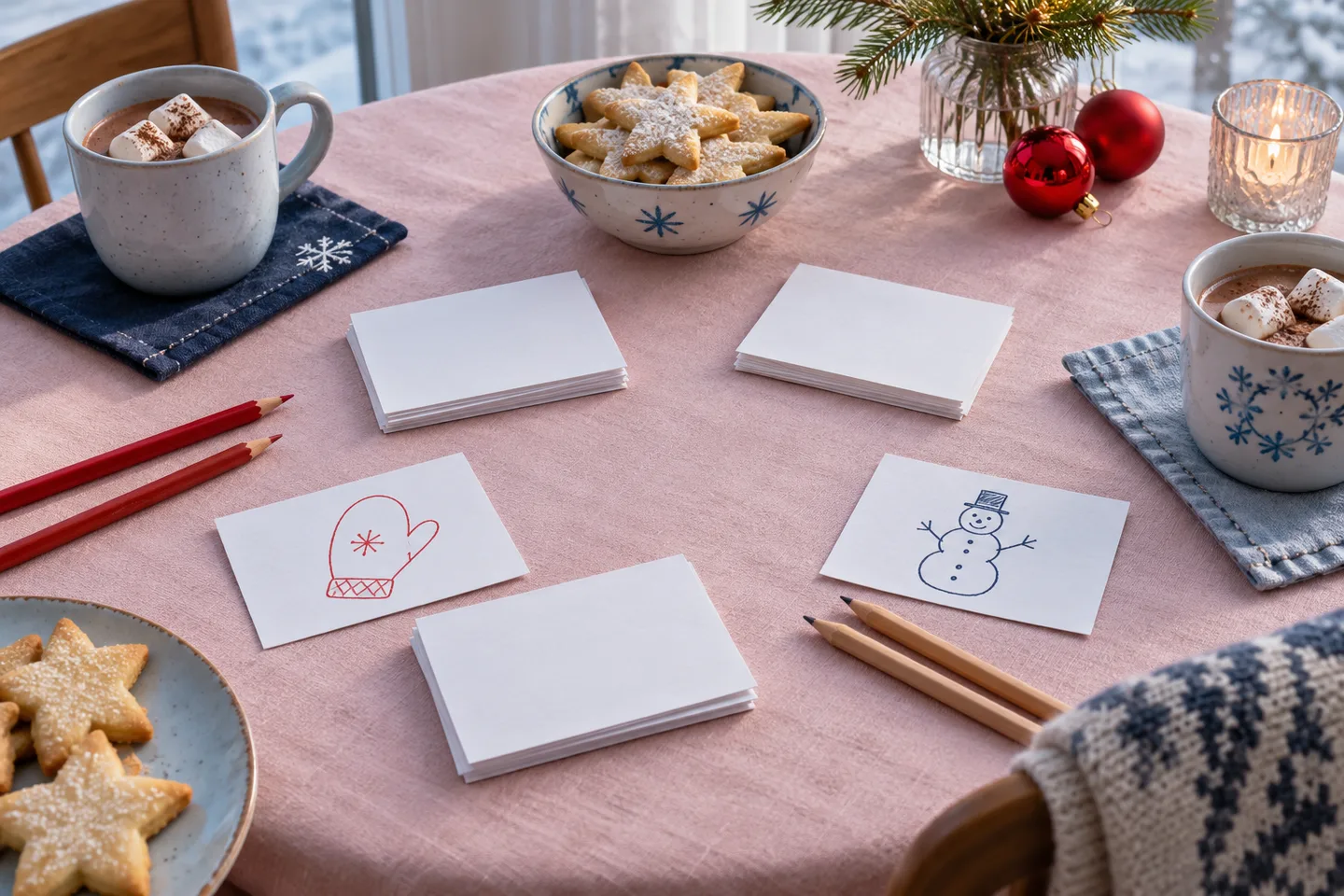
Plan a finish everyone can reach
Pick your countdown time before starting. It can be before dinner, after dessert, or just before a child’s usual bedtime. Say clearly that this is your household’s early celebration rather than the actual change of date.
These games need paper and pencils if you want to draw, but spoken answers work too. Two players can alternate jobs; a larger group can work in pairs. Choose two activities and allow roughly ten minutes for each, then leave a few minutes for your countdown.
Keep personal memories optional. A player who has had a difficult year should not have to produce a happy highlight or a resolution to join the fun.
Write tomorrow’s impossible headlines
Everyone invents a harmless newspaper headline from an imaginary future. Choose a setting together: a town of robots, a village of penguins, or a space station with a very small garden.
Examples: “Penguin elected chief umbrella tester.” “Space-station tomatoes demand a window seat.” “Robot library introduces books that tell you when they’re tired.”
Read each headline aloud. Another player asks what happened next, and the writer adds one sentence. Finish after everyone has shared. An adult can write for a child, or the child can draw the story and ask a partner to announce it.
Make a museum of the imaginary year
Choose three ordinary objects from the room. Each is an exhibit from the year that never happened. Take turns explaining the adventure behind one object.
- Name the object’s imaginary owner: a detective, a tiny astronaut, or a dragon librarian.
- Explain one problem the owner faced.
- Describe how the object helped solve it.
A spoon could have helped an astronaut paddle through an enormous bowl of floating soup. Other players can ask one question about the exhibit. You do not need to remember real events, share photos, or bring a special keepsake.
Draw the most unhelpful clock
Each pair invents a clock that measures something other than time: how sleepy a dragon is, how many socks have gone missing, or how close a cake is to being admired.
Draw or describe its face, its hands, and the sound it makes. Then give it a situation: the dragon has read three bedtime stories; the laundry has just finished; the cake is still in the oven. The pair explains what their clock shows.
Let the group ask how to reset it. There is no best design to judge. End after every pair has presented, or choose one imaginary clock to announce the countdown.
Count down with ten tiny choices
Write the numbers 10 to 1 on a sheet. Beside each, choose a harmless group action: wave, tap the table, make a star shape with your fingers, whisper “hooray,” or point to the person who chooses the next action.
Read the list slowly from ten down to one and do each action together. Let players substitute a spoken word or a gesture that suits them. Finish with your celebration phrase, then move to the activity you already planned next.
There is no need for balloons, poppers, eating challenges, or loud sound effects. If you prefer a conventional countdown, count together and let everyone celebrate in their own way.
Keep one idea for the next ordinary evening
Ask each person to choose a game they would like to play again. “More drawing” or “another little mystery” gives you a practical starting point for a family game night.
For a ready-to-play change of pace, open our free small mystery or the six-question family quiz. Both use one browser and need no account. The full party-game collection is coming soon.
Find your next game night.
Explore the collection, or start with a free sample.
Explore party games Try a free game