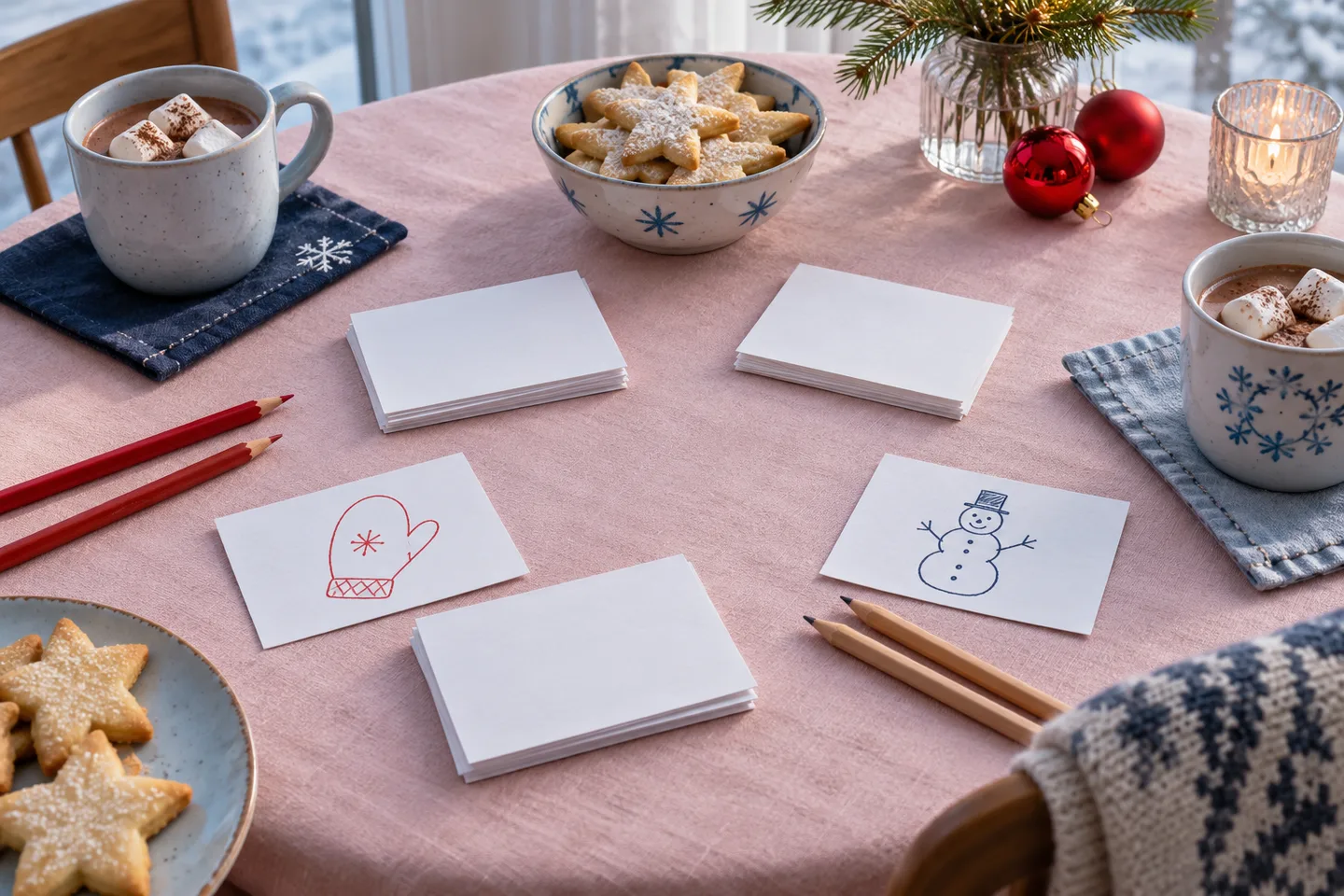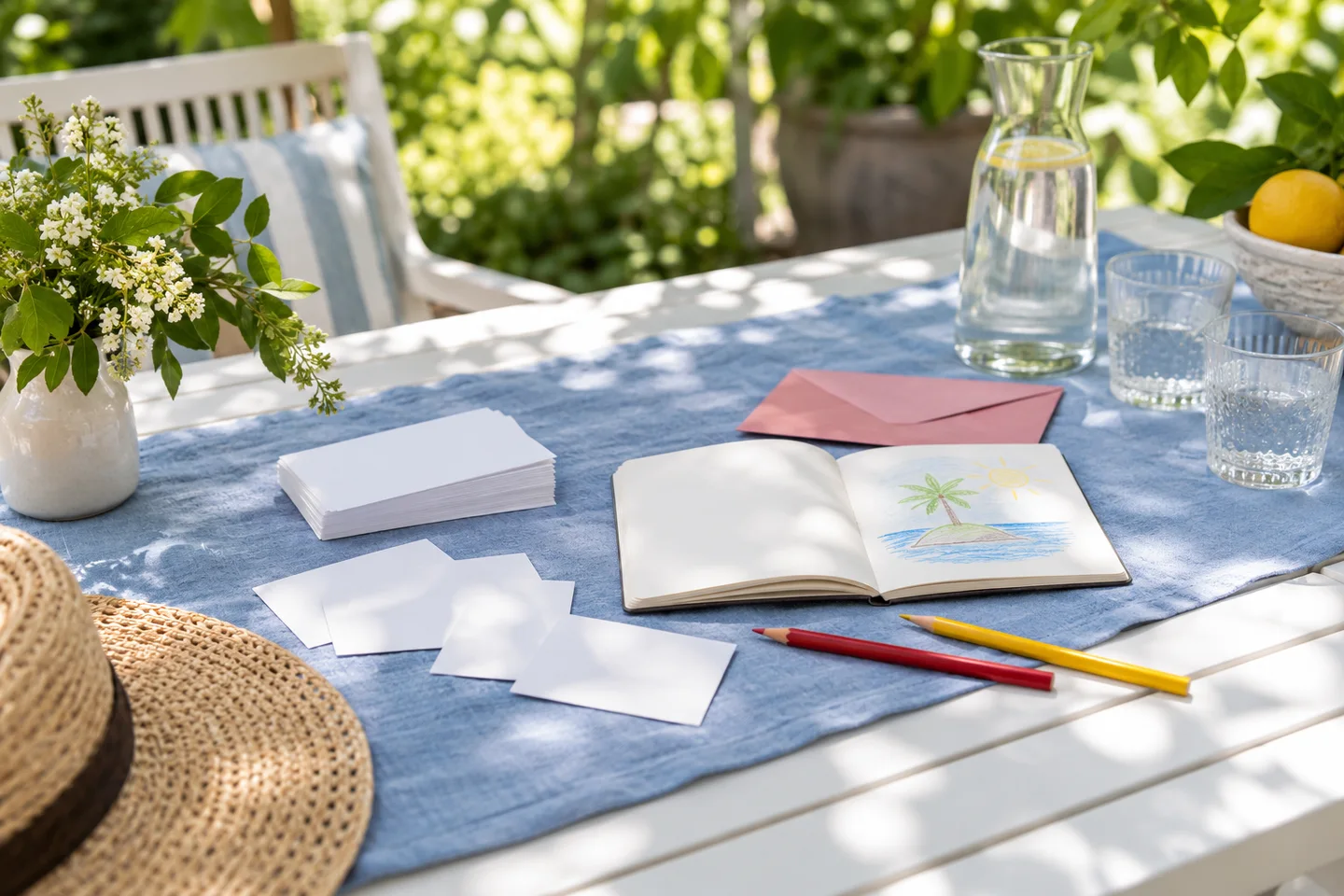
Choose your space, then choose a game
All four activities work indoors. If you take paper outside, use a shaded table and something to stop it blowing away. Keep the game close together rather than sending players out to collect objects.
Two people can play by alternating roles. With a family or small group, work in pairs and let a younger child choose, point, or draw while someone else writes. None of the games needs a countdown, specialist equipment, or a printer.
For Australia and New Zealand, December and January can mean summer holiday time as well as Christmas. In 2026, NSW public-school summer holidays begin December 18; dates elsewhere in Australia vary by state and school. New Zealand schools finish the year no later than December 18, with summer holidays beginning by December 19. Check your own school’s calendar before making plans.
Design an island, then solve its one problem
Draw a large outline on a piece of paper. Each player adds one place: a library, a harbor, a garden, a bakery, or something invented. Say what each place does as you add it. If drawing is not useful for your group, name the places aloud instead.
- Join the places with paths or describe how people travel between them.
- Give the island a name and choose one shared problem: the bridge has closed, the mail has arrived on the wrong beach, or the bakery needs a new delivery route.
- Each player suggests how their place can help. The garden could lend a wheelbarrow; the library could supply an old map.
- Choose a solution that uses at least two players’ ideas. Tell the story of how it works.
Stop after solving the problem. Save the map if you want to revisit it another day with a different problem. A child who likes clear choices can decide between two suggested locations instead of inventing one from scratch.
Become a sound detective
Choose a quiet moment and listen together to the sounds already around you. A player silently chooses one sound they can hear, then describes it without naming its source: repeated or occasional, near or far, soft or sharp.
The group takes one guess after each clue. Reveal the sound after three clues and swap the detective. Nobody needs to leave the room or make a loud noise.
If sound is not an accessible clue for your group, use a visible object instead and describe its shape, material, and job. You can also agree on a category, such as things on the table, to narrow the choices for younger players.
Send a postcard from somewhere impossible
Each pair secretly chooses a place: a city inside a tree, a campsite on the moon, a hotel under the sea, or a village made of pillows. They make a postcard with a picture and three clues, without writing the place’s name.
The clues describe what a visitor can see, how they get around, and what they might eat. For an underwater hotel: “Our window has fish on the outside. The elevator fills with bubbles. The restaurant serves seaweed noodles.”
Show the postcard and read the clues aloud. Everyone else agrees on one guess, then the pair reveals the place. Swap roles. There is no need to mail anything or share real addresses; these are imaginary destinations.
Hold a tiny invention fair
Pick a small holiday problem: a bookmark that keeps slipping out, a picnic blanket that folds the wrong way, or a hat that always lands upside down. Each player designs an invented solution in words or a sketch.
Give the invention a name and explain how it works in two sentences. Another player asks one practical question, then the inventor adds an improvement. Finish when every invention has had a question.
No building materials or competition are required. If the group wants another round, combine two inventions into one. A bookmark that can fold a picnic blanket is a much more interesting sales pitch than either one alone.
Make a small activity menu for the week
Offer two choices each day: island or postcard, sound clues or inventions. Keep the same rules and change the prompts. That gives the group something familiar to start without pretending a solved puzzle will be new again.
For a screen-based option, our free family quiz has six questions and runs on one browser. A grown-up can read while different players choose the answer. The questions stay the same on replay.
Planning a December get-together? The warm-weather Christmas variations use the same seated activities with summer-friendly prompts. For a birthday during the break, try the indoor party plan.
Find your next game night.
Explore the collection, or start with a free sample.
Explore family games Try a free game