Join two dots
On your turn, draw one line between two dots that sit side by side or one above the other. No diagonals.
The pencil-and-paper classic, made for phones. Join two dots, close a box, take another turn. Play the computer or pass the device to a friend.
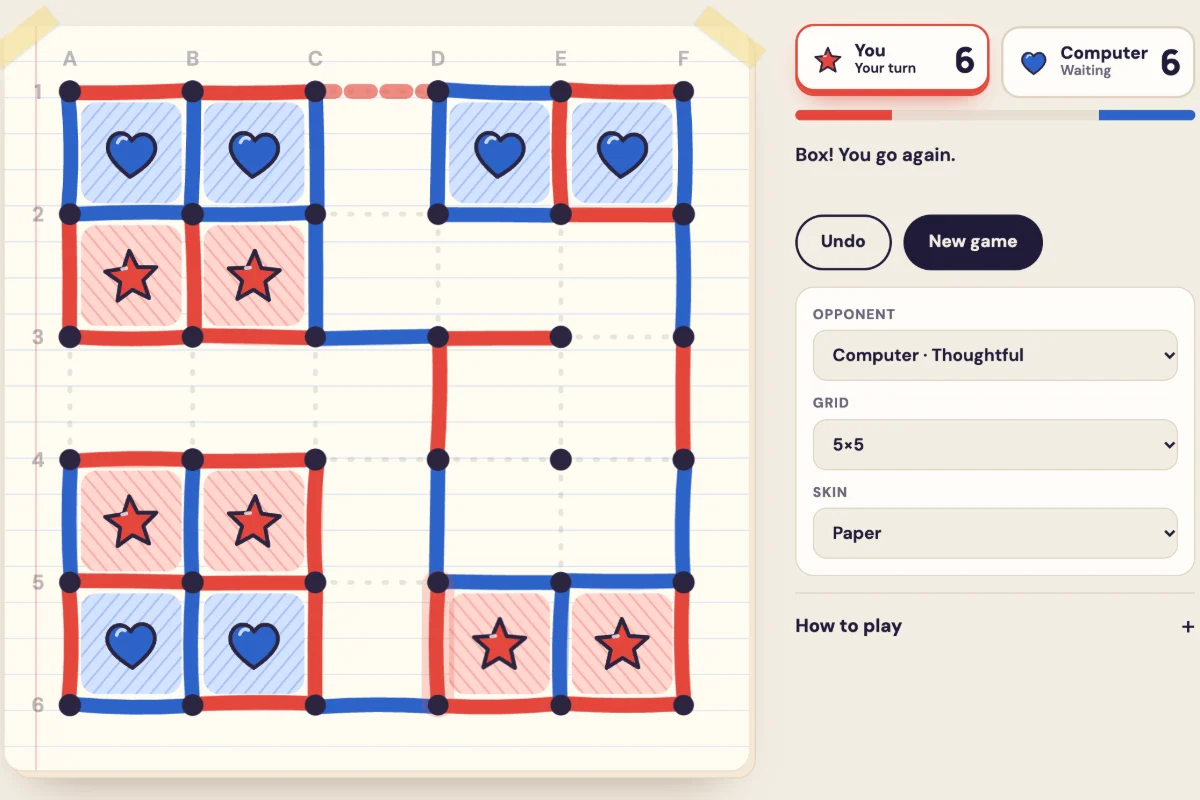
Only the player whose turn it is can draw, and a closed box gives that player another line. The first move swaps between games in the same room.
Your skin, your screenPaper, chalkboard or Halloween: each player can choose the board skin on their own screen without changing the game.
RoomsRooms last two hours, and the host can add time in the final 30 minutes. Reopen your invitation in the same browser to get your seat back after a disconnection, or save your private recovery code from Room options. Room data is removed when the room closes or expires.
Two players take turns. Every line could be the one that gives a box away.
On your turn, draw one line between two dots that sit side by side or one above the other. No diagonals.
Draw the fourth side of a box and it is yours: it fills with your colour and emblem. Then you draw another line straight away.
The game ends when every box is claimed. Count your boxes; the bigger number wins. Grids of 4×4 and 6×6 can end in a draw.
Early moves are quiet. The game is decided at the end, when every line gives boxes away and the board breaks into chains.
A box with two sides is safe. Add a third side and your opponent closes it. Early on, look for lines that touch boxes with fewer than two sides.
Late in the game every line gives something away. The board splits into chains: rows of boxes that fall one after another once the first is opened. Three boxes or more is a long chain.
When someone opens a long chain, take every box except the last two. Then draw the line at the far end. You hand back two boxes, but your opponent must open the next chain, and you collect it.
The player who does not have to open the first long chain usually wins. Count the safe lines left: if the count is going the wrong way, giving away one or two boxes early can swap who opens the long chains later.
Notebook paper, a chalkboard, or a Halloween night with pumpkins and bats. Every skin plays the same; switch at any time, even mid-game.
Yes. Every grid size, both computer levels, two players on one device, undo and all three skins are free. Online tables with a friend are free on 3×3, 4×4 and 5×5 grids; the host’s All Access adds the 6×6 grid online and a private series. There is no download, and guests never pay.
Yes. Choose “Friend · same device” and pass the phone or tablet between turns. The board shows whose turn it is, and each player’s boxes carry their own colour and emblem.
Yes. Create a private table on this page and send your friend the link. You each play on your own phone or computer, and the room checks every line and extra turn. Complete games on 3×3 to 5×5 grids are free; the host’s All Access ($4.99/month or $29/year, USD) adds the 6×6 grid and a private game-night series. Your friend joins free.
Easy always takes a box when it can but often hands boxes over. Thoughtful never draws a third side while a safe line remains, fights over who must open the first long chain, and hands back two boxes to keep control. Smaller grids give you more room to outplan it.
3×3 is a quick game of a few minutes. 4×4 and 5×5 build longer chains. 6×6 has 36 boxes and takes longest; it is where control matters most. Times are estimates and depend on how long you think.
Yes, on 4×4 and 6×6, which have an even number of boxes. 3×3 and 5×5 always have a winner.
Your current game, settings and skin are saved in this browser, so you can close the page and pick up later. Undo takes back your last line (against the computer, it also takes back the computer’s reply).
Yes. Focus the board, move the cursor with the arrow keys, press T to turn it between across and down lines, and press Enter to draw. Every move and score is announced as text.
The French mathematician Édouard Lucas published it in 1889. It has been a pencil-and-paper favourite ever since.